Walking in the Snow by Derya Yazar Atasever
Captured amidst the winter enchantment of Cappadocia, this photograph portrays a lone figure navigating a serene, snow-covered landscape. The image masterfully conveys the hushed tranquility of the environment, where the soft crunch of footsteps harmonizes with the stillness of the season. By focusing on the interplay between the solitary subject and the vast, wintry expanse, the photographer creates a poignant narrative of isolation and grace. This work is award-worthy for its evocative atmosphere, precise technical execution, and the ability to transform a simple walk into a profound visual experience that captures the quiet majesty of the Turkish winter.
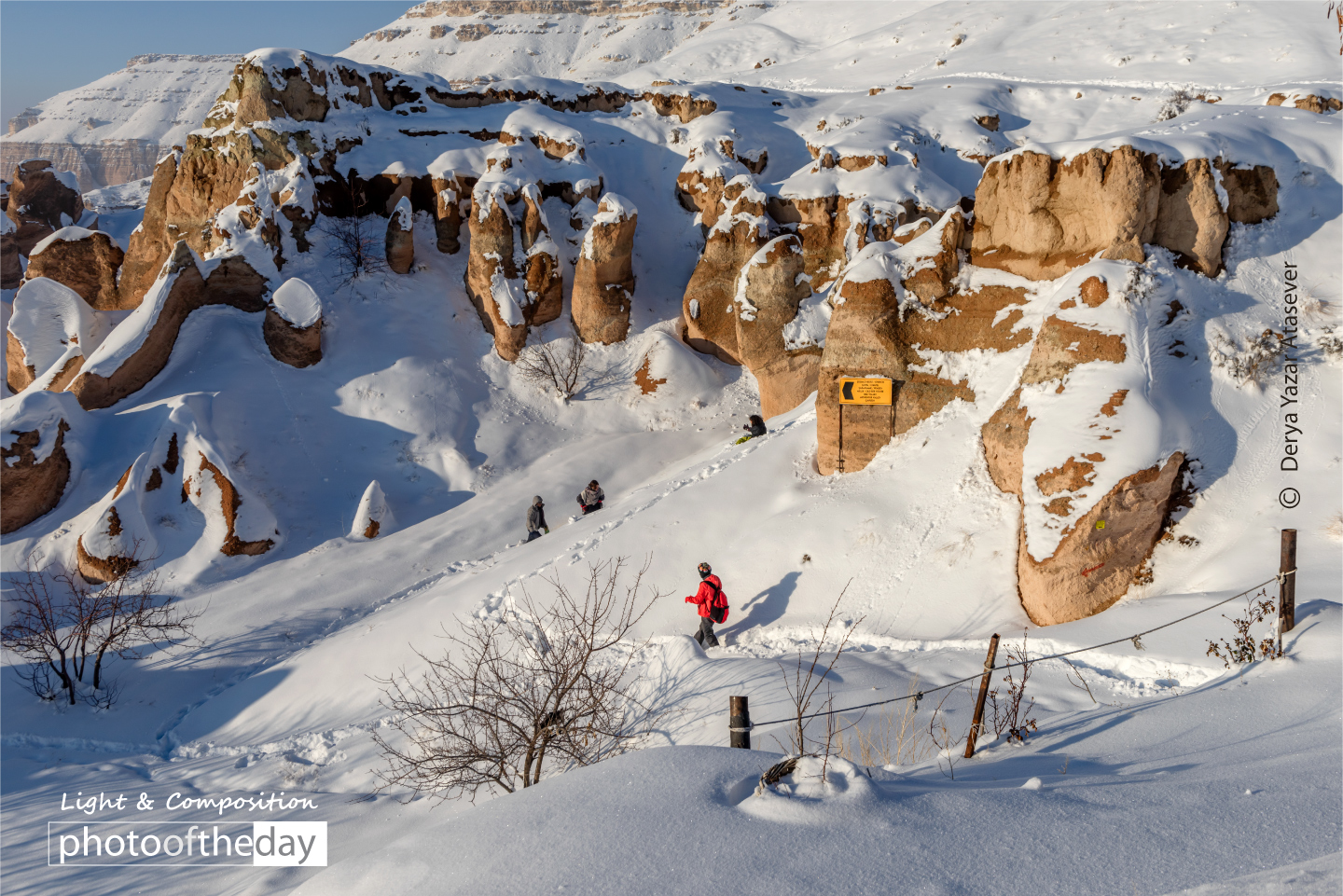
Exposure 1/800sec @ f/10 | ISO 100 | Focal Length 34mm
Derya Yazar Atasever
Born in Erzurum, Turkey, in 1971, Derya Yazar Atasever is a distinguished Master of Fine Arts and EFIAP recipient currently residing in Cappadocia. Beyond her professional background in Health Management and nursing, she has dedicated her life to the arts, notably completing a thesis on the historical development of photography in the health sector and utilizing art therapy for patients. As an active member of the international photography community, she serves as a competition juror, educator, and advocate for the medium, consistently championing the cultural mission of photography within her home region.
Resonance Score Breakdown
Transparency Note: The resonance score (8.1/20) is calculated based on social engagement metrics collected before the award announcement.
Expert Photography Reviews · 6
The Architecture of Silence
Winter does not ask for permission to change the world; it simply arrives, draping a heavy, white velvet over the sharp edges of the earth. In this sudden erasure, the familiar becomes a ghost of itself, and the path we thought we knew vanishes beneath a blanket of quiet.
Read the reflection →The Weight of White
There is a specific silence that follows a heavy snowfall, a muffled quality that swallows the world whole. It is not merely the absence of noise, but the absence of friction.
Read the reflection →Reviews & Comments
Share your thoughts about this award-winning photograph. Your reviews contribute to the community engagement score.
Cappadocia’s topography demands a dialogue with the sublime, yet here, the vastness feels strangely domestic. It’s reminiscent of the quiet, melancholic isolation found in Hiroshi Sugimoto’s seascapes, though lacking his rigorous conceptual minimalism. While the Nikon’s dynamic range handles the snow’s texture with clinical precision, I’m left wanting a more daring compositional risk. It’s technically sound, certainly, but I’ve seen this solitude rendered with more visceral, haunting weight in the works of the early pictorialists. It’s pleasant, but hardly transformative.
The air in Cappadocia doesn’t just hold the cold; it holds a silence that demands everything from you. Derya stood there as the light flattened, waiting for the snow to swallow the noise of the world. I feel a shiver looking at that lone figure—it’s the ache of true solitude. She didn’t force the frame; she let the winter dictate the rhythm. It’s a quiet, holy surrender to the vastness of the Turkish highlands.
The stride is caught mid-extension, but the weight hasn’t shifted to the lead heel yet. It’s a fraction of a second too early; the kinetic energy is still trapped in the core rather than driving through the snow. I’ve spent my life chasing that exact point of contact, and it’s frustrating to see the potential for power left hanging. It’s a beautiful scene, but as an athlete, I’m still waiting for the foot to land.
Cappadocia’s volcanic tuff is usually defined by its porous, carved voids, but here, the snow flattens the datum, erasing the threshold between earth and sky. It’s a rare, haunting erasure of the built environment’s usual geometry. I’m struck by how the figure’s isolation emphasizes the scale of these eroded masses. It doesn’t just show a walk; it captures the crushing silence of a landscape that’s swallowed its own architecture. It’s genuinely unsettling, and I love that.
The frame resolves into a perfect 1:3 vertical ratio, pinning the subject against the expansive, negative quadrant of the snow. That diagonal vector of the figure’s path creates a sharp tension against the horizontal horizon line. It’s a beautifully solved spatial equation. I’m genuinely struck by how the stark contrast of the dark coat anchors the entire composition. It’s not just a walk; it’s a precise calculation of mass and void that feels perfectly balanced.
It’s jarring to see such crisp, high-contrast whites without the usual blue-green shift I’m used to. In my world, light is a thief, stealing warmth by the meter. Here, the air doesn’t swallow the spectrum like water does. There’s no backscatter to fight, no refractive distortion bending the horizon. I find myself craving the chaotic, bioluminescent dance of a deep-sea trench, yet I’m struck by how beautifully quiet this frozen, terrestrial stillness feels.