The Award Award Showcase The Gallery Publications Gears University Expeditions Dev-Lab About Us Career Learning & AI Future Curriculum Curiosity & Consciousness Sign In Submit Your Work →

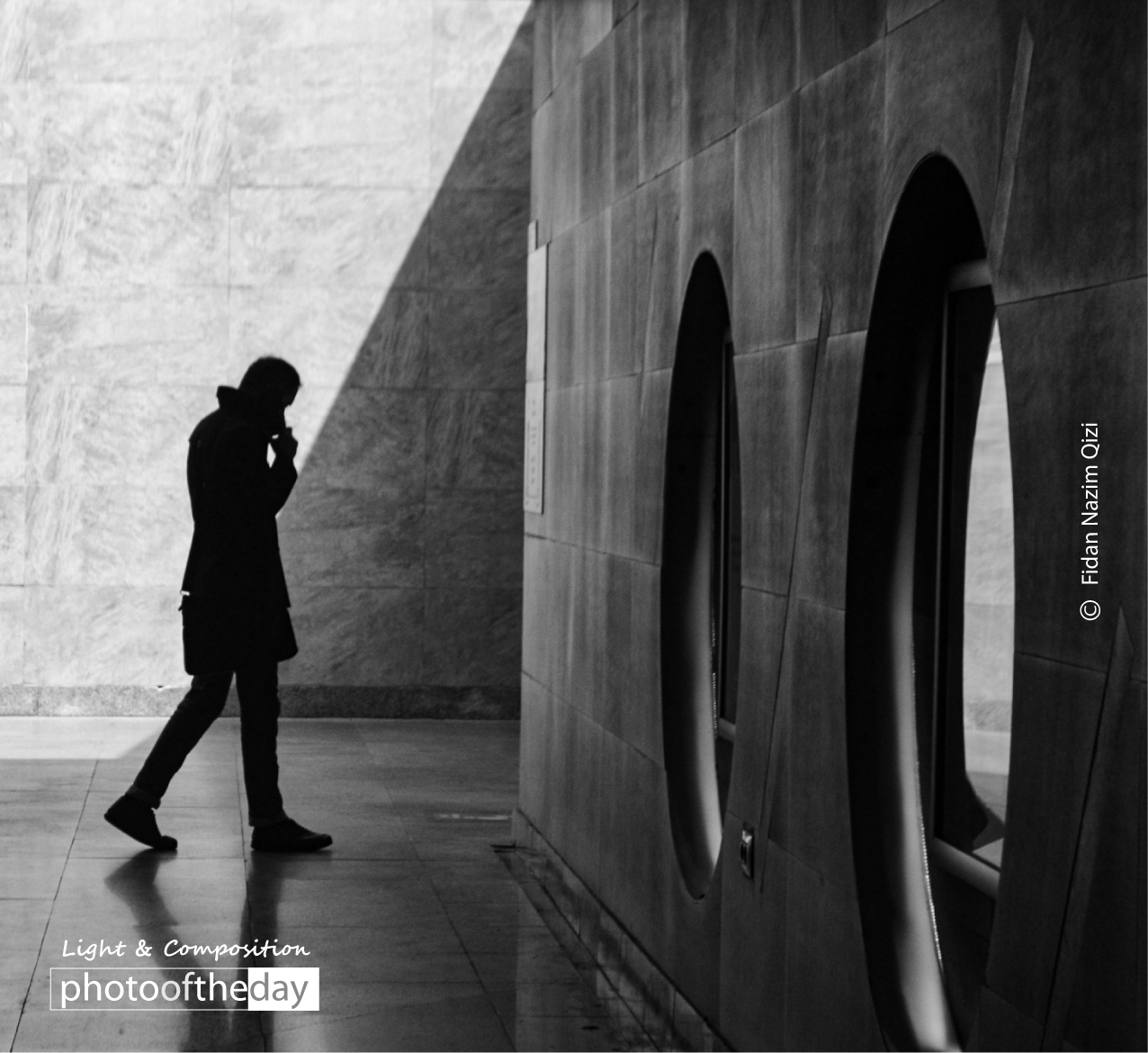
The Shadow by Fidan Nazim Qizi

In 'The Shadow,' Fidan Nazim Qizi explores the mystical quality of human silhouettes found within the quiet depths of underground passages. By focusing on these ephemeral traces rather than the subjects themselves, the photographer captures a sense of anonymity and privacy, suggesting that a shadow can describe a person more profoundly than their physical form. The image stands out for its evocative use of light and dark, transforming mundane urban spaces into a canvas of mystery. This award-winning composition demonstrates a keen eye for finding poetic, hidden narratives in everyday environments, turning fleeting moments into timeless, contemplative art.

The Shadow by Fidan Nazim Qizi
Nikon D3100 with Nikon AF-S DX NIKKOR 18-55mm f/3.5-5.6G VR
Exposure 1/100sec @ f/5.6 | ISO 400 | Focal Length 55mm
Light & Composition Photo of the Day

Fidan Nazim Qizi

REGISTERED PHOTOGRAPHER

Born in Baku, Azerbaijan, Fidan Nazim Qizi is a dedicated photographer who balances her life in her home city with frequent travels to explore the natural world and mountain landscapes. Heavily influenced by the work of Vivian Maier, she specializes in black and white photography, viewing the medium as a vital source of energy, emotion, and inspiration. Her artistic practice is defined by a deep appreciation for the human experience and a commitment to capturing the subtle, often overlooked stories found in her surroundings.

Current Location Baku, Azerbaijan
9.3/20
RESONANCE
SCORE
136/500
SHARE
SUBMISSION
Award Reach | Reviews
5,931 views | 8 Reviews
Award Winner Photo of the Day
Award Date December 13, 2022
Value 13.0
Clarity 13.0
Composition 18.0
Style 13.0
Skill 12.0
Photograph Location
Baku, Azerbaijan

Resonance Score Breakdown

Transparency in Award Scoring

Transparency Note: The resonance score (8.9/20) is calculated based on social engagement metrics collected before the award announcement.

Social Shares
2.5/5 points
508/1,000 Social Share
Page Views
5.0/5 points
5,931/2,500 Page View
Reviews
0.0/5 points
0/100 Review
Submissions
1.4/5 points
136/500 Submission
Jury Score: 69.0/80
Resonance Score: 8.9/20
Total Award Score: 77.9/100

Expert Photography Reviews · 8

Reflections on this Photograph
By Margaret Holt

The Weight of What Remains

There is a curious physics to the way we occupy space. We move through rooms, streets, and corridors, convinced that our presence is defined by the solid weight of our bodies, by the sound of our footsteps or the friction of our clothes against the air.

Read the reflection →
By Layla Ibrahim

The Weight of What Follows

Dear traveler, I have been thinking about the things we leave behind when we think no one is watching. We spend our lives trying to be seen, curating the way we stand and the way we speak, hoping to leave a mark that is solid and permanent.

Read the reflection →

Reviews & Comments

Share your thoughts about this award-winning photograph. Your reviews contribute to the community engagement score.

8 responses to “The Shadow by Fidan Nazim Qizi”

  1. The cold, rhythmic geometry of the Baku underpass dictates the mood before we even glimpse the figure. Those harsh, receding lines create a stage where light becomes a physical weight. I’m struck by how the shadow stretches, claiming more space than the person ever could. It’s a haunting, silent dialogue between architecture and absence. By stripping away the face, Fidan forces us to read the architecture as the soul of the subject. It’s absolutely brilliant.

  2. The frame doesn’t collapse under the weight of its own darkness. It’s a rigid geometry of subterranean lines, forcing the eye toward the silhouette’s precise intersection with the floor. The negative space isn’t just empty; it’s a structural anchor. I’m genuinely unsettled by how the shadow anchors the composition, refusing to dissolve into the periphery. It’s a disciplined study in spatial tension. The architecture holds. It’s rare to find such structural integrity in a fleeting moment.

  3. Most entries this year relied on the subject’s face to carry the weight of the story. Fidan’s work succeeds because it abandons that crutch. By isolating the silhouette against the harsh geometry of the Baku underpass, she forces us to confront the void. It’s haunting. I’ve stared at this for hours, and I’m still unsettled by how much humanity she’s extracted from a mere stain on the concrete. That’s why this will still matter in thirty years.

  4. The tunnel walls hold the weight of the city. A silhouette stretches across the stone. It’s a ghost of a person, stripped of skin and bone. I’ve spent minutes staring at the dark floor. It’s quiet here. The light doesn’t reveal; it subtracts. Nothing here is accidental. The empty corner is not empty. It’s a breath held in the dark. I feel a sudden, sharp ache for the person who isn’t there.

  5. Baku’s underground is a trap for the impatient, but Fidan caught the ghost of a stride. That shadow stretching across the concrete? It’s perfect. If she’d clicked a heartbeat later, the geometry would’ve dissolved into clutter. I love how the darkness swallows the subject, leaving only the silhouette’s intent. It’s raw, honest, and quiet. Cartier-Bresson would’ve tipped his hat to this timing. She didn’t just take a picture; she caught a soul passing through the light.

  6. Submerged in Baku’s subterranean gloom, the light behaves with a familiar, heavy viscosity. It’s not the salt-heavy refraction I’m used to, but the way these silhouettes bleed into the concrete feels exactly like a diver losing contrast in deep, turbid water. I’ve spent lifetimes chasing that elusive clarity, and seeing it here, in a dry, urban passage, gives me a strange, phantom shiver. It’s a beautiful, haunting reminder that light is always a battle, everywhere.

  7. Underground passages in Baku aren’t just transit zones; they’re sites of erasure. By reducing these figures to mere shadows, Fidan Nazim Qizi strips them of their agency. Does anonymity grant privacy, or does it simply render the subject disposable? I find myself unsettled by this aestheticized void. Why must we turn human presence into a ghost to make it poetic? It’s a beautiful frame, sure, but it feels like a deliberate choice to look away from the person.

  8. It’s easy to snap a silhouette in a Baku underpass and call it mystery. Most don’t bother to wait for the light to align with the architecture; they just take what’s given. Yet, there’s a deliberate stillness here that makes me wonder how many hours were spent leaning against those cold walls. I’ve spent enough time in damp tunnels to recognize the patience required. It’s a quiet, earned moment. I actually quite like it.

Leave a Reply

Your email address will not be published. Required fields are marked *