Light and Shadow by Fidan Nazim Qizi
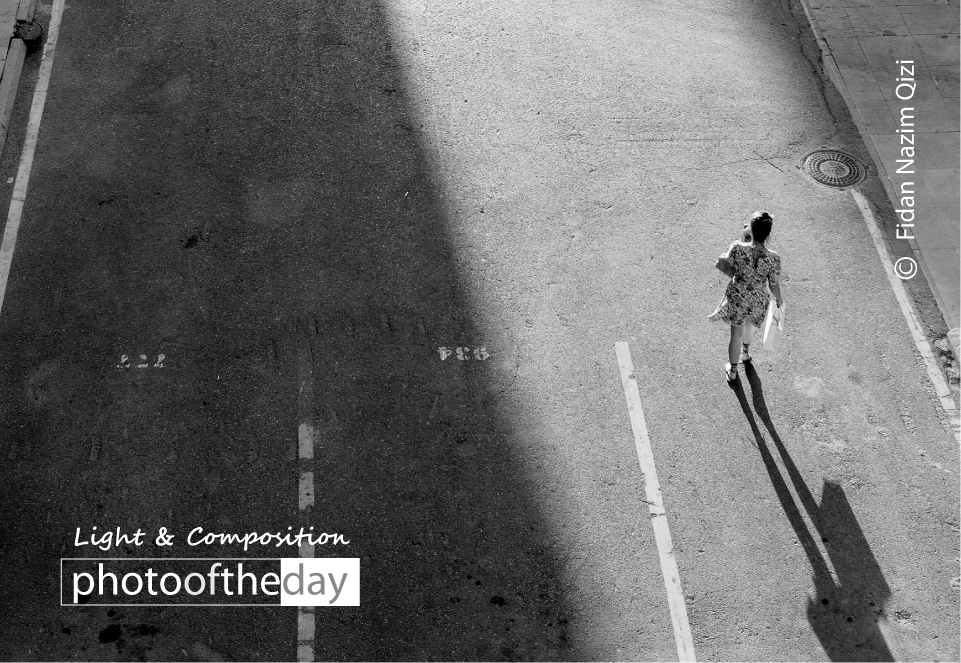
Captured during the golden hour, 'Light and Shadow' explores the symbiotic relationship between illumination and darkness. Fidan Nazim Qizi observed how the late afternoon sun filters through urban architecture, creating a rhythmic interplay of high-contrast silhouettes. By waiting for the precise moment when the light strikes the buildings, the photographer transforms a mundane street scene into a study of geometry and mood. This image is award-worthy for its masterful use of natural light to define space, demonstrating a keen eye for the delicate balance that exists where light meets shadow, ultimately inviting the viewer to find beauty in everyday urban transitions.
Fidan Nazim Qizi
Born in Baku, Azerbaijan, Fidan Nazim Qizi maintains a deep connection to her home city while frequently traveling to capture the natural beauty of global landscapes. Inspired by the evocative black and white work of Vivian Maier, she has dedicated her craft to the monochrome medium, seeking to distill raw energy and human emotion into her frames. Her photography serves as a personal pursuit of inspiration, reflecting a profound appreciation for the interplay of light and shadow in both the mountains and the urban environment.
Resonance Score Breakdown
Transparency Note: The resonance score (7.3/20) is calculated based on social engagement metrics collected before the award announcement.
Expert Photography Reviews · 3
The Architecture of Silence
We often mistake the sun for a constant, forgetting that its true work is done in the margins. As the day begins to lean toward evening, the world undergoes a quiet transformation.
Read the reflection →Where the Edges Soften
I spent this morning trying to organize my bookshelf, pulling out volumes I haven't touched in years. I found a dried leaf pressed between the pages of a journal from a decade ago. It was brittle and faded, but it held the exact shape of the tree it once belonged to.
Read the reflection →Reviews & Comments
Share your thoughts about this award-winning photograph. Your reviews contribute to the community engagement score.
It’s a strange shift to look away from the deep sky and into the sharp, terrestrial geometry of Baku. At f/4, Fidan captures the sun’s final reach before the city falls into the night’s embrace. I’ve spent my life chasing photons that traveled eons, yet here, the light is only minutes old. It’s a fleeting, human blink. I feel a sudden, quiet ache for the shadows that will soon swallow these walls entirely.
The vertical axis here functions as a rigid fulcrum, dividing the frame into a precise 1:2 ratio of light to shadow. Those sharp, diagonal vectors slicing across the architecture aren’t just aesthetic; they’re a perfect spatial equation. I’m genuinely thrilled by how the negative quadrant anchors the composition, preventing the light from overwhelming the structure. It’s a clean, solved problem of urban geometry. When the math aligns this perfectly, it’s impossible not to feel the tension resolve.
The frame’s geometry dictates the rhythm. Sharp, vertical shadows slice the picture plane, anchoring the composition against the encroaching light. It’s a rigid architecture that demands total submission from the viewer. The negative space isn’t merely empty; it’s a calculated fulcrum balancing the urban mass. I’ve rarely seen such disciplined restraint in a street study. It doesn’t rely on sentimentality. The tension holds because the structure is absolute. It’s a cold, precise victory of form over chaos.