Walking on the Rocks by Karthick Saravanan
Walking on the Rocks captures the ethereal transition of dawn, where the rising sun transforms a rugged landscape into a stage for dramatic silhouettes. By positioning the subjects against the golden light of sunrise, the photographer masterfully emphasizes form and atmosphere, turning a simple walk into a visual narrative of light and shadow. This image is award-worthy for its evocative use of backlighting and the deliberate composition that highlights the interplay between the textured rocky terrain and the soft, glowing horizon, creating a truly captivating and serene experience.
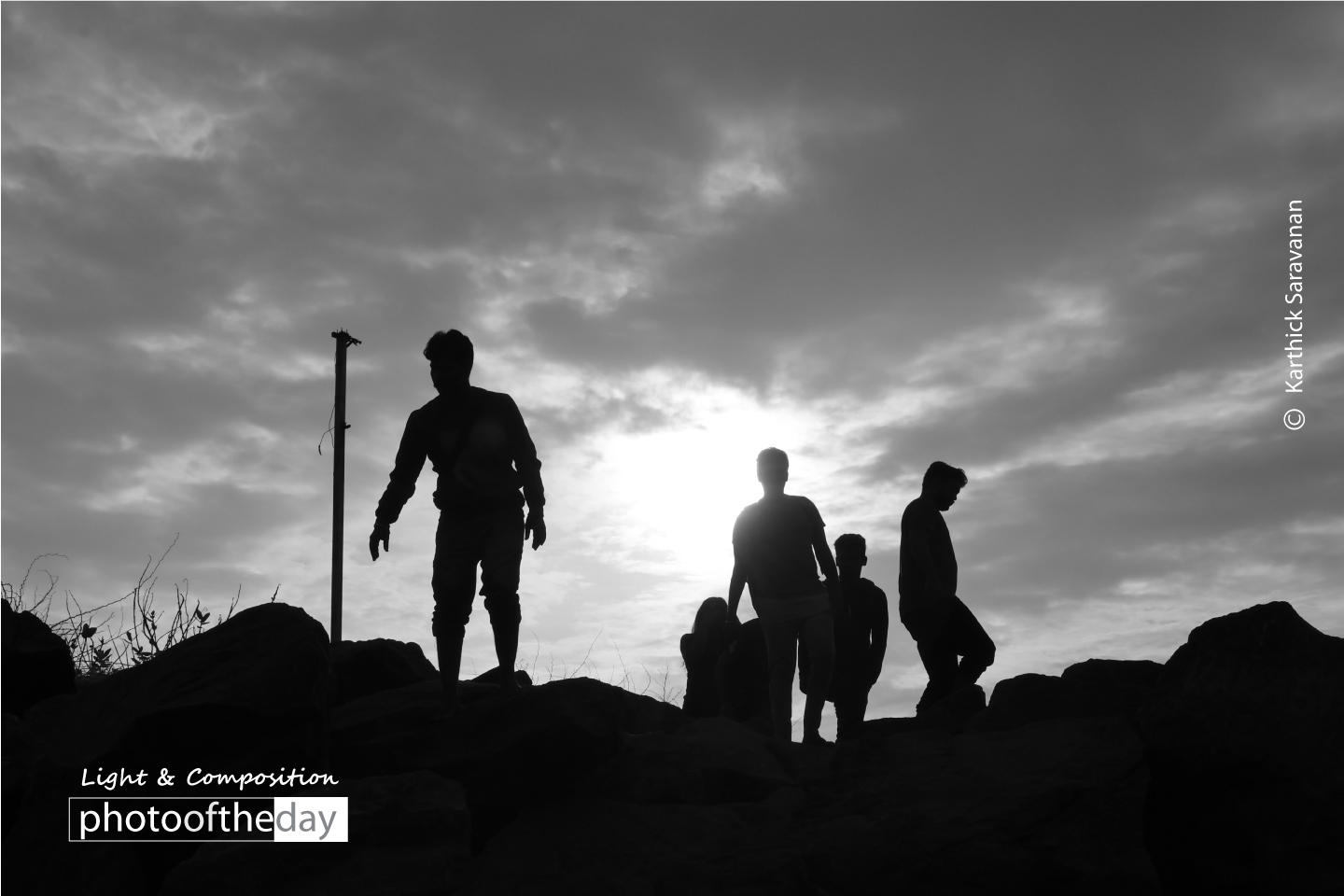
Exposure 1/80sec @ f/4.5 | ISO 125 | Focal Length 18mm
Karthick Saravanan
Based in Chennai, India, Karthick Saravanan is a dedicated photographer celebrated for his profound mastery of monochrome imagery. His artistic journey, which began in his youth, evolved significantly during the pandemic as he documented life on his farmland before transitioning his focus to the evocative rhythms of street photography. Through his lens, Saravanan captures the raw essence of both living and non-living subjects, consistently demonstrating a unique ability to find timeless beauty and deep emotional resonance within the stark contrasts of black and white.
Resonance Score Breakdown
Transparency Note: The resonance score (8.1/20) is calculated based on social engagement metrics collected before the award announcement.
Expert Photography Reviews · 5
The Weight of the Path
Epictetus once remarked that we are like travelers on a ship; we may choose our seat, but we do not choose the destination or the currents that carry us.
Read the reflection →The Weight of Solid Ground
I keep a smooth, grey river stone on my desk that I picked up during a summer when the world felt entirely too fluid. It is heavy, cool to the touch, and carries the stubborn density of something that refuses to be moved by the current.
Read the reflection →Reviews & Comments
Share your thoughts about this award-winning photograph. Your reviews contribute to the community engagement score.
Most entries in this category rely on tired silhouettes to mask a lack of substance. What separates this from the pack is the way the jagged, uneven foreground forces the eye to navigate the rocks before reaching the horizon. It’s a quiet, patient frame. I’ve seen thousands of sunrises, yet this one makes me want to stand there and breathe the salt air. It’ll last because it captures a stillness we’re all desperately losing.
At 18mm, the Canon’s optics struggle with the diffraction limit near the sun’s edge, yet that slight softening creates a beautiful, ethereal bloom. It’s a delicate trade-off between sharpness and atmosphere. The focal plane renders the foreground rocks with a tactile grit that contrasts sharply against the blown-out highlights. Honestly, the way the light bleeds across those silhouettes makes my heart skip; it’s a raw, optical honesty that digital sensors rarely capture with such grace.
The silhouettes on those Mahabalipuram rocks feel distant, don’t they? While the light is undeniably beautiful, I’m left wanting more. These figures are props in a landscape, not people I’ve been invited to meet. I don’t see their eyes or the weight of their hands. It’s a lovely scene, but it doesn’t offer the intimacy I crave. I’d trade that golden horizon for one honest, unposed glance. It’s a pretty picture, but it’s missing a soul.
The frame’s geometry relies on the jagged foreground rocks to anchor the horizon’s luminous void. It’s a precarious balance. The silhouettes provide necessary scale, yet the composition’s weight leans heavily toward the lower left quadrant. I’m genuinely unsettled by how the negative space threatens to swallow the subjects entirely. It doesn’t collapse, though. The tension holds. That structural discipline saves the work from becoming mere sentiment. It’s a cold, calculated success.
The jury’s obsession with clarity here feels stifling. At 1/80th, Saravanan teeters on the edge of motion, yet pulls back into a safe, conventional silhouette. I’m genuinely frustrated; why not let the rocks dissolve into the light? It’s closer to Sugimoto’s long-exposure theatres than to standard landscape practice, yet it clings to resolution. What did the photographer choose not to resolve? I’d have preferred a blur that actually interrogated the dawn, rather than just documenting it.