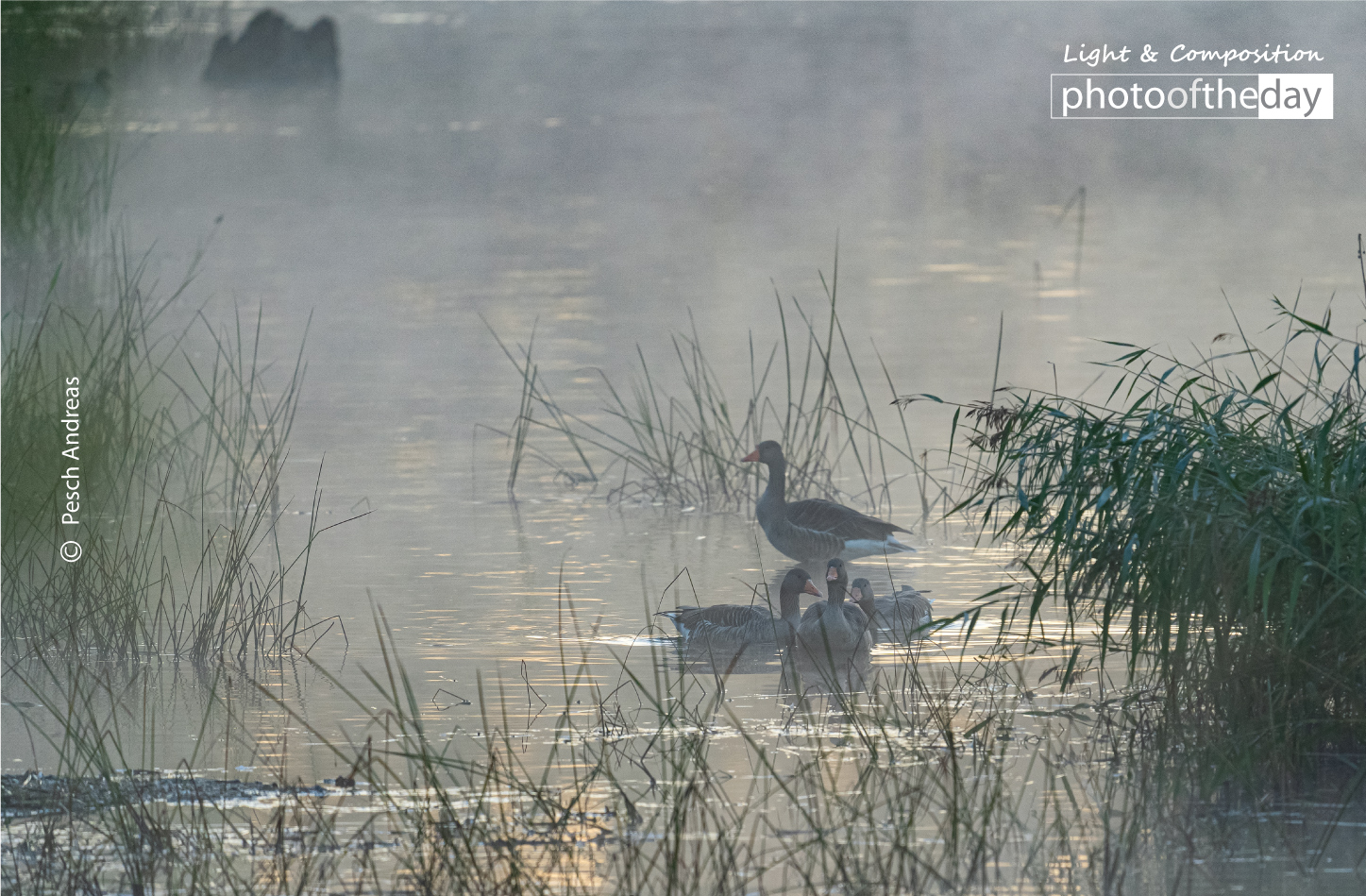
Geese in the Morning Dust by Pesch Andreas
Captured during a crisp mid-October afternoon, this photograph highlights a quiet moment of serenity amidst the bustling activity of a local quarry pond. While the water was filled with the commotion of migrating birds, the photographer focused on a young resident swan, captivated by its ability to remain undisturbed by the surrounding chaos. The image beautifully captures the swan’s peaceful demeanor, contrasting its stillness against the backdrop of a busy ecosystem. This photograph is award-worthy for its intimate portrayal of wildlife behavior and the photographer’s patience in isolating a singular, tranquil narrative within a crowded environment.
Pesch Andreas
Based in Magdeburg, Germany, Pesch Andreas rediscovered his passion for photography after a long hiatus, beginning with documentation of his son’s choir performances. His artistic journey evolved from early black-and-white experiments in a family cellar to a dedicated pursuit of wildlife photography, often inspired by walks with his dog. Driven by the thrill of the hunt and the technical challenges of capturing nature, Andreas continues to refine his craft, constantly seeking new experiences and equipment to elevate his evocative portrayals of the natural world.
Resonance Score Breakdown
Transparency Note: The resonance score (8.1/20) is calculated based on social engagement metrics collected before the award announcement.
Expert Photography Reviews · 8
The Quiet in the Crowd
I was standing in the middle of the train station this morning, waiting for my connection. It was one of those days where everyone seemed to be moving in a frantic, jagged rhythm.
Read the reflection →The Quiet Between Footsteps
I often find myself standing at the edge of the tram tracks near the old market, watching the morning commuters blur into a single, rushing grey coat.
Read the reflection →Reviews & Comments
Share your thoughts about this award-winning photograph. Your reviews contribute to the community engagement score.
1/640sec at f/6.3, 600mm, ISO 1000. It’s a narrow margin for error. At 600mm, that shutter speed is barely adequate for handheld stability, yet the focus is razor-sharp. I’m genuinely impressed by the lack of motion blur. Shooting wide open at f/6.3 was the only logical choice to isolate the subject from the chaotic background. It’s a calculated risk that paid off. The technical discipline here is undeniable. It’s a clean, precise execution of intent.
It’s refreshing to see a swan captured without the usual frantic splashing. At 600mm, Pesch clearly kept his distance, allowing the bird to maintain its natural, unbothered posture amidst the quarry’s chaos. I’ve spent enough mornings in blinds to know that stillness isn’t just a setting; it’s a choice. This quietude feels earned, not forced. It’s a rare, honest look at a creature simply existing, and honestly, it makes me want to put my own camera down.
The air in Magdeburg must have been biting that October afternoon. Pesch waited until the chaos of the quarry pond settled into a singular, quiet grace. I’ve spent enough dawns in the reeds to know that stillness isn’t found; it’s earned. Watching this swan drift through the dust-moted light, I feel a sudden, sharp ache for that kind of solitude. It’s a rare, holy patience that lets the world stop moving just for a breath.
At 600mm, the swan’s stillness feels like a cosmic anchor. While I usually track photons that have traveled eons, there’s a profound gravity in this terrestrial quiet. Pesch caught the light at f/6.3, isolating a single life against the chaos of migration. It’s a fragile, fleeting blink in time. I find myself holding my breath, watching that bird drift through the dust. It’s a beautiful, grounded reminder that we’re all just drifting through the dark.
It’s refreshing to see a swan captured from the surface, where the refractive index doesn’t distort the subject’s grace. I’m used to the brutal physics of the deep, where light is stolen and backscatter ruins everything. Here, the clarity is crisp, free from the murky particulate matter I usually battle. Watching that young swan remain still amidst the chaos of the Salbker See makes me ache for the quiet, weightless peace I only find submerged.
We look at this swan and we see a portrait of solitude. Amidst the frantic migration at Salbker See, Pesch Andreas didn’t just aim his lens; he waited until the bird’s stillness became a conversation. It’s a quiet, grounding presence. I find myself breathing slower just watching that young swan hold its own against the chaos. It’s a rare, intimate grace. This is a photograph that asks to be returned to, again and again.
The swan’s neck is arched, but the water tension around the breast hasn’t broken yet. It’s a quiet frame, sure, but I’m looking for the kinetic snap of a wing beat or the precise millisecond of a splash. The timing is a bit soft; it’s missing that physiological peak of movement. I’ve spent my life chasing that perfect tenth of a second, and honestly, this feels like it’s just a breath too late.
The quarry’s industrial void is usually defined by rigid edges, but here, the dust softens the datum of the horizon. It’s a rare moment where the swan’s silhouette anchors the frame, turning the water into a tactile surface rather than just a void. I’m struck by how the light catches the bird’s plumage, creating a depth that architecture often lacks. It’s not just wildlife; it’s a study of stillness within a site’s raw, unbuilt geometry.