Orange in Orange Mode by Rodrigo Aliaga
In this creative food photography exercise, Rodrigo Aliaga explores the concept of 'orange in an orange mode.' By placing oranges atop a glass surface, he captures their vibrant reflections, creating a sense of depth and symmetry. To achieve the specific aesthetic, he utilized a background flash modified with a CTO gel to bathe the scene in a warm, monochromatic glow, while keeping secondary flashes unfiltered to maintain color balance. The resulting image is a testament to his deliberate control over lighting and composition, transforming a simple subject into a sophisticated study of color and texture.
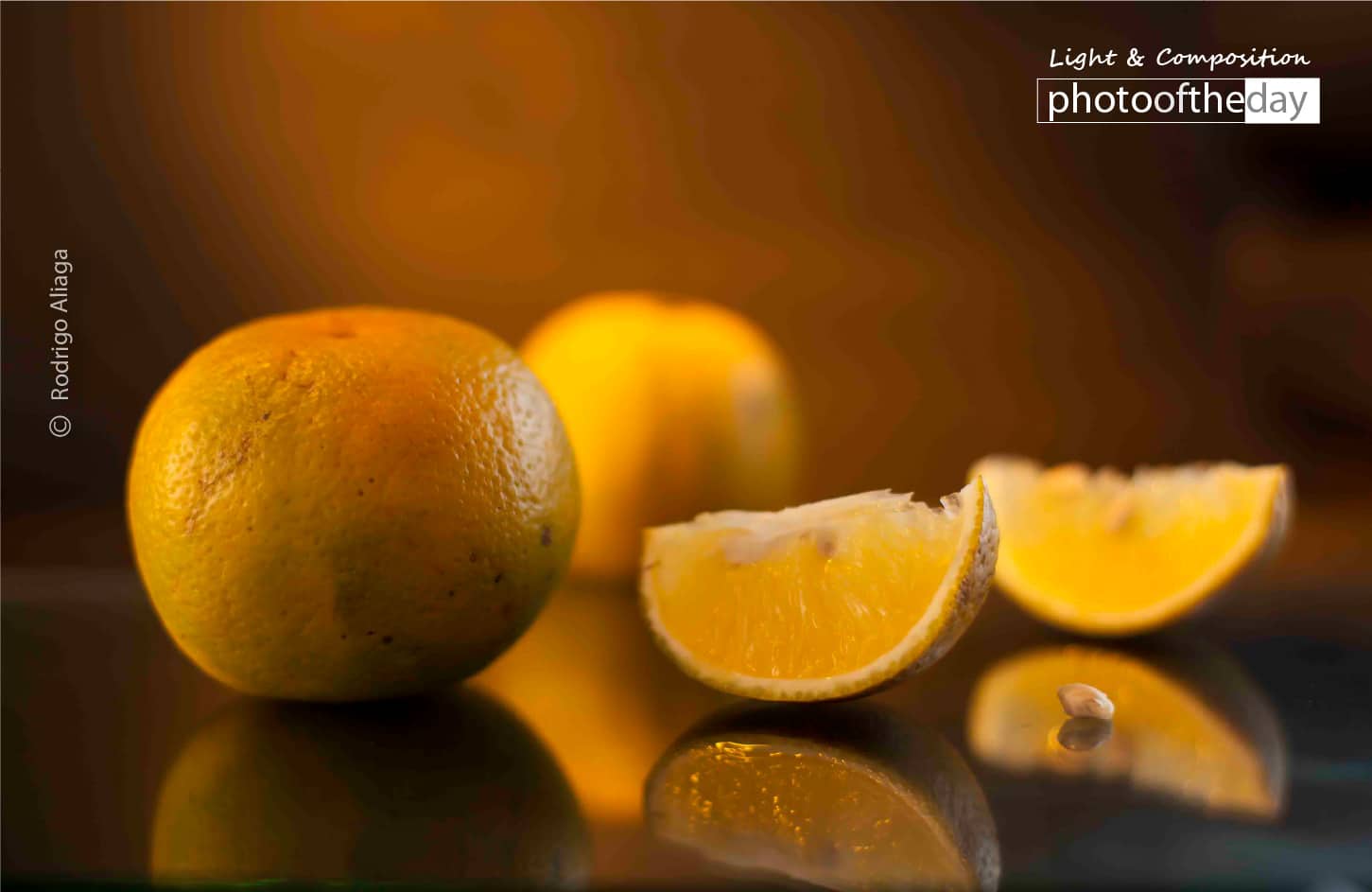
Rodrigo Aliaga
Born in La Paz, Bolivia, Rodrigo Tato Aliaga is a professional director of photography with a deep background in film production and television advertising. Transitioning his expertise from the motion picture industry to digital photography, he has carved a niche in food photography. Aliaga skillfully blends his technical mastery of lighting with a refined creative vision, consistently producing images that are as technically precise as they are visually exquisite.
Resonance Score Breakdown
Transparency Note: The resonance score (7.5/20) is calculated based on social engagement metrics collected before the award announcement.
Expert Photography Reviews · 8
The Geometry of Sunlight
I remember a market stall in La Paz, tucked away near a steep, winding alley where the air always smells of roasted nuts and damp stone. There, the fruit was piled in precarious, glowing pyramids, defying gravity with a quiet, stubborn grace.
Read the reflection →The Weight of the Sun
When I was seven, my grandmother kept a bowl of fruit on the windowsill in Enugu. In the late afternoon, the sun would hit the skins of the oranges, turning them into small, glowing lanterns that seemed to hold the heat of the entire day inside their rinds.
Read the reflection →Reviews & Comments
Share your thoughts about this award-winning photograph. Your reviews contribute to the community engagement score.
The geometry of the reflection anchors the frame. Aliaga’s placement of the fruit creates a rigid vertical axis, forcing the eye into a disciplined descent. It’s a clean, structural triumph. The negative space doesn’t collapse; it holds the weight of the spheres with clinical precision. I’m genuinely unsettled by how perfectly the glass surface bisects the composition. It’s rare to see such cold, calculated symmetry yield this much visual gravity. The frame holds.
The frame operates on a perfect horizontal axis of symmetry, bisecting the oranges from their glass-bound reflections. It’s a 1:1 ratio of object to echo, creating a closed geometric loop. The circular forms anchor the composition, pulling the eye toward the center of gravity. I’m genuinely thrilled by how the CTO-gelled light flattens the depth, turning organic fruit into pure, abstract spheres. It’s a beautifully solved spatial equation that feels both clinical and warm.
Before the eye identifies the fruit, a sudden warmth floods the chest. It’s an activation of pure, saturated light that feels like a held breath. The symmetry pulls me into a meditative loop, grounding my pulse in that amber glow. Returning to it months later, I still feel the phantom heat of the CTO gel on my skin. It’s a strange, citrus-scented comfort that follows me into sleep, lingering long after the screen goes dark.
It’s refreshing to see such deliberate control of light. Down where I work, we’re constantly fighting the ocean’s theft of the warm spectrum; red vanishes within five metres. Rodrigo’s use of a CTO gel to force that monochromatic glow is a clever inversion of the physics I battle daily. I’m genuinely struck by the symmetry here. It’s a clean, clinical study of texture that doesn’t suffer from a single speck of backscatter. It’s beautifully, unnervingly precise.
It’s a clever exercise in geometry and light, but it leaves me cold. I’ve spent my life looking for the pulse in a frame, and here, there’s no one to meet my gaze. The oranges are perfectly staged, yet they don’t have a story to tell. I miss the messy, human friction of a real encounter. It’s technically sharp, sure, but it feels like a hollow room. I’m just not feeling anything here.
We look at these oranges and we don’t just see fruit; we see a conversation between light and skin. Rodrigo has listened to the texture of the peel, letting the warmth of the gel tell a story of a La Paz afternoon. It’s a quiet, glowing portrait of a simple thing. I find myself wanting to reach out and touch that glass. It’s a photograph that asks to be returned to, again and again.
La Paz is chaos, but here, Rodrigo finds a quiet, glowing geometry. It’s a studio piece, sure, but that reflection on the glass? It’s got the pulse of a street shot. If he’d fired a fraction later, the symmetry would’ve drifted into mess. I love the warmth of that CTO gel; it feels like a sunset caught in a bottle. It’s not the raw grit of Winogrand, but the timing is sharp. It’s clean, precise, and alive.
Static subjects don’t hide timing errors, but they reveal a lack of intent. Aliaga’s oranges sit in a vacuum, lacking the kinetic energy of a falling object or a juice-spraying impact. It’s technically clean, yet it’s dead air. I’ve spent my life chasing the millisecond where muscle meets gravity, and this feels like the frame before the action starts. It’s pretty, sure, but it doesn’t have the pulse of a real peak moment. I’m bored.