Drill Down by Ruben Alexander
In this meticulously crafted macro study, Ruben Alexander explores the industrial beauty of a Titanium Nitride drill bit. By experimenting with various angles and lighting conditions, the photographer discovered that the addition of a DIY blue gel provided the perfect contrast to the bit’s signature gold hue. This creative decision transforms a mundane tool into a striking subject, highlighting the interplay between metallic texture and artificial light. The image is award-worthy for its technical precision and the photographer's ability to elevate an everyday object into a compelling, artistic composition through thoughtful experimentation.
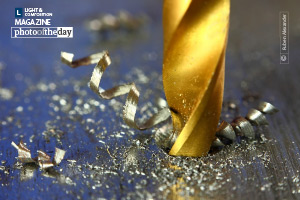
Ruben Alexander
Based in Bangalore, India, Ruben Alexander balances a professional career in the IT industry with a dedicated pursuit of photography. As a self-taught artist, he utilizes his camera as a creative outlet and a means of stress relief, focusing his lens on nature, macro subjects, and inventive still life compositions. His evolving portfolio reflects a growing interest in landscape, portrait, travel, and street photography as he continues to refine his artistic vision and technical expertise.
Resonance Score Breakdown
Transparency Note: The resonance score (8.7/20) is calculated based on social engagement metrics collected before the award announcement.
Expert Photography Reviews · 6
The Architecture of Utility
I often find myself lingering near the hardware shops on the outskirts of the city, where the air smells of iron filings and heavy oil.
Read the reflection →The Geometry of Use
The honeybee’s stinger is a marvel of biological engineering, a serrated lance designed for a singular, violent purpose, yet it is governed by the same structural logic as the honeycomb itself.
Read the reflection →Reviews & Comments
Share your thoughts about this award-winning photograph. Your reviews contribute to the community engagement score.
Titanium Nitride’s gold hue mimics the spectral class of a G-type star, yet here it’s tethered to a workbench in Bangalore. At ISO 100, there’s no thermal noise to hide the microscopic scars of industry. It’s a strange, quiet shift for me to look at something so small, so terrestrial. I’ve spent my life chasing photons millions of years old, but I’m genuinely moved by the deliberate, human precision captured in this drill bit.
There is a quiet, industrial holiness in this gold edge. I’ve spent my life watching the sun crawl across canyons, yet here, Ruben finds that same patience in a workshop. He waited for the blue gel to bleed into the steel, listening to the light until it finally surrendered. It’s a strange, metallic prayer. Looking at it, I feel a sudden, sharp ache for the precision of a morning that refuses to be rushed.
We look at this drill bit and we don’t see a tool; we see a spine. Ruben Alexander has listened to the steel, finding a golden resilience beneath the industrial cold. The blue light feels like a quiet breath held in the dark. It’s a portrait of labor itself, stripped of the worker but full of their intent. I find myself leaning in, wanting to hear the hum of the machine. It’s a photograph that asks to be returned to.
The cool, artificial blue light dances across the flutes of the drill bit, creating a tension that feels almost architectural. It’s a stark, industrial landscape where the gold finish glows like a relic in a modern tomb. I’m genuinely struck by how this tool, stripped of its human operator, still carries the weight of labor. It doesn’t need a face to tell its story; the cold, metallic precision is the portrait of the work itself.
0.3 seconds at ISO 100 on an XSi. That’s a long exposure for a macro subject, demanding absolute rigidity. Alexander’s choice of a blue gel against the titanium nitride gold is a calculated, effective contrast. It’s technically sound. I’ve spent years looking at industrial components, and frankly, I’m annoyed that a drill bit actually looks this compelling. The sharpness holds up. It’s a precise execution that doesn’t waste the sensor’s limited dynamic range.
The jury’s obsession with the technical precision of this drill bit feels stifling. It’s a sharp, gold-hued object, sure, but where’s the risk? I’m bored by the clarity. Why resolve every flute of the metal so aggressively? I’d have preferred a long-exposure smear, something closer to Sugimoto’s blurred theatres than this clinical cataloging. It’s technically sound, but it doesn’t breathe. I want to see what Alexander chooses not to show us next time.