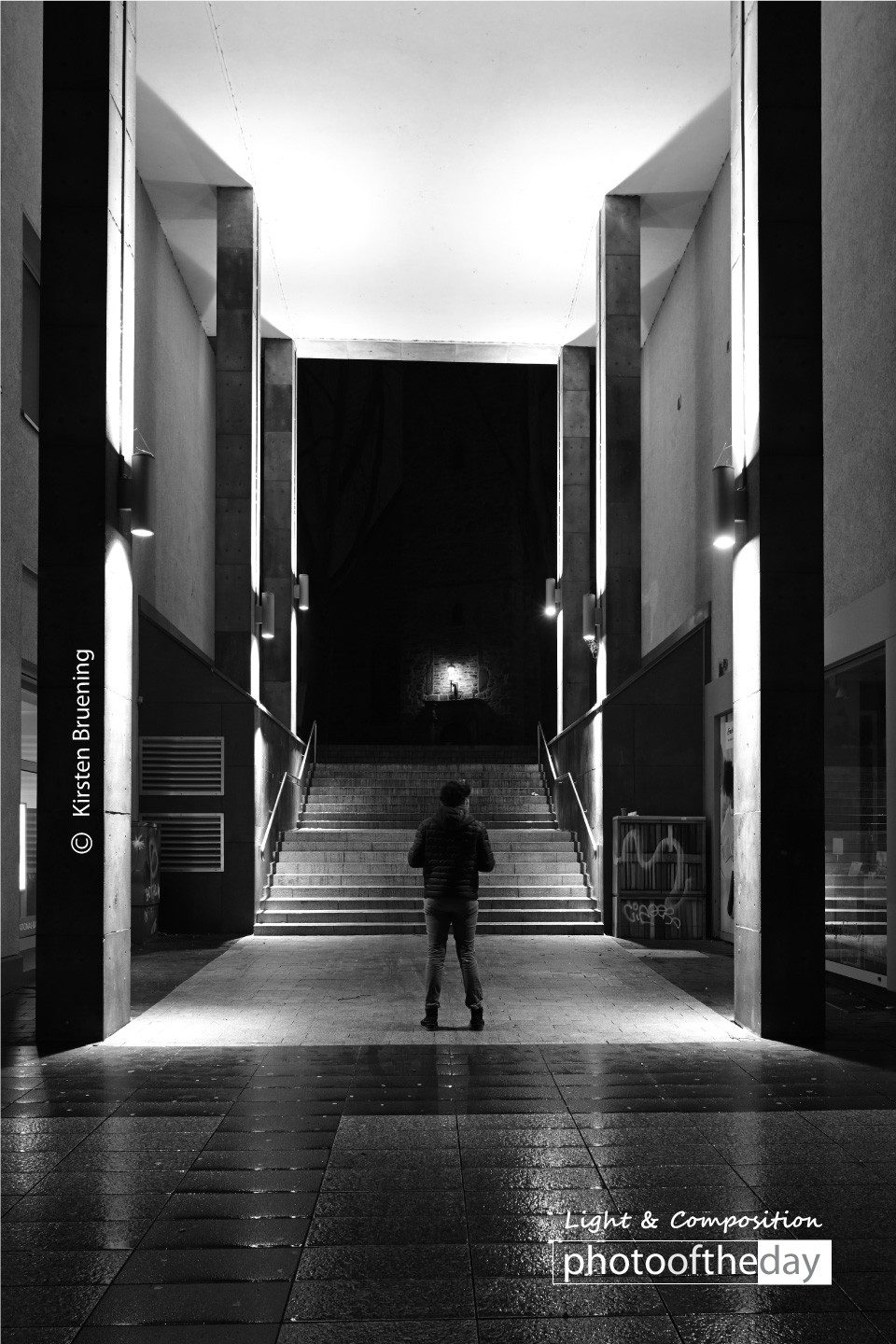
Tragedy by Kirsten Bruening
Captured during the global pandemic, this poignant image reflects the profound sense of isolation and abandonment felt during periods of restricted contact. Kirsten Bruening explores the quiet realization that, despite the stillness of domestic life and the monotony of endless books and films, the world continues to turn. The photograph serves as a meditative reminder of the resilience of the human spirit and the importance of gratitude. Its award-worthy quality lies in its ability to translate complex, heavy emotions into a singular, evocative visual narrative, finding beauty and hope in the simple knowledge that tomorrow holds the promise of a better day.
Kirsten Bruening
Based near Cologne, Germany, Kirsten Bruening is a dedicated photographer whose creative journey began in childhood with an early exploration of analogue techniques. After a fifteen-year hiatus, she returned to the medium with a renewed focus on black and white photography, specializing in nature, portraiture, and wildlife. She is deeply committed to the expressive power of light and shadow, and she is currently pursuing further academic studies to refine her technical expertise and artistic vision.
Resonance Score Breakdown
Transparency Note: The resonance score (8.8/20) is calculated based on social engagement metrics collected before the award announcement.
Expert Photography Reviews · 3
The Quietude of Dormancy
In the deepest part of winter, many deciduous trees enter a state of profound dormancy, shedding their leaves to conserve energy while the frost hardens the soil.
Read the reflection →The Weight of Walls
The room holds its breath. It is not empty, though no one is here. It is full of the things we did not say, the hours we spent watching the dust settle in shafts of gray light.
Read the reflection →Reviews & Comments
Share your thoughts about this award-winning photograph. Your reviews contribute to the community engagement score.
The frame operates on a strict 1:2 vertical division, anchoring the subject against a stark, negative quadrant. Bruening’s geometry relies on the sharp diagonal of the chair’s edge, which forces the eye toward the center of gravity—that solitary, slumped form. It’s a beautifully solved spatial equation of isolation. I’ve stared at this composition for ten minutes; the way the light bleeds into the shadows creates a perfect, haunting tension. It’s mathematically precise, yet deeply, painfully human.
Bruening’s work here isn’t about the pandemic’s stillness; it’s about the friction of light against a static frame. I’m genuinely moved by how she lets the shadows bleed into the grain, refusing the clinical sharpness that usually kills such intimacy. It’s closer to Sugimoto’s long-exposure theatres than conventional portraiture. Why resolve the details when the blur captures the ache better? She’s chosen to leave the edges unresolved, and frankly, that’s where the real truth hides.
Bochum’s artificial glow usually drowns out the heavens, yet here, the darkness feels heavy, almost physical. It’s a quiet isolation. While the sensor’s noise floor captures the grain of our confinement, I can’t help but feel a strange comfort. The stars don’t care about our lockdowns; they’ve been burning through the void long before we arrived. It’s humbling to see such stillness. I’ve spent my life watching the sky, and this silence feels exactly right.