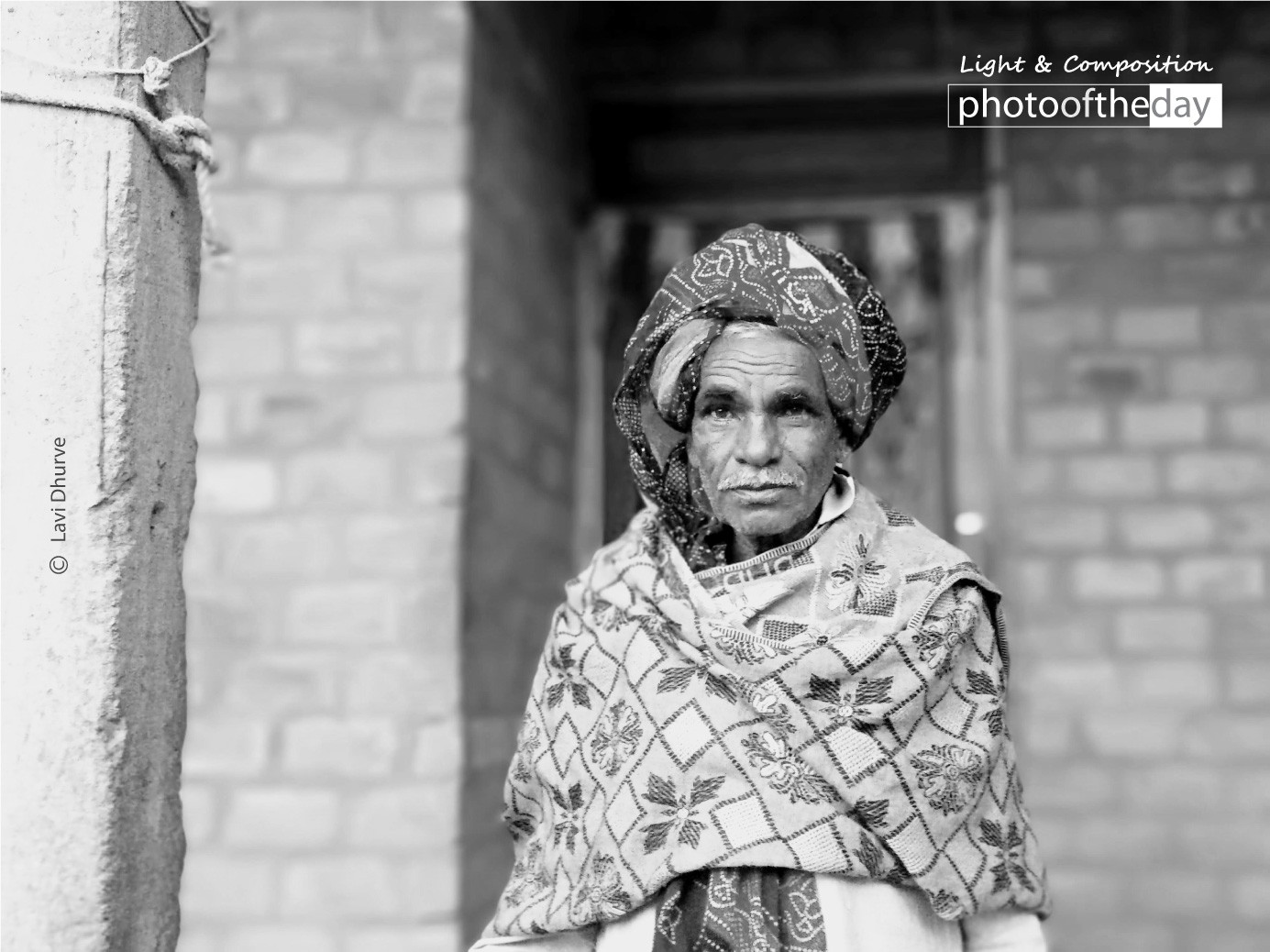
An Old Man with a Turban by Lavi Dhurve
Captured during an NSS camp in a rural village, this portrait documents an elderly man whose vibrant, colorful turban immediately caught the photographer's eye. Despite the challenges of navigating local caste-based sentiments and initial resistance from villagers, the photographer managed to build a rapport with this individual, who was among the few willing to share his story. The image is award-worthy for its ability to transform a tense, complex social encounter into a moment of genuine human connection, highlighting the dignity of the subject through his striking traditional attire and the photographer's patient, observant approach.
Lavi Dhurve
Hailing from a small village in Madhya Pradesh, the ‘Heart of India,’ Lavi Dhurve finds profound beauty in the simplicity of rural life. Her photographic practice is deeply rooted in a passion for art, culture, and the natural world, with a particular focus on capturing the essence of children and local people. Currently based in Indore, she approaches her work as a celebration of life’s daily wonders, consistently seeking to document the beauty found in sunrises, sunsets, and the diverse human experiences she encounters.
Resonance Score Breakdown
Transparency Note: The resonance score (10.3/20) is calculated based on social engagement metrics collected before the award announcement.
Expert Photography Reviews · 8
The Weight of a Story
I spent this morning trying to fix an old wooden chair that has been wobbling in my kitchen for months. I kept putting it off, thinking it was too much trouble, but today I finally sat down with the glue and the clamps.
Read the reflection →The Weight of Woven Threads
I keep a small, frayed piece of indigo wool in a wooden box, a remnant of a scarf my grandfather wore until the fabric grew thin as a moth’s wing. It holds the scent of cedar and the specific, quiet gravity of a life spent working the earth.
Read the reflection →Reviews & Comments
Share your thoughts about this award-winning photograph. Your reviews contribute to the community engagement score.
That turban’s saffron intensity, a hue reminiscent of Turner’s most feverish sunsets, doesn’t merely adorn; it commands the frame, vibrating against the man’s weathered, umber-toned skin like a Morandi still life suddenly ignited by the Indian sun. It’s a chromatic collision that leaves me breathless, for one finds here a visceral, almost tactile dialogue between the ancient, dust-choked earth and the defiant, brilliant plumage of a life lived in the searing, unfiltered light of Madhya Pradesh.
f/2.8 at 50mm, 1/200s, ISO 400. A standard portrait configuration, yet it’s executed with clinical precision. The shallow depth of field isolates the subject’s weathered skin from the chaotic background, forcing focus onto the turban’s texture. It’s a calculated risk that pays off. I’ve seen too many portraits ruined by lazy bokeh, but here, the separation is surgical. It’s technically sound. Honestly, the sharpness in those eyes actually made me pause. A rare, disciplined choice.
That turban is a vibrant shield, but it’s the man’s eyes that stopped me cold. You can tell he didn’t just sit for a lens; he invited Lavi in. There’s a quiet, weary grace in the way he holds his hands, a sign of someone who’s finally been truly seen. It’s rare to find this much soul in a stranger’s gaze. This face has a whole life in it. He trusted, and it shows.
That vibrant turban acts as a visual lure, but I’m left unsettled by the power dynamic behind the lens. The curator mentions resistance from the village; why did the photographer persist until they yielded? Does the man’s dignity belong to him, or is it something we’ve extracted for an award? I feel a sharp, cold discomfort looking at his eyes. Whose story are we actually consuming here? It’s a beautiful portrait, but at what cost to his privacy?
That turban is a riot of color against the dust of Sarni. Lavi caught him in a moment of quiet defiance. It’s not just a portrait; it’s a bridge built across social tension. I love the way the light hits those deep, weathered lines on his face. One tenth of a second later and the gaze would have shifted, the connection lost. You nailed the timing. It’s raw, honest, and absolutely vital. Well done.
The shutter clicked a heartbeat too late. In sports, you’d call this a missed connection; the man’s eyes are already drifting, losing that sharp, singular focus on the lens. It’s a decent portrait, but it lacks the physiological tension of a true peak moment. I’ve spent my life chasing that perfect millisecond, and honestly, it makes me restless. The turban is vibrant, sure, but the subject’s spirit had already shifted away. It’s almost there, but not quite.
You didn’t just snap a portrait; you earned a seat at his table. I can feel the weight of those village tensions in the air, yet you pushed past them to find the man beneath the turban. It’s that steady, quiet gaze that hits me hardest. You waited, and he finally let his guard down. There’s something deeply honest happening here. You didn’t just take his picture; you respected his story. That’s rare work.
The turban’s vibrant weave is a distraction from the true subject: the encroaching gloom behind his eyes. It’s here, in the hollows of his weathered skin, where the image finally thinks. I’ve stared at these shadows until my own pulse slowed. They don’t just frame him; they consume the social tension of that village, leaving only the weight of an unuttered history. It’s a haunting, heavy silence that resists our gaze, demanding we acknowledge the dark.