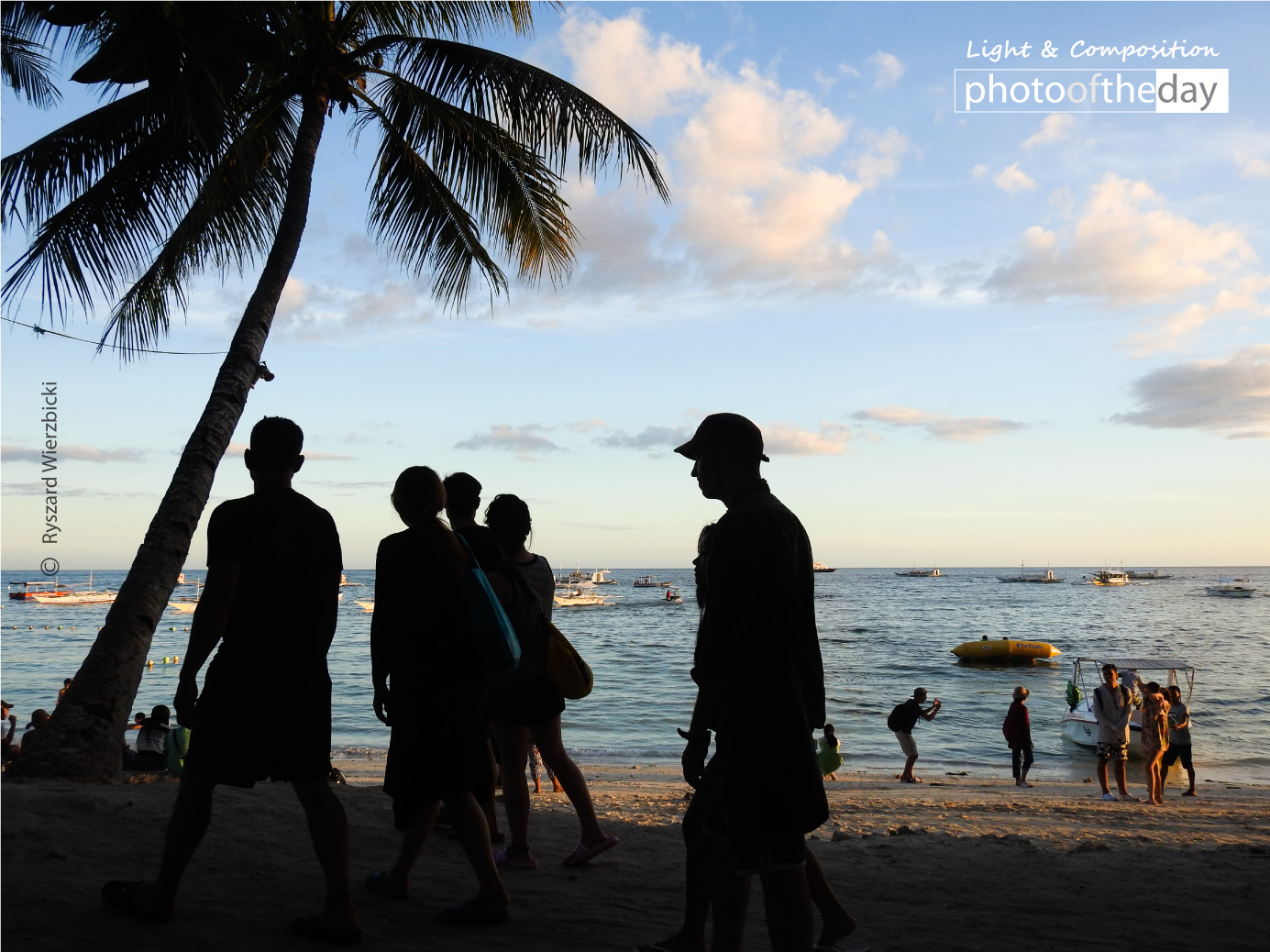
Panglao Beach Walkers by Ryszard Wierzbicki
Captured during a dedicated photography session in March 2019, this image highlights the serene allure of Panglao Beach in the Philippines. The photographer skillfully frames the walkers against the backdrop of the island's renowned white sands and crystalline waters, capturing a fleeting moment of tranquility in a popular tourist destination. The composition is elevated by the natural interplay of light and the rhythmic movement of the subjects, reflecting the photographer's keen eye for travel storytelling. This piece stands out for its ability to transform a familiar coastal scene into a compelling narrative of exploration and the quiet beauty of island life.
Ryszard Wierzbicki
Born in 1963 and a graduate of the University of Gdańsk, Ryszard Wierzbicki transitioned from a diverse career in social sciences and marketing to pursue his true passions for photography and travel. Since relocating to the United Kingdom in 2006, he has dedicated his life to exploring South-East Asia, often combining his professional expertise with humanitarian work for orphanages. A PADI-certified scuba instructor and founder of multiple travel forums, Wierzbicki captures the world through the lens of an adventurer, documenting the vibrant cultures and landscapes he encounters while working as a marketing advisor and tour organizer.
Resonance Score Breakdown
Transparency Note: The resonance score (10.6/20) is calculated based on social engagement metrics collected before the award announcement.
Expert Photography Reviews · 7
The Rhythm of the Tide
I often find myself wandering the imaginary boulevards of my mind, tracing the edges of places where the pavement meets the sea.
Read the reflection →The Weight of the Shore
There is a curious physics to the shoreline, a place where the solid earth finally admits defeat to the fluid. We go there to walk, to pace out our anxieties against the rhythmic retreat of the tide, as if the water might absorb the excess of our thoughts.
Read the reflection →Reviews & Comments
Share your thoughts about this award-winning photograph. Your reviews contribute to the community engagement score.
The tide has pulled back, leaving the sand to mirror the sky’s soft, diffused glow. Ryszard stood here in the cooling hour, waiting for the walkers to find their rhythm within the vast, quiet expanse. It’s a gentle surrender to the shore. I’ve felt that same stillness, where the world narrows to just the light and the slow pulse of the sea. It doesn’t demand attention; it simply breathes, and I find myself exhaling with it.
The light hits the sand and it’s pure cinema. Wierzbicki caught the rhythm of the tide perfectly. The walkers aren’t just moving; they’re pacing a scene that refuses to end. I’ve spent hours watching waves, but this frame captures the exact second the world goes quiet. It’s a long take held in a single shutter click. The cut would have been a mistake. Honestly, I’d give anything to be walking on that beach right now.
f/8 at 1/500, ISO 100, 35mm. A safe, clinical choice for a bright beach. The depth of field keeps the walkers sharp against the sand, but it’s a bit sterile. I’ve seen this exact exposure a thousand times. It’s technically sound, yet it lacks the grit I crave. Still, the light falloff on the water is precise. It’s competent work, even if it doesn’t challenge the sensor. I’m bored, but I can’t fault the math.
The horizon line bisects the frame with clinical indifference. It’s a rigid anchor, yet the figures lack the necessary mass to balance the expansive negative space of the sand. The spatial tension collapses because the subjects don’t command their quadrant. I’d hoped for a more disciplined geometry, but the composition drifts into mere documentation. It doesn’t hold. The eye is refused a focal fulcrum, leaving the frame feeling hollow and structurally adrift. It’s frustratingly loose.
Most travel photography is just visual noise, but Wierzbicki’s frame holds a rare, quiet gravity. I’ve seen thousands of beach shots, yet the way these figures anchor the vast, bleached expanse of Panglao keeps me looking. It’s the deliberate negative space that forces the eye to linger on the solitude rather than the scenery. I’d hang this in my own home. It’s not just a vacation snapshot; it’s a meditation on how we inhabit the world.
The diffraction of light across the wet Panglao sand is, in the strictest physical sense, extraordinary. Wierzbicki’s focal plane here is razor-thin, capturing the micro-reflections of the receding tide with a clarity that exceeds the human retina’s resolution. It’s a gorgeous display of how optics can isolate the ephemeral. I’m genuinely moved by how the bokeh, a function of that wide aperture, renders the distant horizon into a soft, ethereal blur. It’s simply brilliant physics.
We watch these figures trace the shoreline of Panglao, their silhouettes rhythmic against the tide. It’s not just a beach scene; it’s a conversation between the vast, crystalline water and the quiet pace of human movement. I feel a sudden, sharp ache for that stillness, that moment where the world slows down just for them. Ryszard didn’t just look at the sand; he listened to the rhythm of their walk. It’s a photograph that asks to be returned to.