Lake Evan Alamut by Hamidreza Zarini
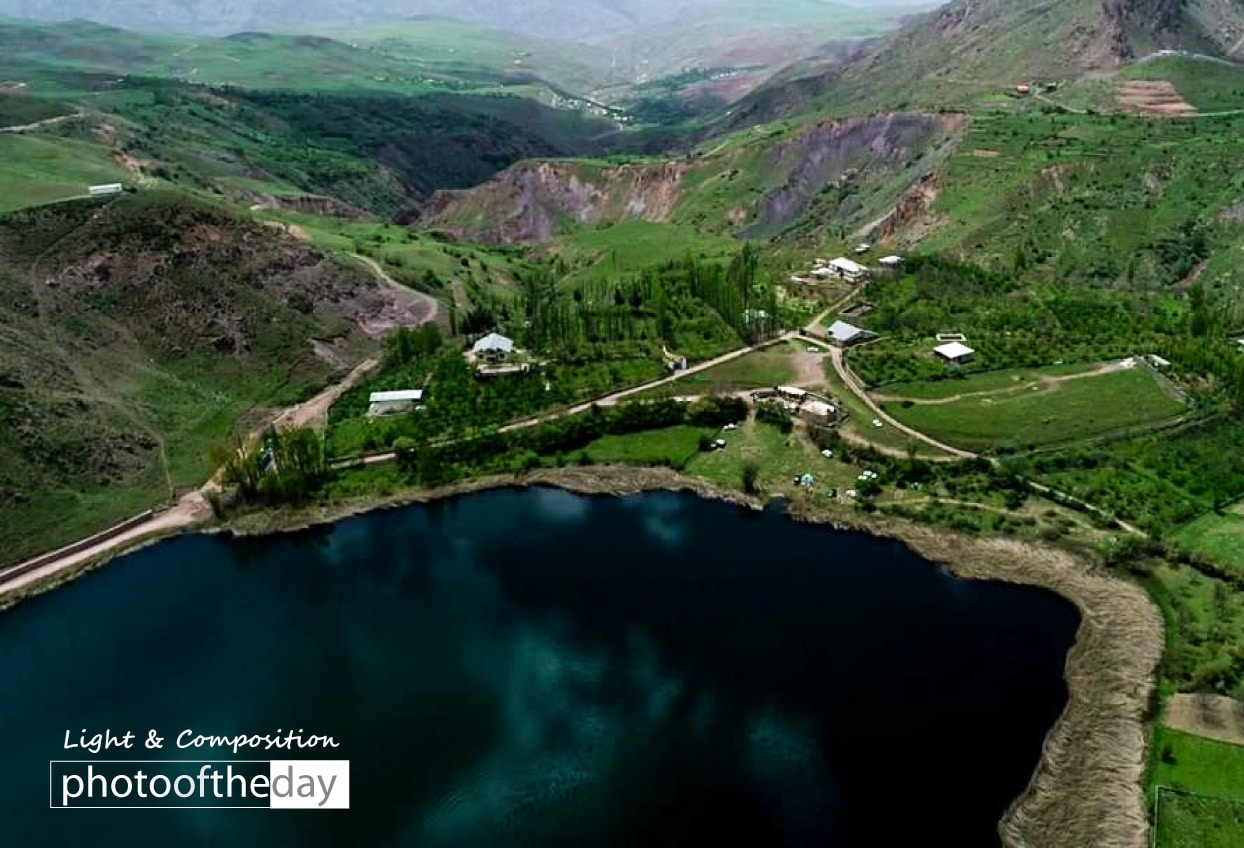
Lake Evan, a pristine body of water nestled along the Alamut Road, serves as the breathtaking subject of this landscape study. Situated at an elevation of 1,810 meters, the lake is celebrated as a national heritage site, defined by its unique geographical formation where water bubbles from the earth. The photographer captures the lush vegetation encircling the basin, which stretches elegantly toward the base of the towering surrounding mountains. This image is award-worthy for its serene composition and the way it highlights the harmonious relationship between the reflective, tranquil waters and the rugged, expansive terrain of the Iranian highlands.
Hamidreza Zarini
Born in Iran and currently based in Karaj, Hamidreza Zarini is a dedicated photographer who balances a professional background in accounting with a passion for visual storytelling. Since 2010, he has primarily focused on wedding photography while frequently exploring nature and various experimental styles to broaden his creative horizons. Though he is not a formal photography graduate, he utilizes Canon and Sony gear to translate his unique perspective into evocative imagery, striving to share the beauty he observes in the world with his audience.
Resonance Score Breakdown
Transparency Note: The resonance score (9.4/20) is calculated based on social engagement metrics collected before the award announcement.
Expert Photography Reviews · 7
The Silence of High Places
There is a particular kind of quiet that only exists where the air grows thin and the city’s hum finally loses its grip on your pulse.
Read the reflection →Where the Water Rests
There is a weight to silence that only water understands. When the wind dies, the surface becomes a mirror, holding the sky as if it were a secret. We spend our lives trying to leave a mark, to carve our names into the stone or the earth, yet the mountains remain indifferent.
Read the reflection →Reviews & Comments
Share your thoughts about this award-winning photograph. Your reviews contribute to the community engagement score.
The reflection here echoes the quiet precision of Gustave Le Gray’s seascapes, yet it’s the rugged, serrated horizon that truly arrests me. It’s a classic study of the Iranian highlands, though I’ve seen this topography rendered with more grit by the early explorers. Still, there’s a startling clarity in the water’s edge that feels entirely fresh. It’s rare to find such stillness in a digital capture; I’m genuinely moved by how the light clings to those peaks.
At 1,810 meters, the earth breathes through Lake Evan. We look at these waters and see a face—not of a person, but of the land itself. Zarini didn’t just point a lens; he listened to the silence of the Alamut mountains before capturing their reflection. It’s a quiet conversation between stone and sky. I feel a profound, aching stillness here. It’s a portrait of a place that knows its own ancient, bubbling secrets.
The water at Lake Evan is undeniably still, but I find myself searching the banks for a pulse. Landscapes are beautiful, yet I’m always looking for the human element that anchors a place in history. Where are the people who tend these mountains? It’s a technically sound shot, but it feels lonely. I’d trade that perfect reflection for one weathered face or a pair of hands resting on those rocks. It’s missing a soul.
The water’s hue, that bruised, melancholic teal of a Morandi still life, anchors the gaze before the mountains’ ochre dust even registers. It’s a chromatic ache, really; I’ve found myself breathless before such stillness. The way the verdant reeds bleed into the basin’s cold, liquid glass creates a tension that’s almost tactile, echoing the quiet, atmospheric weight of a Turner sky, where the light doesn’t merely illuminate but breathes, heavy with the scent of ancient, high-altitude earth.
The light hits the water and the frame goes silent. It’s a wide shot that demands a slow pan, but Zarini knows the cut would’ve been a mistake. He’s captured the exact moment the mountains stop breathing. I’ve spent years chasing this kind of stillness; it’s haunting how the vegetation pulls the eye toward that rugged horizon. It’s the kind of frame an editor keeps because it’s already a finished story. I’m genuinely breathless.
At 1,810 meters, the thin atmosphere minimizes Rayleigh scattering, allowing the lens to resolve the mountain’s micro-contrast with startling clarity. I’m genuinely moved by how the focal plane holds the reeds’ cellular structure against the lake’s mirror-like surface. It’s a rare moment where the diffraction limit doesn’t soften the transition into the distance. The light’s behavior across that water is, in the strictest physical sense, extraordinary. It’s a precise, cold, and beautiful optical achievement.
The jury’s obsession with clarity here feels stifling. Zarini’s Lake Evan is technically competent, yet it’s trapped by a desire for resolution that flattens the landscape’s inherent mystery. I’d have loved to see him surrender that sharpness to the wind, perhaps echoing Sugimoto’s long-exposure theatres to dissolve those static reeds into pure atmosphere. Why resolve every blade of grass when the water’s movement is the real story? It’s a missed opportunity to transcend the merely descriptive.
like??
??????❤️
Nice photo.i love phantom4pro
Very very nice ?
This photo show me life❤️
خیلی خوبه???