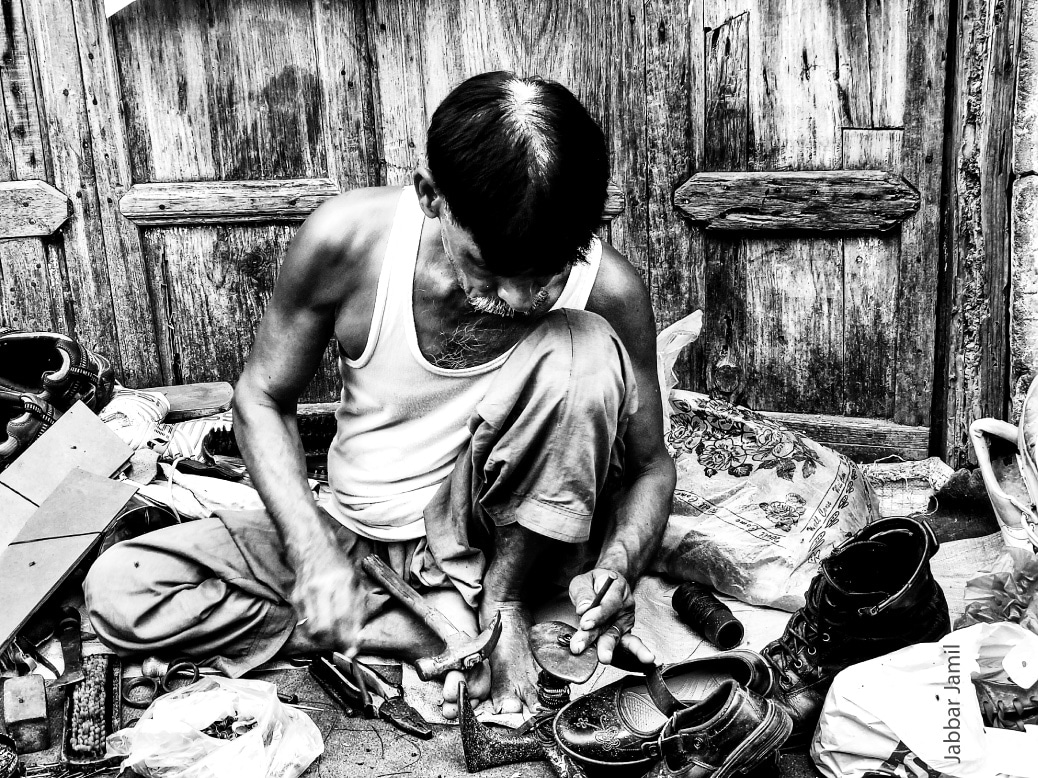
A busy Cobbler by Jabbar Jamil
In the bustling streets of Sialkot, Pakistan, Jabbar Jamil captures the rhythmic life of a local cobbler. The photographer observed a fleeting moment where a craftsman worked diligently on a pair of shoes, surrounded by a queue of waiting customers and the humble tools of his trade. By choosing to document this roadside scene, Jamil highlights the quiet dignity of everyday labor. The image is award-worthy for its authentic documentary approach, effectively freezing a transient slice of urban life that might otherwise go unnoticed, while maintaining a respectful distance that preserves the integrity of the subject's environment.
Jabbar Jamil
Based in Sialkot, Pakistan, Jabbar Jamil is a dedicated street photographer who views his craft as a vital bridge to the outside world. Through his lens, he explores the raw realities of urban life, finding that photography serves as both a creative outlet and a therapeutic escape from daily stress. Jamil is committed to documenting the world exactly as he finds it, often focusing on the unvarnished and authentic moments that define the human experience in his community.
Resonance Score Breakdown
Transparency Note: The resonance score (11.1/20) is calculated based on social engagement metrics collected before the award announcement.
Expert Photography Reviews · 3
The Weight of Hands
I spent twenty minutes this morning trying to fix the strap on my favorite bag. My fingers felt clumsy, and I kept dropping the needle, feeling a strange, mounting frustration at such a small task.
Read the reflection →The Weight of Hands
It is 3:14 am. The house is holding its breath, and I am sitting here wondering about the things we fix just to keep moving. We spend our lives mending what wears thin—the leather of our shoes, the edges of our patience, the promises that started to fray months ago.
Read the reflection →Reviews & Comments
Share your thoughts about this award-winning photograph. Your reviews contribute to the community engagement score.
The frame’s geometry is cluttered, yet the cobbler’s hunched posture provides a necessary fulcrum. It’s a dense arrangement of tools and limbs that threatens to collapse, but the vertical alignment of the shop’s edge saves it. I’ve grown weary of such chaotic street scenes, but the spatial tension here actually holds. It doesn’t succumb to sentimentality. The composition is tight, disciplined, and finally, it’s earned its place within the frame. It’s a rare, structural success.
It’s a decent enough slice of Sialkot, though one wonders if Jamil simply happened by. The composition is tidy, yet it lacks the grit of a man who’s spent days in that dust. I’ve sat in enough roadside heat to know that true intimacy requires more than a respectful distance; it requires becoming part of the furniture. It’s a clean shot, certainly, but I’m left wishing he’d stayed until the light—and the cobbler—stopped caring he was there.
Before the eye identifies the cobbler, a sudden stillness settles in the chest. It’s the rhythm of the needle, the weight of the leather, that anchors the pulse. I’ve felt that same heavy, quiet focus in my own hands when I’m lost in work. Returning to this a year later, the scene doesn’t feel like a distant street in Sialkot anymore; it’s a familiar, grounding hum that follows me into the quiet of my own sleep.