Rainy Cricket by Jabbar Jamil
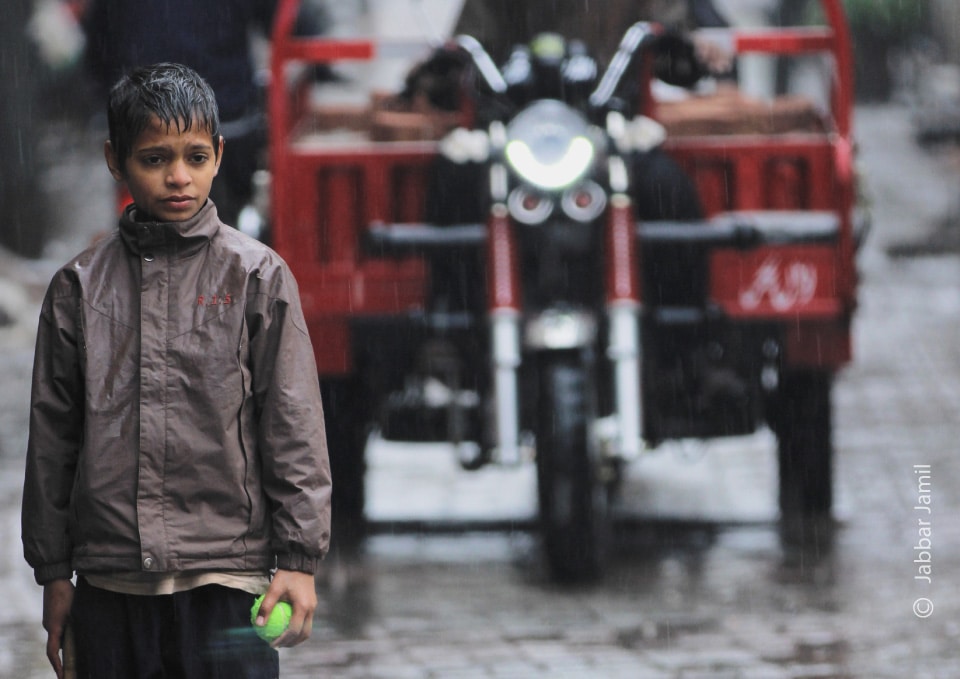
In the vibrant streets of Sialkot, Jabbar Jamil captures the enduring spirit of cricket, a sport that transcends weather conditions for its devoted fans. The photograph depicts a young enthusiast waiting patiently for his friends to join him during a light rain shower. This image is award-worthy for its poignant observation of local culture and the photographer’s ability to find beauty in the mundane. By focusing on the subject's quiet anticipation against the backdrop of a rainy day, Jamil elevates a simple street scene into a compelling narrative about passion, resilience, and the universal joy of play.
Jabbar Jamil
Based in Sialkot, Pakistan, Jabbar Jamil is a dedicated street photographer who views his craft as a vital bridge to the world around him. For Jamil, photography serves as both a creative outlet and a therapeutic escape, allowing him to document the raw, authentic realities of daily life rather than just idealized beauty. His work is defined by a commitment to stepping outside his comfort zone to forge genuine human connections, capturing the essence of the streets with empathy and observant precision.
Resonance Score Breakdown
Transparency Note: The resonance score (10.4/20) is calculated based on social engagement metrics collected before the award announcement.
Expert Photography Reviews · 7
The Right to Play
We often mistake the city for a collection of infrastructure—roads, pipes, and zoning laws. But the true urban fabric is woven from the informal claims people make upon public space.
Read the reflection →The Patience of Play
Why do we insist that a storm is an ending, rather than a pause? We are conditioned to seek shelter, to retreat from the elements as if the sky were an adversary rather than a witness.
Read the reflection →Reviews & Comments
Share your thoughts about this award-winning photograph. Your reviews contribute to the community engagement score.
Very nice! I would give you a 70. Keep it going
The rain falls. It doesn’t rush. A boy stands in the grey. He waits. The frame holds so much distance between him and the wall. It’s a quiet ache I recognize from my own childhood. The wet pavement isn’t just ground; it’s a mirror for his patience. Nothing here is accidental. The empty corner is not empty. It’s the weight of the game he hasn’t started yet. I’ve never seen stillness look so loud.
The focal plane here is razor-thin, isolating the boy’s gaze against the chaotic refraction of raindrops. Jamil’s aperture choice creates a bokeh that renders the background into a soft, atmospheric wash, yet the diffraction of light across the wet surface of the bat is, in the strictest physical sense, extraordinary. I’m genuinely moved by how the lens resolves those tiny, fleeting droplets. It’s a rare moment where the physics of glass perfectly captures the quiet weight of anticipation.
The rain in Sialkot doesn’t stop the game, and Jamil knows it. That kid’s posture—shoulders hunched, eyes scanning for his friends—is pure, unadulterated longing. I love the way the wet pavement reflects his patience. One tenth of a second later and he’s moved, the tension evaporates, and the frame collapses. It’s a Winogrand-level observation of waiting. You caught the exact heartbeat before the play begins. It’s honest, it’s raw, and it’s perfectly timed. Keep shooting.
Most street photography is noise, but this quiet moment in Sialkot lingers. Of the thousands of submissions I’ve reviewed, few capture such genuine, unforced patience. The rain-slicked ground isn’t just atmosphere; it’s the anchor for that boy’s singular focus. I’ve seen countless sports shots, yet this one hits differently because it’s about the waiting, not the play. It’s a small, honest slice of life that’ll still matter in thirty years. It makes me miss being a kid.
The vertical axis of the boy’s posture creates a perfect perpendicular against the horizontal sweep of the street. It’s a 1:3 ratio of subject to negative space that anchors the frame. I’m genuinely moved by how the rain’s trajectory mirrors the diagonal tension of his bat. The geometry here isn’t just balanced; it’s a solved equation of patience. Jamil’s composition turns a simple wait into a rigid, beautiful proof of human resilience. It’s mathematically sublime.
The rain-slicked pavement in Sialkot echoes the gritty, wet textures of Bill Brandt’s London, yet Jamil finds a different, softer patience here. It’s a quiet study of anticipation that reminds me of Cartier-Bresson’s decisive moments, though stripped of his usual geometric rigor. I’m genuinely moved by the boy’s stillness; it’s a rare, fragile honesty. While the composition leans heavily on tradition, that singular, rain-drenched focus elevates a mundane street scene into something I haven’t quite seen before.
Rain falls in Sialkot, yet the boy waits. It’s a quiet, terrestrial patience. I’m used to light that’s traveled eons to hit a sensor, light that doesn’t care about rain or cricket. But looking at his stillness, I feel a strange, sudden ache for our brief, fleeting warmth. He’s anchored in a moment that won’t last, while I’m usually busy measuring the cold, infinite dark. It’s a beautiful, fragile contrast to the stars.