Oldest Lady by Jabbar Jamil
Captured during a family visit to a rural village, this poignant portrait documents the matriarch of a five-generation household. At 115 years old, the subject’s weathered features tell a profound story of longevity and resilience, despite the challenges of failing sight and hearing. The photographer approached this encounter with deep empathy, documenting the woman shortly before her passing. The image is award-worthy for its raw, unfiltered honesty and the intimate connection established between the photographer and his subject, transforming a fleeting family moment into a timeless, dignified testament to a life spanning over a century.
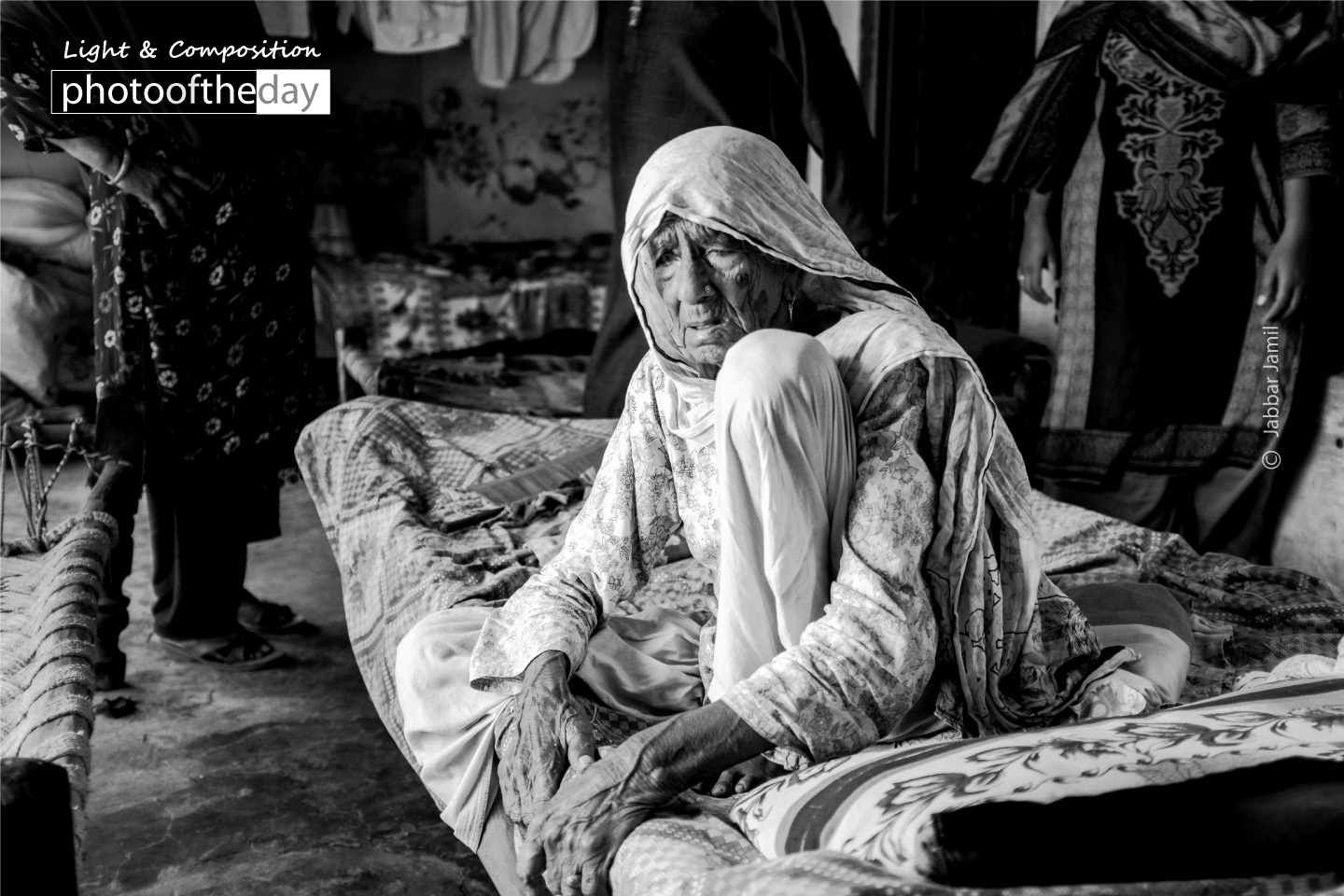
Jabbar Jamil
Based in Sialkot, Pakistan, Jabbar Jamil is a dedicated street photographer who views his craft as a vital bridge to the world around him. He finds that photography serves as both a creative outlet and a therapeutic escape, allowing him to document the complexities of life beyond his comfort zone. By focusing on the authentic, often unvarnished realities of his surroundings, Jamil strives to forge meaningful human connections that transcend the frame of his images.
Resonance Score Breakdown
Transparency Note: The resonance score (10.3/20) is calculated based on social engagement metrics collected before the award announcement.
Expert Photography Reviews · 8
The Map of a Century
I once sat with a woman in a village near the border who had lived through enough history to fill a library, though she had never learned to read a single page. She traced the lines on her palms as if they were a map of every road she had ever walked.
Read the reflection →The Map of a Life
I spent this morning tracing the lines on my own palms, wondering how much of my history is written there. It started because I dropped a glass in the kitchen; as I swept up the shards, I noticed how my hands looked different than they did a few years ago.
Read the reflection →Reviews & Comments
Share your thoughts about this award-winning photograph. Your reviews contribute to the community engagement score.
The light here doesn’t fall; it lingers, caught in the deep, tectonic ridges of her skin. Jabbar waited for that soft, diffused glow that only touches a face when the world has grown quiet. I’ve spent hours in such stillness, and I feel a sudden, sharp ache in my chest looking at her eyes. She’s not just a person; she’s a landscape of time itself. It’s a rare, holy patience that let this moment breathe.
At 115, the body doesn’t move with explosive power, but there’s still a peak moment. Jamil caught the exact millisecond her gaze drifted, a flicker of consciousness before the light fades. It’s not about athletic tension, but the stillness of a life at its absolute limit. I’ve spent my career chasing the perfect frame, and honestly, this one hits me hard. It’s the precise, quiet exhale of a century. The timing is perfect.
The focal plane sits perfectly across the deep furrows of her skin, where the lens resolves every micro-texture of a century’s erosion. It’s a masterclass in controlled depth of field; the bokeh, a function of a wide aperture, isolates her gaze from the chaotic rural background. I’m genuinely moved by how the light catches the diffraction of her cataract-clouded eyes. It’s not just a portrait; it’s the physics of time rendered in exquisite, unforgiving detail.
At 115 years, she has orbited our sun more times than most of us can fathom. Her skin maps a century of solar cycles, a topography as ancient as the nebulae I usually track. It’s humbling. While I’m obsessed with photons traveling millions of years to hit a sensor, Jamil captured a light that’s fading right here. I find myself breathless looking at her eyes. They’ve seen so much time pass. It’s truly profound.
We look at this face and we understand something about the weight of a century. Jabbar Jamil didn’t just point a lens; he sat in the silence of her fading senses until she let him in. I’m moved by the way her skin maps a history we can’t fully read. It’s a quiet, heavy grace. I’ve seen many portraits, but this one asks to be returned to. It’s a conversation held in the dark.
Before the eye identifies the skin’s topography, the breath hitches. It’s a sudden, heavy stillness. Those clouded eyes don’t look back; they look inward, pulling my own focus into the quiet dark of a century. I’ve returned to this portrait three times today, and each time, the weight of her silence settles in my chest like lead. It’s not just a face; it’s the visceral, lonely ache of time finally running out of things to say.
I’ve spent weeks in blinds waiting for a creature to trust my presence, and I recognize that same stillness here. It’s not an extraction; it’s a surrender. The way she holds her hands, oblivious to the lens, suggests the photographer didn’t intrude but simply existed in her orbit. It’s rare to see such quietude. Honestly, it makes my chest ache. He didn’t force this portrait; he earned the right to be in the room.
One suspects Jamil didn’t just stumble upon this matriarch during a casual stroll. That depth in her gaze suggests a photographer who sat in the dust long enough to become part of the furniture. It’s a rare, quiet intimacy that can’t be faked with a long lens. I’ve spent enough hours shivering in the hills to know when someone’s actually put in the work. It’s a haunting, earned piece of history. Well done.