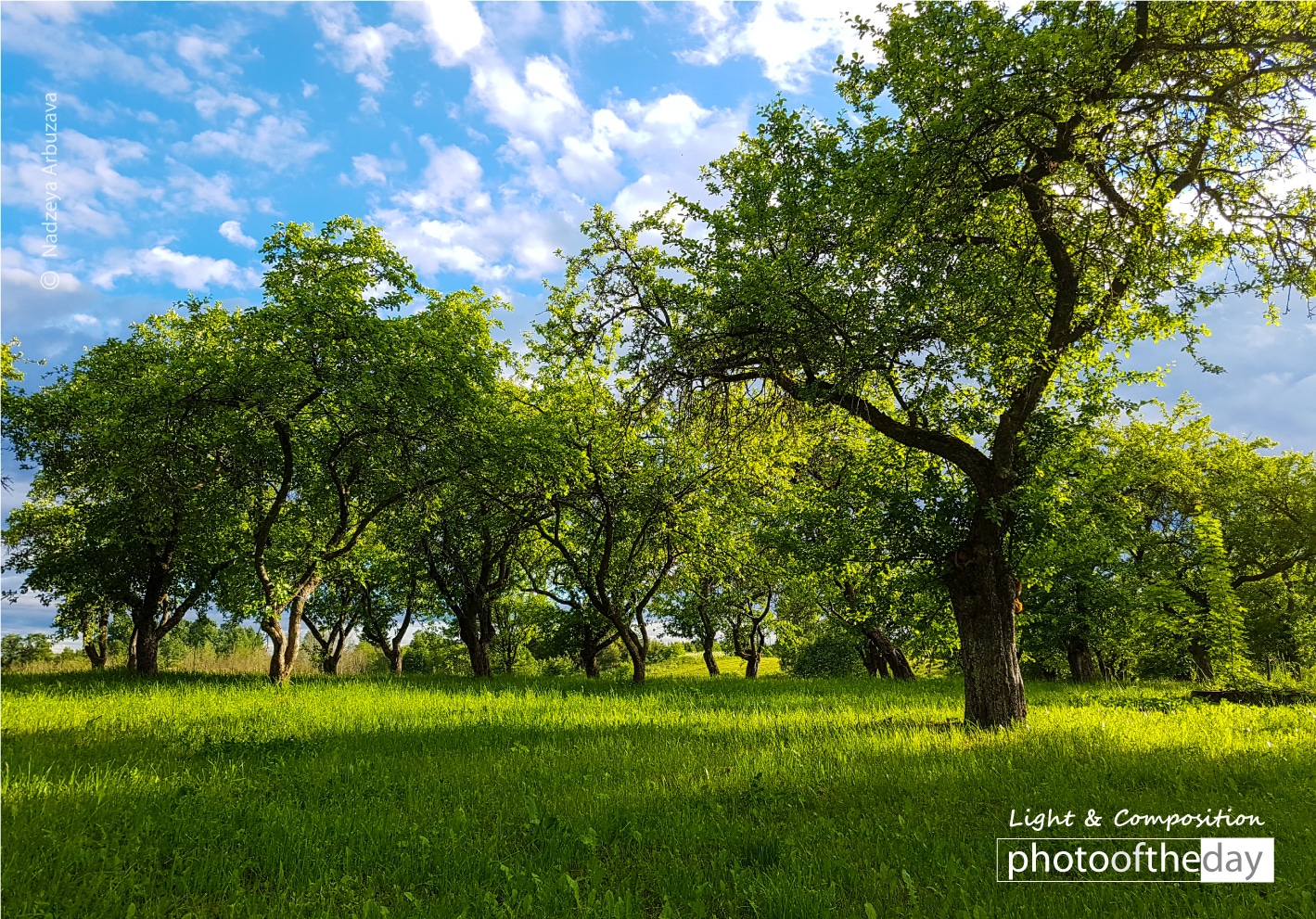
100 Years Old Garden by Nadzeya Arbuzava
Captured on a remote, tranquil farm in Belarus, this photograph immortalizes a garden that has flourished for over a century. The photographer was drawn to the site by its profound atmosphere of serenity and timeless harmony, seeking to distill the essence of the Belarusian landscape into a single frame. The image serves as a meditative reflection on nature’s endurance, inviting viewers to experience the quiet magic of a place where history and peace converge. Its ability to evoke such deep, resonant stillness is precisely what distinguishes this work as an award-winning piece of nature photography.
Nadzeya Arbuzava
Based in Minsk, Belarus, Nadzeya Arbuzava is a medical university graduate who balances a professional background in healthcare with a passionate pursuit of visual storytelling. Her photography is driven by a desire to celebrate the beauty of the natural world, ranging from delicate floral studies and architecture to the expansive serenity of the sea. Through her lens, she strives to inspire others to find happiness and appreciation in the everyday, documenting the wonders of the world with an optimistic and life-affirming perspective.
Resonance Score Breakdown
Transparency Note: The resonance score (12.3/20) is calculated based on social engagement metrics collected before the award announcement.
Expert Photography Reviews · 8
The Quietude of Roots
Seneca once remarked that we are like trees, which must be deeply rooted if they are to withstand the winds of fortune. We often mistake growth for speed, measuring our lives by the frantic pace of our achievements, yet the most enduring things in nature do not hurry.
Read the reflection →The Memory of Roots
Time is not a straight line, but a slow, circular breathing. We imagine history as something written in heavy books, yet it lives more truly in the way a branch learns to lean toward the light, or how the soil remembers the weight of a thousand winters.
Read the reflection →Reviews & Comments
Share your thoughts about this award-winning photograph. Your reviews contribute to the community engagement score.
It’s a relief to see a landscape that doesn’t suffer from the crushing weight of a water column. Without the refractive index of water distorting these lines, the clarity is startling. I’m so used to fighting backscatter and the blue-green void that this stillness feels almost alien. There’s no light absorption here to steal the warmth from these century-old greens. It’s beautiful, really—a quiet, terrestrial exhale I rarely get to experience in my own work.
A century of growth shouldn’t feel this sanitized. Arbuzava captures a Belarusian garden, but whose history is she curating? The frame excludes the labor that keeps this soil alive, favoring a hollow, postcard serenity. It’s beautiful, sure, but I feel a strange, cold distance looking at it. Why does the stillness feel so curated? Does nature’s endurance really look this tidy, or are we just ignoring the messy, human reality of the farm?
A century of growth, yet it feels frozen. I’m looking for the pulse, the twitch of life that Cartier-Bresson hunted. It’s quiet, sure, but where’s the friction? Nature doesn’t wait, but here, the stillness feels staged. I’d kill for a stray bird or a gust of wind to break that heavy, static air. It’s beautiful, but it’s too polite. One tenth of a second later and the light might have actually told a story.
There’s a haunting silence in this Belarusian garden, but I find myself searching for the hands that tended it. A landscape this old isn’t just nature; it’s a life’s work. I wish the photographer had invited a person into the frame to ground that history. Without a human presence, it feels like a beautiful, empty room. I’m left longing for the face that belongs to these century-old shadows. It’s a lovely scene, but it’s missing a soul.
There’s a haunting, spectral quality here that makes me want to step right into the frame. By refusing to pin down the foliage with clinical sharpness, Arbuzava captures the garden’s ghost rather than its inventory. It’s closer to Sugimoto’s long-exposure theatres than conventional nature photography. Why resolve every leaf when the blur tells the truth of time? I’m genuinely moved by this choice; it’s a rare, beautiful surrender to the atmosphere of a century.
The garden’s geometry doesn’t collapse under the weight of its own history. Arbuzava anchors the frame with a rigid, vertical axis that forces the eye to reconcile the overgrown periphery with the central clearing. It’s a disciplined arrangement of mass. I’ve found myself lingering on the tension between the dense foliage and the open foreground. The spatial distribution holds. It’s rare to see such structural restraint in a landscape. The frame is finally, mercifully, quiet.
The garden breathes. It’s a slow, rhythmic exhale of century-old soil. I’ve spent minutes watching the light settle on the grass. It doesn’t demand attention. It simply exists. The negative space here isn’t a void. It’s a weight. A presence. I feel my own pulse slowing down just looking at it. Nothing here is accidental. The empty corner is not empty. It’s a pause. A quiet, necessary breath in a loud world.
Nature doesn’t sprint, but it has its own kinetic peak. In this garden, the light hits the foliage at the exact millisecond of maximum saturation before the shadows lengthen. It’s the physiological equivalent of a sprinter’s perfect stride. I’ve spent my life chasing that singular, weightless instant, and honestly, it makes me want to slow my own breathing. The timing here is precise. It’s not the frame before the light fades. It’s this one.
Wonderful trees.
Great
Excellent shooting
Thanks
The kind of garden I like.
I like it too
Amazing old garden!
it’s true
Magnifica foto..
Really
lovely capture
:*