Nature’s Candy by Agnieszka Bodes
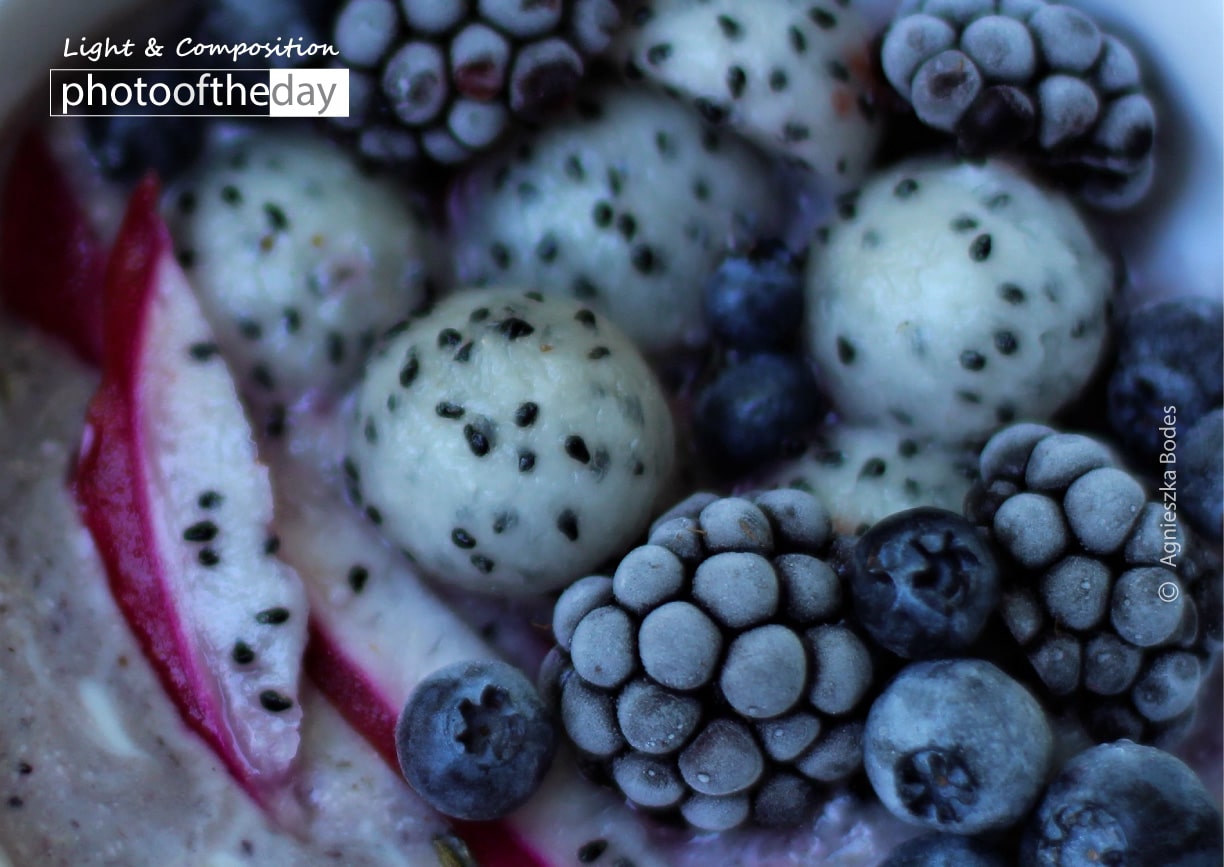
Captured as a technical exploration of a new lens, this photograph highlights the vibrant, frozen textures of fruit with remarkable clarity. By choosing to shoot in natural light, the photographer maintained a minimalist aesthetic that allows the inherent beauty of the subject to take center stage. The decision to zoom in closely emphasizes the intricate details of the frozen elements, transforming simple ingredients into a compelling visual study. This image is award-worthy for its masterful use of shallow depth of field and its ability to elevate everyday food items into an evocative, artistic composition that celebrates the raw, natural essence of the subject.
Agnieszka Bodes
Born in Poland and currently based in Ottawa, Canada, Agnieszka Bodes transitioned from a career in fashion blogging to a dedicated focus on food photography. Her creative process is deeply inspired by natural light and the textures of the culinary world, often utilizing self-painted backdrops and vintage props to style her images. Bodes views food as a complex narrative of color, memory, and shared experience, consistently seeking to capture the unseen details that define our relationship with what we eat.
Resonance Score Breakdown
Transparency Note: The resonance score (11.2/20) is calculated based on social engagement metrics collected before the award announcement.
Expert Photography Reviews · 8
The Architecture of Frost
When water transitions into ice, it does not simply harden; it organizes itself into intricate, hexagonal lattices, a process of crystallization that forces the liquid to shed its chaotic fluidity for a rigid, geometric grace.
Read the reflection →The Geography of Sustenance
We often mistake the city for its concrete skin, forgetting that the urban fabric is held together by the quiet rituals of consumption. Every market stall, every kitchen, and every shared meal is a site of negotiation between the natural world and the built environment.
Read the reflection →Reviews & Comments
Share your thoughts about this award-winning photograph. Your reviews contribute to the community engagement score.
Most food photography is disposable, destined for a quick scroll and immediate forgetting. Bodes avoids this by leaning into the brutal, crystalline bite of the frost. At f/1.6, the focus is razor-thin, forcing the eye to confront the fruit’s cellular structure rather than its utility. It’s cold, sharp, and honestly, it makes me shiver. In thirty years, this won’t be a dated ad; it’ll be a timeless study of texture that refuses to melt away.
You’ve got a sharp eye for texture here. The frost on that fruit feels cold enough to sting my fingers, and I appreciate the restraint. It’s clean, honest work. Because you didn’t clutter the frame, I’m actually looking at the ice crystals instead of the lens specs. And honestly? It makes me crave a winter morning in Ottawa. You waited for the light to hit just right. That’s a rare kind of patience. Nice work.
Frozen fruit shouldn’t feel this heavy. Bodes captures the crystalline surface of these berries, yet it’s the encroaching void behind them that haunts me. She’s allowed the darkness to swallow the edges, turning simple sustenance into a cold, existential anchor. I’ve stared at these icy textures for an hour, feeling the chill of a world stripped of warmth. It’s not just food; it’s a quiet, brutal confrontation with the inevitable decay of all things.
It’s technically sharp, sure, but there’s nobody home. I’ve spent my life looking for the pulse in a frame, and here, I just find ice. When you photograph fruit, you’re documenting a harvest, but there’s no hand that picked it, no sweat, no story. It’s cold. I find myself craving a human face, someone who actually chose to be seen. Without a soul to meet my eyes, it’s just a pretty, hollow exercise.
Frozen fruit isn’t the street, but Bodes nails the timing. That 1/400 shutter speed caught the frost mid-melt, a fleeting transition I’ve spent years chasing in urban crowds. It’s crisp, clean, and honest. I’m actually craving the bite of that ice just looking at it. Cartier-Bresson looked for the geometry of people; here, the geometry is in the crystals. One tenth of a second later and the light shifts, the texture dies. She caught it.
Looking at these frozen fruits, I’m struck by the absolute luxury of full-spectrum light. Down at twenty metres, those vibrant reds and oranges would have been swallowed by the water column, leaving only a muddy, monochromatic blue. Here, the light doesn’t fight the medium; it just dances on the ice. It’s refreshing to see such crisp, unscattered clarity. I’d trade my strobe rig for this effortless, natural brilliance any day. It’s truly gorgeous work.
It’s a technically crisp study, but I find myself cold. When I spend weeks in a blind, I’m waiting for a heartbeat, not a grocery list. There’s no relationship here, just a sterile arrangement of frozen fruit. It’s extracted, not earned. I’d trade all this shallow depth of field for one frame where the subject had a choice. Nature isn’t a prop for a lens test; it’s a living, breathing entity that demands our respect.
Frost clings to the skin of the fruit. It’s a quiet, biting cold. The blur behind the berries isn’t just a lens choice; it’s a breath held in the dark. I’ve spent minutes staring at the soft, white void. It’s comforting. Nothing here is accidental. The empty corner is not empty. It’s a space for the eye to rest. I feel a sudden, sharp ache for winter. Silence, captured in a single, frozen frame.