Wind, Waves, and Rocks by Manon Mathieu
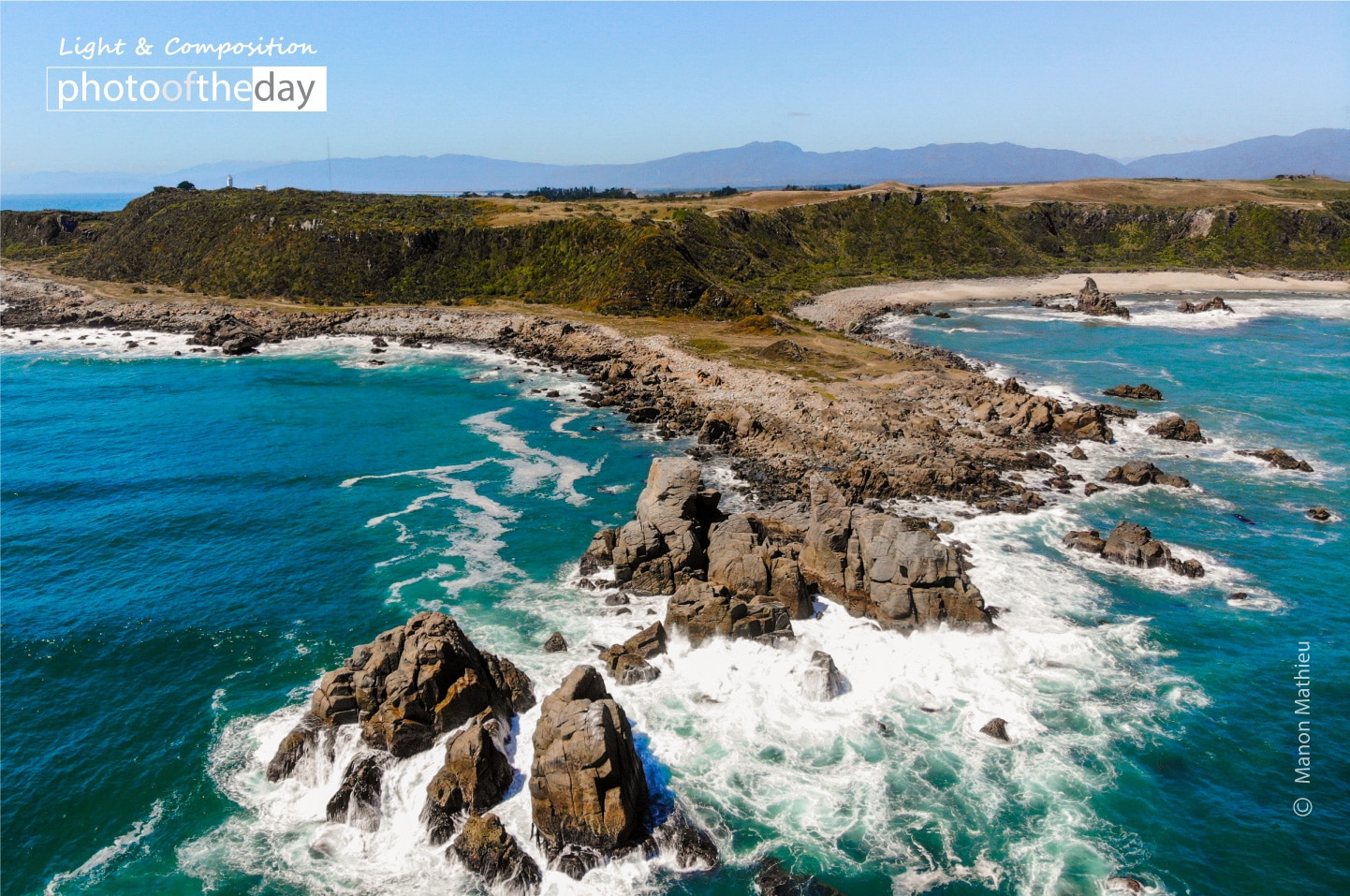
Captured along the rugged West Coast of New Zealand’s South Island, this photograph documents the raw, elemental power of the ocean as it collides with the ancient cliffs of Cape Foulwind. The photographer utilized an aerial perspective to frame the dramatic interplay between the crashing waves and the jagged rock formations, while simultaneously capturing the serene presence of a nearby sea lion colony. This image is award-worthy for its successful juxtaposition of the violent, rhythmic energy of the Tasman Sea against the tranquil, sheltered life of the local wildlife, all rendered with precise technical execution.
Manon Mathieu
Born in the south of France, Manon Mathieu is a journalist whose professional background spans cities from Paris to Marseille. Currently embarking on a global journey, she documents her travels through New Zealand while living in a campervan. Her photography is driven by a deep appreciation for nature, focusing on the landscapes, coastlines, and fleeting moments that evoke a strong emotional response. Through her lens, she captures the essence of the environments she explores, translating her nomadic experiences into compelling visual narratives.
Resonance Score Breakdown
Transparency Note: The resonance score (10.1/20) is calculated based on social engagement metrics collected before the award announcement.
Expert Photography Reviews · 6
The Archive of Salt and Stone
We are all carved by the things we cannot hold. The shoreline is not merely a boundary, but a conversation between the stubbornness of earth and the restlessness of the tide.
Read the reflection →The Edge of Everything
I spent this morning trying to fix a leaky faucet in the kitchen. It was one of those small, nagging tasks I’d been putting off for weeks. I kept turning the wrench, feeling the cold metal against my palm, and for a moment, I just stopped.
Read the reflection →Reviews & Comments
Share your thoughts about this award-winning photograph. Your reviews contribute to the community engagement score.
The Tasman Sea here isn’t merely water; it’s a churning, bruised indigo, reminiscent of Turner’s most tempestuous maritime sketches, colliding with the ochre-stained basalt of Cape Foulwind. It’s a chromatic violence that leaves me breathless, shivering at the cold, slate-grey undertones of the foam. One finds the sea lions’ tawny, sun-warmed hides offer a necessary, Morandi-esque stillness against such a relentless, icy palette, grounding the composition in a fragile, earthy harmony I’ve rarely seen captured so perfectly.
The frame’s geometry is compromised. While the Tasman Sea’s white foam provides necessary tonal contrast against the basalt, the sea lion colony creates a chaotic visual weight that disrupts the horizon’s authority. It’s a messy inclusion. The aerial perspective flattens the cliffs, stripping them of their vertical menace. I’d prefer a tighter crop to isolate the rhythmic collision of water and stone. It doesn’t quite hold its own against the vast, indifferent geography.
Cape Foulwind isn’t a city street, but the chaos of that surf demands the same reflexes as Winogrand. You’ve got the white foam exploding against the black rock, and then, the sea lions. It’s a gamble. Did you catch the spray at its peak? Yes. One tenth of a second later and the energy dissipates into static water. I’m actually holding my breath looking at that collision. You were paying attention. That’s the decisive moment.
At f/2.8, the Mavic Air’s sensor struggles with the diffraction limit, yet Mathieu’s capture of the Tasman surf is surprisingly crisp. The focal plane renders the sea lion colony with a clinical sharpness that reveals textures the naked eye would miss from that altitude. I’m genuinely moved by how the chromatic aberration at the wave crests mimics the chaotic energy of the spray. It’s a rare instance where the optics don’t just record; they breathe.
We look at these jagged cliffs and feel the Tasman Sea’s ancient, rhythmic pulse. It’s not just a landscape; it’s a conversation between stone and tide. When we spot the sea lions resting in the sheltered coves, we realize they’ve listened to the ocean’s roar for centuries. I’m moved by their quiet endurance amidst such violence. It’s a portrait of a place that knows how to survive. This is a photograph that asks to be returned to.
A drone at Cape Foulwind? It’s a convenient way to avoid the salt spray and the climb, isn’t it? One suspects the Tasman Sea didn’t demand much of the photographer here. While the composition is tidy, it lacks the grit of a tripod planted in the mud for three days. I’ve spent enough time on that coast to know the difference between a lucky flight and a hard-won frame. It’s technically sharp, but it’s cheap.