A Leaf by Siew Bee Lim
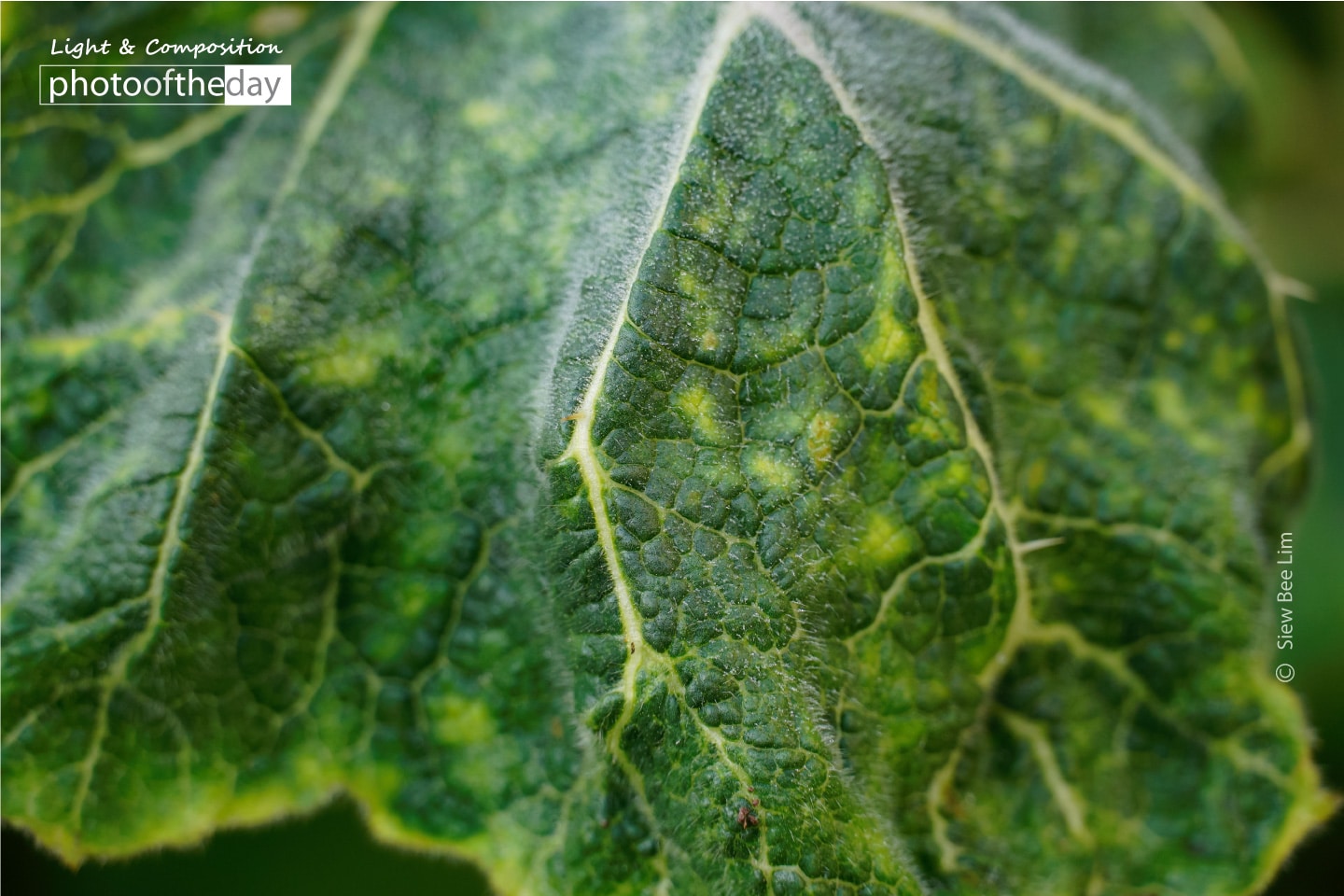
Captured in February 2019, this striking close-up of a Solanum undatum leaf highlights the intricate structural beauty of nature. The photographer focused on the leaf’s unique topography, where the surface bends along its prominent veins rather than lying flat, accented by subtle yellowish spots. By utilizing a 135mm focal length, the image emphasizes the depth and tactile dimension of the plant's texture. This photograph is award-worthy for its masterful isolation of a common subject, transforming a simple botanical detail into a compelling study of organic form, light, and natural complexity.
Siew Bee Lim
Born in 1965 in Singapore, Siew Bee Lim is a dedicated photographer who rediscovered her passion for the craft later in life. Though she initially explored photography during her early career as a programmer, she is now committed to formalizing her skills through the Light & Composition platform. Drawing inspiration from a lifelong appreciation for Chinese painting and literature, she seeks to overcome her self-described lack of traditional artistic training by mastering the technical and creative nuances of modern digital photography.
Resonance Score Breakdown
Transparency Note: The resonance score (11.6/20) is calculated based on social engagement metrics collected before the award announcement.
Expert Photography Reviews · 5
The Architecture of Breath
We often mistake the surface of things for the whole, forgetting that every skin is merely a map of the life pulsing beneath. A leaf is not just a leaf; it is a complex system of rivers, a miniature geography of veins that carry the sun’s labor into the dark, quiet earth.
Read the reflection →The Architecture of Small Things
I remember sitting on a rusted bench in a botanical garden in Kyoto, watching an elderly man spend nearly an hour examining a single patch of moss.
Read the reflection →Reviews & Comments
Share your thoughts about this award-winning photograph. Your reviews contribute to the community engagement score.
One suspects Siew Bee Lim didn’t just stumble upon this Solanum undatum. It’s easy to snap a leaf, but capturing that specific, stubborn topography requires a stillness most lack. I’ve spent enough hours shivering in damp undergrowth to recognize the patience here. The way the light catches those yellowed imperfections suggests a photographer who waited for the wind to die down. It’s a quiet, earned study. I find myself wanting to touch the veins. Well done.
It’s a relief to see a leaf that isn’t trying to be a clinical specimen. By pulling the focus, Lim forces us to confront the topography of the Solanum undatum rather than its taxonomy. I’m genuinely moved by how the soft, yellowish decay bleeds into the blur; it’s closer to a painterly abstraction than standard botanical documentation. Why resolve the veins when the texture itself tells the story? It’s a brave, quiet rejection of sharpness.
The light catches those veins like the structural ribs of a gothic cathedral, turning a simple leaf into a landscape. I’m struck by how the topography mimics the human skin, mapping age and resilience in every yellowed spot. It’s not just botany; it’s a portrait of endurance. When I look at these curves, I don’t see a plant—I see the quiet, weathered face of someone who has lived through everything, captured in the architecture of nature.
Looking at these veins, I’m reminded of how we design structural grids to distribute load. The leaf’s topography mimics a vaulted ceiling, where the central rib acts as a primary datum. It’s a study in tension and compression, really. I find myself wanting to trace those yellowish spots, feeling the surface’s resistance. It’s rare to see organic form capture the logic of a building so perfectly. It’s a beautiful, quiet piece of engineering.
Most macro work is just technical vanity, but this leaf demands a second look. I’ve seen thousands of botanical studies, yet the way Lim captures the tension in those veins—the way the surface refuses to lie flat—is what keeps me staring. It’s not just a record of a plant; it’s a topographical map of survival. Honestly, it makes me want to reach out and touch the frame. That’s why it’ll still matter in thirty years.