Colosseo by Antonio Biagiotti
Captured at night, this striking image of the Colosseum highlights the photographer's fascination with repeated geometric forms. By utilizing long-exposure techniques, the photographer allows the monument's artificial lighting to carve out dramatic contrasts, where light and shadow chase one another across the ancient stone. This deliberate choice emphasizes the architectural grandeur of the structure, transforming a familiar landmark into a decisive, evocative composition. The image stands as a testament to the Colosseum's enduring power as a creative source, demonstrating how technical precision and a keen eye for geometry can elevate architectural photography into a compelling, award-worthy narrative.
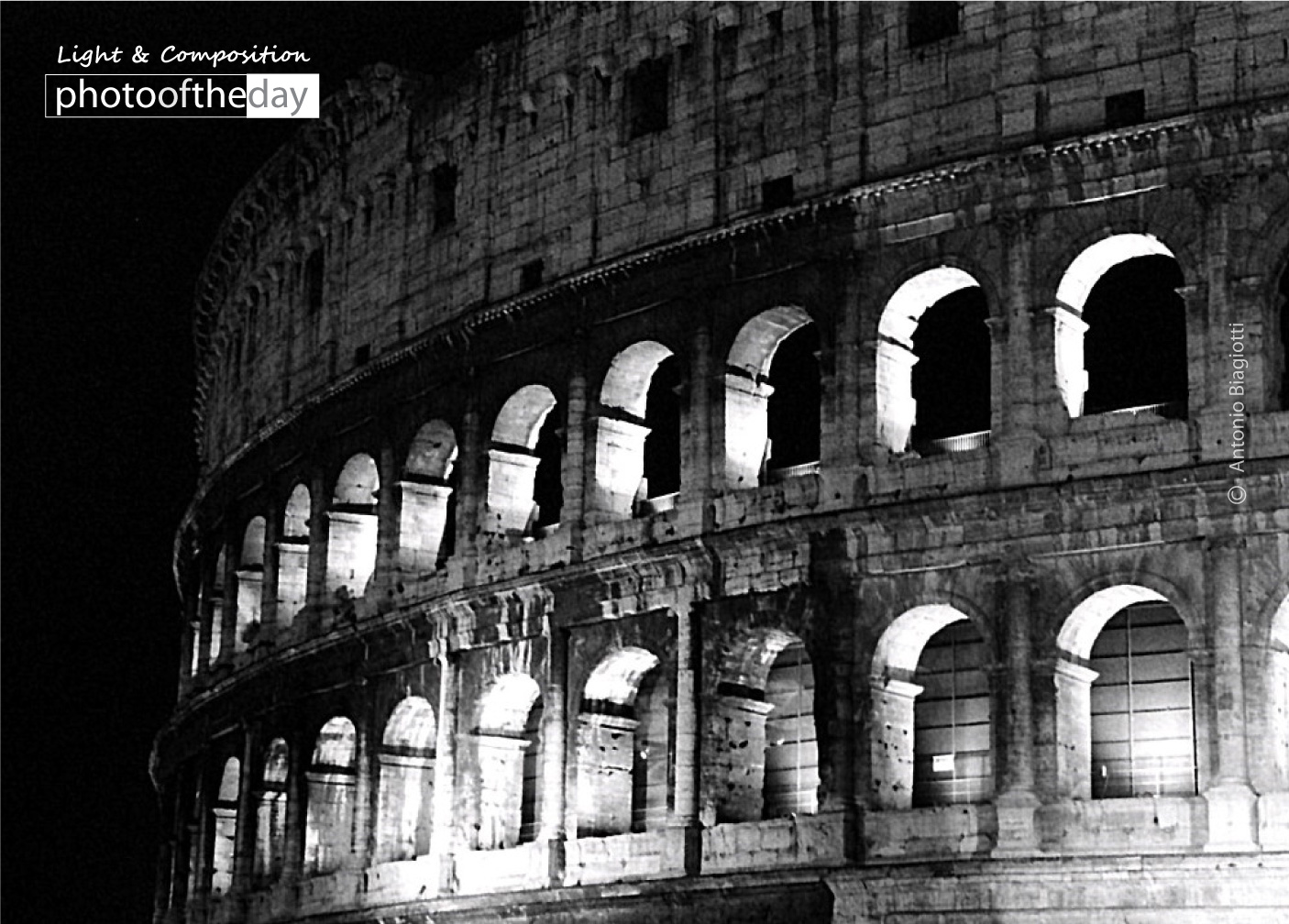
Exposure 8 Minutes @ f/64 | ISO 100 | Focal Length 240mm
Antonio Biagiotti
Born in 1971 in Porretta Terme, Italy, Antonio Biagiotti resides and works within the scenic landscape of the Appennino Tosco-Emiliano. A dedicated practitioner of traditional methods, he specializes in large and medium format black-and-white photography, personally overseeing the development and printing process in his own darkroom. His work is defined by a deep commitment to the technical nuances of shutter speed, framing, and aperture, often utilizing classic equipment like the Pentax K1000 to explore the interplay of light and form.
Resonance Score Breakdown
Transparency Note: The resonance score (11.4/20) is calculated based on social engagement metrics collected before the award announcement.
Expert Photography Reviews · 8
The Grit of History
The smell of damp limestone always brings me back to the cellar of my childhood home, where the walls were cold enough to make your palms ache if you pressed them too hard.
Read the reflection →The Weight of Stone
Time does not pass in a straight line. It circles. We build monuments to convince ourselves that we are permanent, carving our names into rock, stacking heavy blocks against the sky.
Read the reflection →Reviews & Comments
Share your thoughts about this award-winning photograph. Your reviews contribute to the community engagement score.
Eight minutes at f/64 is a suffocatingly safe choice. While the geometry is undeniably clean, it’s a sterile, predictable exercise in technical perfection. I’d hoped for more than just a sharp postcard. Why resolve every stone when the night air could have been a canvas for light’s decay? It’s technically flawless, sure, but it lacks the visceral, haunting blur I crave. It’s just too polite. Where’s the risk? I’m bored by such rigid clarity.
Of the thousands of architectural submissions I’ve reviewed, most fail the thirty-year test by relying on tired angles. Biagiotti avoids this by committing to an eight-minute exposure that turns the Colosseum into a ghost of itself. It’s the f/64 precision that makes the stone feel heavy, almost tactile. I’ll admit, the way the artificial light bleeds into the shadows actually gave me chills. It’s a rare, haunting permanence that makes this work worth keeping.
It’s technically flawless, sure, but where’s the pulse? I’ve spent my life chasing the flicker of humanity in a stranger’s gaze, yet here, the Colosseum feels like a cold, empty stage. It’s a beautiful monument, but it’s silent. I find myself longing for a single person to break that rigid geometry, to give this stone a heartbeat. Without a soul to anchor it, it’s just architecture. It doesn’t tell me a thing about being alive.
Eight minutes of exposure turns the Colosseum into a ghost of stone. It’s a long, slow pan that never happens. The light doesn’t just hit the arches; it pools inside them like liquid. I’ve stared at this monument a thousand times, but here, the stillness feels heavy, almost suffocating. Biagiotti caught the exact moment the city stopped breathing. The cut would’ve been a mistake. It’s the frame the editor keeps because it’s already finished.
Stopping down to f/64 on a 240mm Rodenstock pushes the diffraction limit, yet Biagiotti’s choice yields a staggering depth of field. It’s a calculated risk; the light doesn’t just hit the stone, it clings to every porous crevice. I’m genuinely breathless at how the long exposure renders the artificial glow as a soft, tactile presence. It’s rare to see such clinical optical discipline transform ancient, weathered travertine into something so hauntingly, physically alive.
Eight minutes at f/64 in the Roman night. One doesn’t simply stumble upon that sort of stillness; one endures the damp cobblestones and the tourists’ inevitable intrusions until the city finally holds its breath. It’s a cold, calculated gamble that paid off. I’ve spent enough nights shivering under a dark cloth to know when someone’s truly committed. Biagiotti didn’t just snap a landmark; he waited until the stone itself decided to cooperate. Respect.
We look at this stone giant and we don’t just see architecture; we see a thousand years of whispers trapped in the masonry. Antonio waited eight minutes for the light to settle, listening to the silence of Rome. It’s a portrait of a ghost, really. I feel a strange, heavy ache in my chest looking at those hollow arches. It’s a photograph that asks to be returned to, because it’s finally heard what the ruins have to say.
Looking at this Colosseum, I’m struck by the absence of the medium I know best. There’s no light absorption here, no orange hues vanishing into the abyss, and no backscatter to ruin the sharp geometry of those arches. It’s unnervingly clear. I’m used to fighting the refractive index of water just to see a subject, but here, the light stays true. It’s a strange, dry precision that makes me crave the beautiful, chaotic struggle of the deep.