The Ancient Symbol of Mother Earth by Kirsten Bruening
Captured on a sun-drenched Sunday afternoon in a botanical garden, this photograph immortalizes a turtle stretching its head toward the warmth of the light. The photographer was struck by the profound stillness of this ancient creature, a symbol of Mother Earth that has endured for 220 million years. By focusing on the turtle’s quiet interaction with its environment, the image captures a moment of serene connection between human observer and wildlife. Its award-worthy quality lies in the delicate balance of light and the evocative, peaceful narrative that transforms a simple garden encounter into a timeless reflection on nature's enduring power.
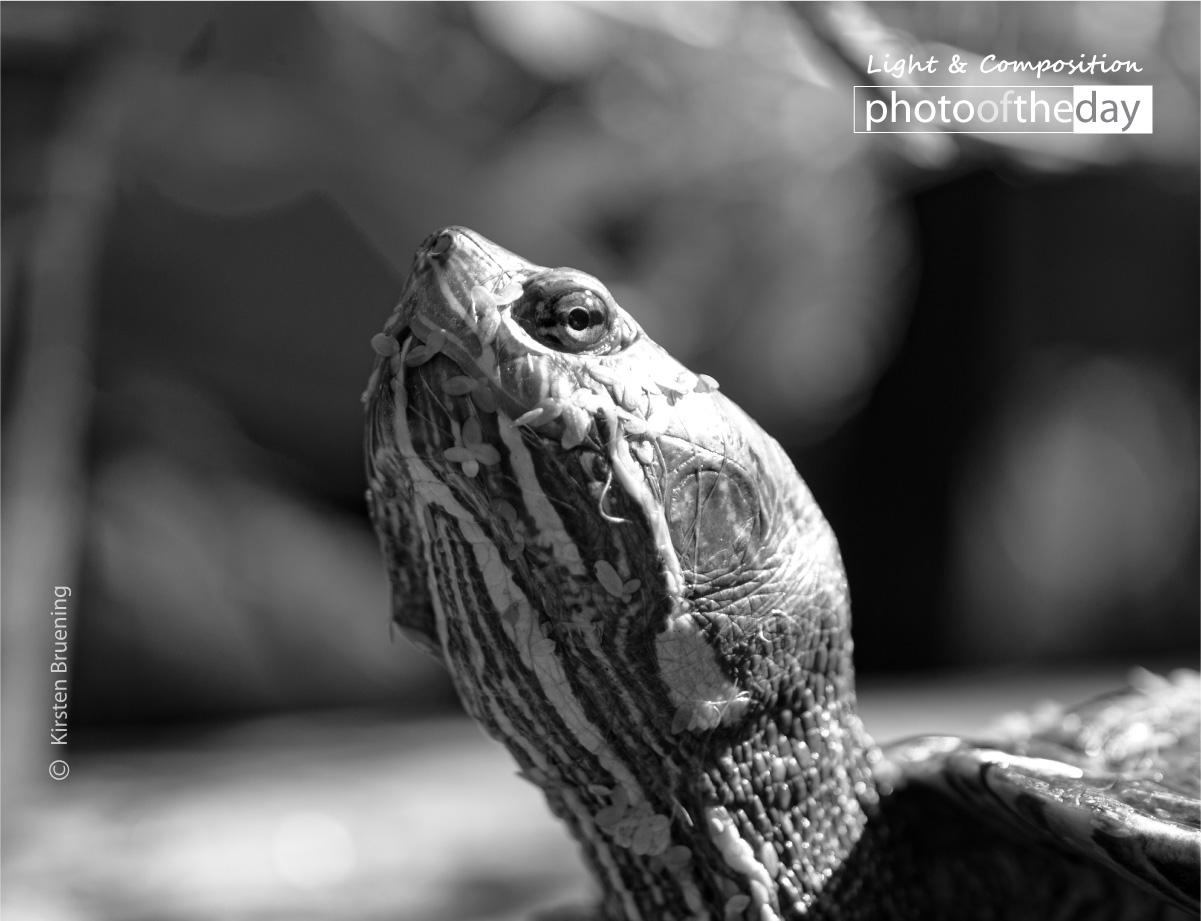
Exposure 1/320sec @ f/2.8 | ISO 100 | Focal Length 50mm
Kirsten Bruening
Based near Cologne, Germany, Kirsten Bruening is a dedicated photographer whose creative journey began in childhood with the tactile exploration of analogue film. After a fifteen-year hiatus, she returned to the craft with a renewed focus on nature, portraiture, and wildlife, often favoring the expressive depth of black and white imagery. Driven by a belief that light and shadow best convey the nuances of human emotion and natural beauty, she is currently pursuing formal studies to further refine her technical expertise and artistic vision.
Resonance Score Breakdown
Transparency Note: The resonance score (11.3/20) is calculated based on social engagement metrics collected before the award announcement.
Expert Photography Reviews · 8
The Weight of Time
I once spent an afternoon in a small park in Kyoto, watching an old man feed a koi that seemed as wide as a dinner plate. He told me the fish had been in that pond since his grandfather’s time, surviving wars, droughts, and the slow creep of the city around them.
Read the reflection →The Weight of Slow Time
There is a specific quality to the light on a mid-July afternoon, when the sun hangs heavy and thick, turning the air into a golden syrup that seems to slow the very movement of the earth.
Read the reflection →Reviews & Comments
Share your thoughts about this award-winning photograph. Your reviews contribute to the community engagement score.
It’s refreshing to see a turtle in its terrestrial element, free from the refractive index distortions I battle daily. Without water’s aggressive light absorption, the warm, golden tones here are pure, unforced. I’ve spent so many hours fighting backscatter and color loss that this clarity feels almost surreal. Seeing this ancient creature bask in unfiltered sunlight makes me ache for the surface. It’s a beautiful, quiet reminder of the resilience these animals carry across every boundary.
You waited for that turtle to find its peace, didn’t you? It’s a quiet moment, but I can feel the weight of those millions of years in its neck. Most people would’ve rushed the shot, but you let the sun do the heavy lifting. And honestly, looking at that stillness, I felt my own shoulders drop. You didn’t just photograph a reptile; you caught a breath of time. There’s something truly honest happening here. Good work.
At f/2.8, the Nikon’s focal plane is razor-thin, isolating the turtle’s textured dermis with clinical precision. I’m genuinely moved by how the lens resolves the keratin scales against the soft, creamy bokeh of the botanical garden. It’s a masterclass in light transmission; the diffraction across those ancient, sun-drenched surfaces reveals a tactile depth the naked eye simply misses. You’ve captured the physics of stillness perfectly. It’s rare to see such optical honesty in wildlife portraiture.
Sunlight hits that shell and I’m transported. It’s a quiet, ancient geometry. Most people walk past, but Kirsten caught the neck extended—that precise, fragile reach for warmth. If she’d waited a heartbeat longer, the turtle would’ve retracted, the tension lost. It’s not a city street, but the instinct is the same. I feel a genuine, sudden calm looking at this. She didn’t blink. She caught the exact fraction of a second where time actually stopped.
Sunlight hits the shell. The turtle stretches. It’s a slow, deliberate reach toward the warmth. I feel a sudden, sharp ache for that stillness in my own life. The frame isn’t crowded. There’s enough room for the creature to simply exist. The background recedes. It doesn’t demand attention. Nothing here is accidental. The empty corner is not empty. It’s a breath held in the garden. I’ve found peace in this pause.
The dappled light filtering through the botanical foliage creates a soft, rhythmic texture that feels almost like a Renaissance fresco. It’s here, amidst the mossy, textured earth, that the turtle finds its stage. I’m genuinely moved by how the environment anchors this creature in geological time. The shell’s rugged geometry echoes the garden’s organic chaos, grounding the subject. It’s not just a turtle; it’s a living relic, perfectly framed by the quiet, sun-warmed permanence of the soil.
Technically, it’s a perfectly competent wildlife shot, but that’s exactly why I find it stifling. Why resolve the turtle’s shell with such clinical, boring precision? I’d have preferred a long exposure to dissolve that ancient form into the light, echoing Sugimoto’s ethereal stillness. By choosing total clarity, Bruening misses the chance to make the creature feel as timeless as she claims. It’s a missed opportunity to turn a garden encounter into something truly haunting.
The turtle’s neck forms a perfect vector, bisecting the frame along a diagonal that anchors the composition. It’s a precise 1:2 ratio of shell mass to negative space, creating a satisfying visual tension. I’m genuinely moved by how the light maps the creature’s texture against the blurred geometry of the garden. It’s a solved equation of stillness. By aligning the head with the upper-right quadrant, Bruening turns a simple wildlife encounter into a rigorous, balanced spatial proof.