Secrets of Nature by Kirsten Bruening
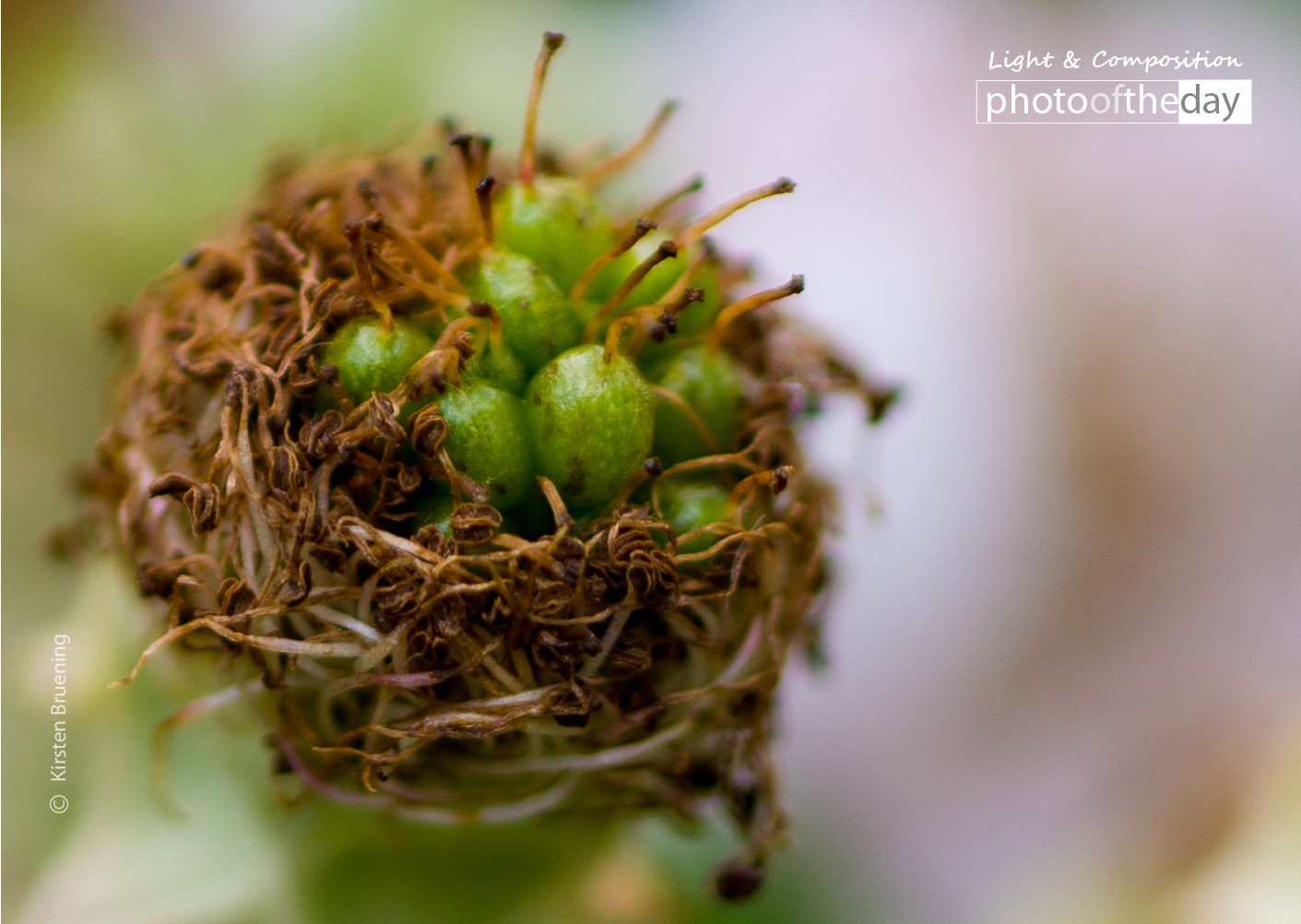
Captured during a quiet afternoon walk, this close-up study of a wild blackberry highlights the fruit in its early ripening stage, where the clusters resemble delicate, miniature grapes nestled within a natural frame. The photographer focused on the intricate textures and structural beauty of the plant, drawing attention to the botanical details that often go unnoticed. By isolating the subject against a soft background, the image emphasizes the raw, organic elegance of nature. This photograph is award-worthy for its technical precision and the photographer's ability to transform a simple, fleeting moment in the wild into a compelling, high-clarity visual narrative.
Kirsten Bruening
Based near Cologne, Germany, Kirsten Bruening is a dedicated photographer whose creative journey began in childhood with the exploration of analogue techniques. Following a fifteen-year hiatus, she returned to the medium with a renewed focus on nature, portraiture, and wildlife, often favoring the timeless aesthetic of black and white imagery. Driven by a belief that light and shadow best convey the depth of human emotion and natural beauty, she is currently pursuing formal studies to further refine her technical expertise and artistic vision.
Resonance Score Breakdown
Transparency Note: The resonance score (11.5/20) is calculated based on social engagement metrics collected before the award announcement.
Expert Photography Reviews · 8
The Quiet Geometry of Growth
I often find myself wandering the outskirts of the city, where the pavement begins to fray and the wild, unkempt edges of the world reclaim the space between the concrete.
Read the reflection →The Weight of Unripeness
There is a specific ache in the half-formed. I remember the green tomatoes left on the vine when the first frost arrived, hard as river stones and just as cold. They were promises that the season had no intention of keeping.
Read the reflection →Reviews & Comments
Share your thoughts about this award-winning photograph. Your reviews contribute to the community engagement score.
Why do we insist on sanitizing the wild? Bruening isolates this blackberry, stripping away the tangled, chaotic thicket that actually defines its existence. It’s technically sharp, sure, but it feels like a specimen pinned to a board. Does this clinical gaze respect the plant, or does it just demand nature perform for our aesthetic comfort? I find the sterility here unsettling. Whose desire for order are we satisfying by erasing the thorns and the dirt?
Karl Blossfeldt’s rigorous botanical typologies haunt this frame, yet Bruening’s blackberry lacks his clinical detachment. At f/2.8, the depth of field is dangerously thin, echoing the soft focus of early pictorialist studies rather than modern macro precision. I’m genuinely charmed by the way she captures the fruit’s nascent, waxy sheen; it’s a quiet, tactile intimacy. It doesn’t reinvent the genre, but it’s a lovely, honest conversation with the tradition of nature as a structural curiosity.
There’s a quiet precision here, but I find myself searching for a pulse. I’ve spent my life looking for the flicker of a soul in a subject’s eyes, and while these blackberries are technically sharp, they don’t invite me in. It’s a beautiful study of texture, sure, but it’s a cold exchange. I don’t feel the life of the plant; I just feel the lens. It’s a capture, not a conversation. I’m left wanting more.
It’s refreshing to see such crisp focus without fighting the refractive index of water. Down here, that blackberry’s deep reds would’ve vanished into a muddy grey within five metres, and those delicate textures would be lost to backscatter if I’d fired a strobe at the wrong angle. I’m genuinely envious of how easily she captured that light. It’s a clean, sharp study that doesn’t need to battle the ocean’s relentless, light-stealing physics to exist.
Nature doesn’t wait for the shutter, but it doesn’t move like a crowd in Cologne either. I’m looking at these blackberries and I’m torn. It’s technically sharp, sure. But where’s the friction? Winogrand would’ve waited for a hand to reach in, for the chaos of the street to collide with the fruit. It’s pretty, but it’s static. One tenth of a second later and nothing changes. I need the pulse of the city, not just a garden.
At f/2.8, the focal plane is razor-thin, isolating the blackberry’s drupelets with clinical precision. You can see the light refracting through the translucent skin, revealing cellular structures the naked eye misses. It’s a gorgeous display of bokeh as a function of aperture, turning the background into a soft, chromatic wash. I’m genuinely moved by how the lens resolves those tiny, glistening hairs; it’s a rare, intimate look at nature’s architecture that feels almost microscopic.
A quiet afternoon walk, the curator says. It shows. The focus is sharp enough, but it’s a photograph of convenience, not commitment. One suspects the blackberry didn’t demand much of the photographer’s time. I’ve spent weeks shivering in hedgerows for less, and frankly, I find the lack of struggle here rather disappointing. It’s technically competent, certainly, but it hasn’t been earned. It’s just a pretty berry, plucked without the necessary toll of patience.
You stopped for a blackberry. Most people walk right past that, but you saw the quiet geometry in those ripening drupelets. It’s technically sharp, sure, but that’s not why I’m looking. I’ve spent years in the dirt, and there’s a stillness here that reminds me of the woods behind my childhood home. You waited for the light to hit just right. And it’s honest. You didn’t force the nature; you just let it be.