Looking for Livelihood by Sammam Junaid
Captured in the village of Tushkhali, this poignant image documents the harsh reality of child labor in Bangladesh. Through the lens of a Canon EOS 6D, the photographer frames a young boy whose childhood has been traded for the demands of survival. The composition highlights the heavy burden placed upon the youth, serving as a visual critique of the socioeconomic conditions that prioritize immediate income over education. This photograph is award-worthy for its raw, empathetic storytelling, which transforms a local struggle into a universal call for awareness regarding the welfare and future of children.
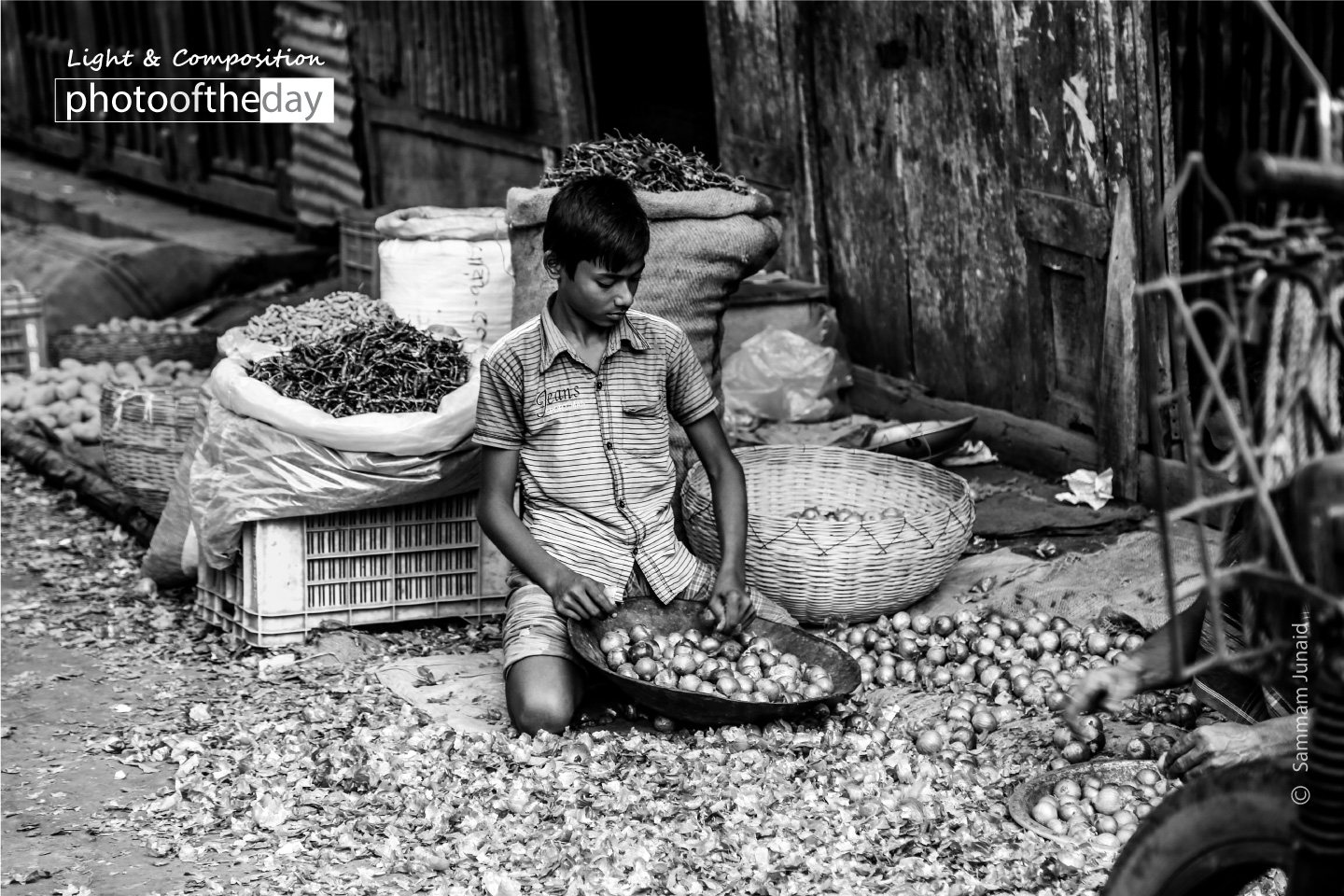
Exposure 1/80sec @ f/4.5 | ISO 125 | Focal Length 93mm
Sammam Junaid
Born in Bangladesh in 2003, Sammam Junaid is a self-taught photographer currently residing in Dhaka. While pursuing his studies at Notre Dame College, he channels his deep curiosity for the natural world and human condition into evocative imagery. Though he lacks formal academic training in photography, his active participation in various photography groups has honed his ability to capture the authentic beauty and struggles of his homeland, establishing him as a dedicated observer of contemporary Bangladeshi life.
Resonance Score Breakdown
Transparency Note: The resonance score (9.9/20) is calculated based on social engagement metrics collected before the award announcement.
Expert Photography Reviews · 7
The Weight of Morning
There is a quiet rhythm to the way the world asks us to carry its burdens. Often, we move through our days without noticing the small, heavy things that others hold.
Read the reflection →The Weight of Salt and Dust
There is a specific grit that settles into the creases of the palms when you have spent the morning hauling things that are heavier than your own bones.
Read the reflection →Reviews & Comments
Share your thoughts about this award-winning photograph. Your reviews contribute to the community engagement score.
Before the eye identifies the boy, something in the chest tightens. It’s the weight of the load he carries, a pressure that migrates into my own shoulders. I’ve returned to this frame for months, and the stillness of his gaze still triggers a sharp, quiet ache. It doesn’t just document labor; it forces a physiological recognition of stolen time. I find myself holding my breath, waiting for him to finally set that burden down.
The boy’s gaze pulls me in, yet I’m unsettled by the framing. Why does the composition aestheticize his exhaustion? By turning a child’s survival into a high-contrast study of light and shadow, we risk consuming his struggle as mere texture. Does this lens bridge the distance between us, or does it widen the gap? I find myself looking away, feeling like an intruder in his labor. Is this empathy, or just a beautiful tragedy?
The boy sits. The frame is vast, heavy with gray light. He doesn’t look at us. He looks at the work. The space around him is not empty; it’s a weight. It’s the silence of a childhood traded for a wage. I’ve looked at this for an hour. It’s quiet, yet it screams. Nothing here is accidental. The empty corner is not empty. It’s the absence of a school desk. It’s a cold, hard truth.
The weight on that boy’s shoulders is heavy, but it’s the timing that hits me. Junaid caught him mid-stride, eyes locked forward, ignoring the lens entirely. That’s the street. If he’d clicked a fraction later, the tension would’ve leaked out of the frame. It’s raw, honest, and it hurts to look at. Winogrand would’ve loved the grit here. You didn’t hesitate, and because of that, the moment stays alive. It’s a gut punch. Well done.
Lewis Hine’s industrial portraits of child laborers echo here, yet Junaid’s framing feels distinct. The 93mm compression flattens the Tushkhali landscape, trapping the boy in a claustrophobic, monochromatic struggle that feels almost sculptural. It’s a heavy, somber weight I haven’t felt in years. While the tonal range lacks the deep, velvety blacks of a classic silver gelatin print, the composition’s tension is undeniable. It’s a haunting, necessary addition to the long, painful lineage of documenting the forgotten.
The frame relies on a rigid vertical axis, bisected by the boy’s posture against the textured backdrop. It’s a study in unbalanced weight; the heavy load he carries creates a downward vector that pulls the eye toward the bottom-left quadrant. I’m struck by how the diagonal lines of the structure intersect with his weary frame, solving a complex spatial equation of burden. It’s mathematically precise, yet that slight tilt of his head breaks the geometry, haunting me.
Stripped of pigment, the monochrome palette here doesn’t mourn, but rather hums with the silver-grey silence of a Morandi still life, where the boy’s skin tone against the textured, charcoal-dusted background creates a tension so profound it’s almost unbearable. I’ve found myself breathless, tracing the way the light clings to his weary shoulders like damp linen; it’s a chiaroscuro of survival, where the absence of colour forces one to confront the raw, aching weight of his existence.