An Aimless Life by Park Se Jin
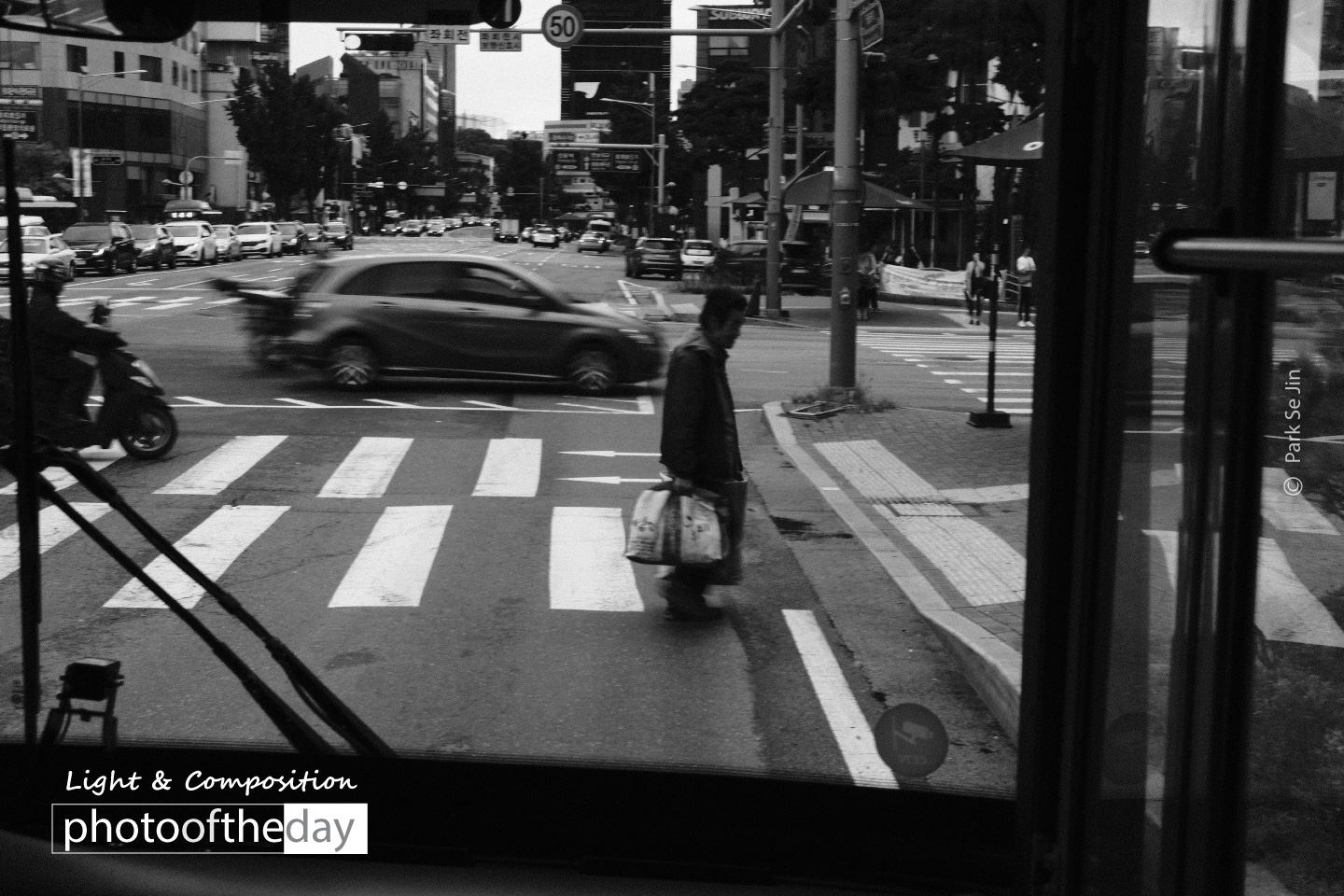
Captured through a bus window, this poignant street portrait depicts a man whose weary expression suggests a profound sense of detachment from the world. The photographer, initially hesitant to intrude upon such a vulnerable moment, ultimately chose to document the scene, balancing the desire for candid storytelling with a deep respect for the subject's privacy. The resulting image is a masterclass in observational photography, where the muted atmosphere and the subject's stillness create a powerful narrative of urban isolation. It is this raw, unscripted emotional honesty that makes the photograph a compelling and award-worthy piece of street photography.
Park Se Jin
Born and based in Seoul, Park Se Jin is a dedicated street photographer who finds beauty in the spontaneous rhythms of daily life. Rather than meticulously planning his shoots, he embraces the unpredictability of the streets, often prioritizing the experience of witnessing a moment over the act of capturing it. Currently, Park is expanding his creative horizons with a new ambition to traverse South Korea by motorcycle, aiming to document the diverse landscapes and human stories found far beyond the familiar streets of his home city.
Resonance Score Breakdown
Transparency Note: The resonance score (10.3/20) is calculated based on social engagement metrics collected before the award announcement.
Expert Photography Reviews · 6
The Weight of Stillness
The smell of cold glass against a forehead is a specific kind of loneliness. It is the scent of damp wool and the metallic tang of a city that has forgotten your name.
Read the reflection →The Drift of Stillness
In the deep winter, the pond turtle settles into the silt at the bottom of the water, entering a state of dormancy where its metabolism slows to a near-halt. It does not fight the cold; it simply waits, suspended in the dark, becoming part of the riverbed itself.
Read the reflection →Reviews & Comments
Share your thoughts about this award-winning photograph. Your reviews contribute to the community engagement score.
The condensation on the glass creates a hazy, impressionistic veil, blurring the urban sprawl into a muted, melancholic grey. It’s a cold, detached frame that isolates the man within his own private exile. I find myself shivering slightly at the sheer loneliness of that bus seat. The environment isn’t just a backdrop; it’s the physical manifestation of his solitude, pressing against him until his weary face becomes merely another object lost in the city’s indifferent transit.
Peering through that bus window, I can’t help but feel a pang of discomfort. There’s a heavy, tired resignation in his eyes, but he’s clearly unaware he’s being watched. It’s a clean composition, sure, but it’s a theft. We’re looking at his exhaustion without his permission. I’ve spent years earning the right to look at a face like that, and this just doesn’t feel like a gift. It’s a lonely, beautiful, stolen moment.
The frame is bisected by a rigid vertical mullion, creating a 1:2 ratio that forces the subject into the negative quadrant. This off-center placement creates a heavy visual gravity, pulling the eye toward the glass’s distorted edge. It’s a brilliant spatial equation where the man’s weary posture mirrors the bus window’s tilt. I’m genuinely struck by how the geometry traps his isolation; the math doesn’t just contain him, it defines the very weight of his solitude.
The glass separates us. A gray blur of Seoul passes by, yet he remains fixed. It’s a heavy stillness. I’ve felt that same weight on a crowded train, wanting to vanish into the seat. The frame doesn’t crowd him. It gives him room to breathe, to be alone. Nothing here is accidental. The empty corner is not empty. It’s the silence he carries. I find myself holding my breath, just watching him exist.
Shooting through glass creates a barrier, yet it doesn’t absolve the photographer of the intrusion. I’ve spent weeks in a blind, motionless, just to avoid altering a creature’s path; here, the subject is trapped in a public transit cage, unaware he’s being harvested for a narrative. It’s a cold extraction. I find the voyeurism here deeply uncomfortable. If you can’t engage your subject with transparency, you haven’t earned the right to their vulnerability.
The glass of the bus window acts as a veil, softening the world into a muted, gray meditation. He’s caught in that flat, directionless light of a heavy afternoon, where time seems to pool around his shoulders. I’ve felt that same heavy stillness, waiting for the land to exhale. It’s a quiet, aching solitude. Looking at his weary face, I find myself wanting to offer him a seat, or perhaps just a moment of true, unhurried rest.