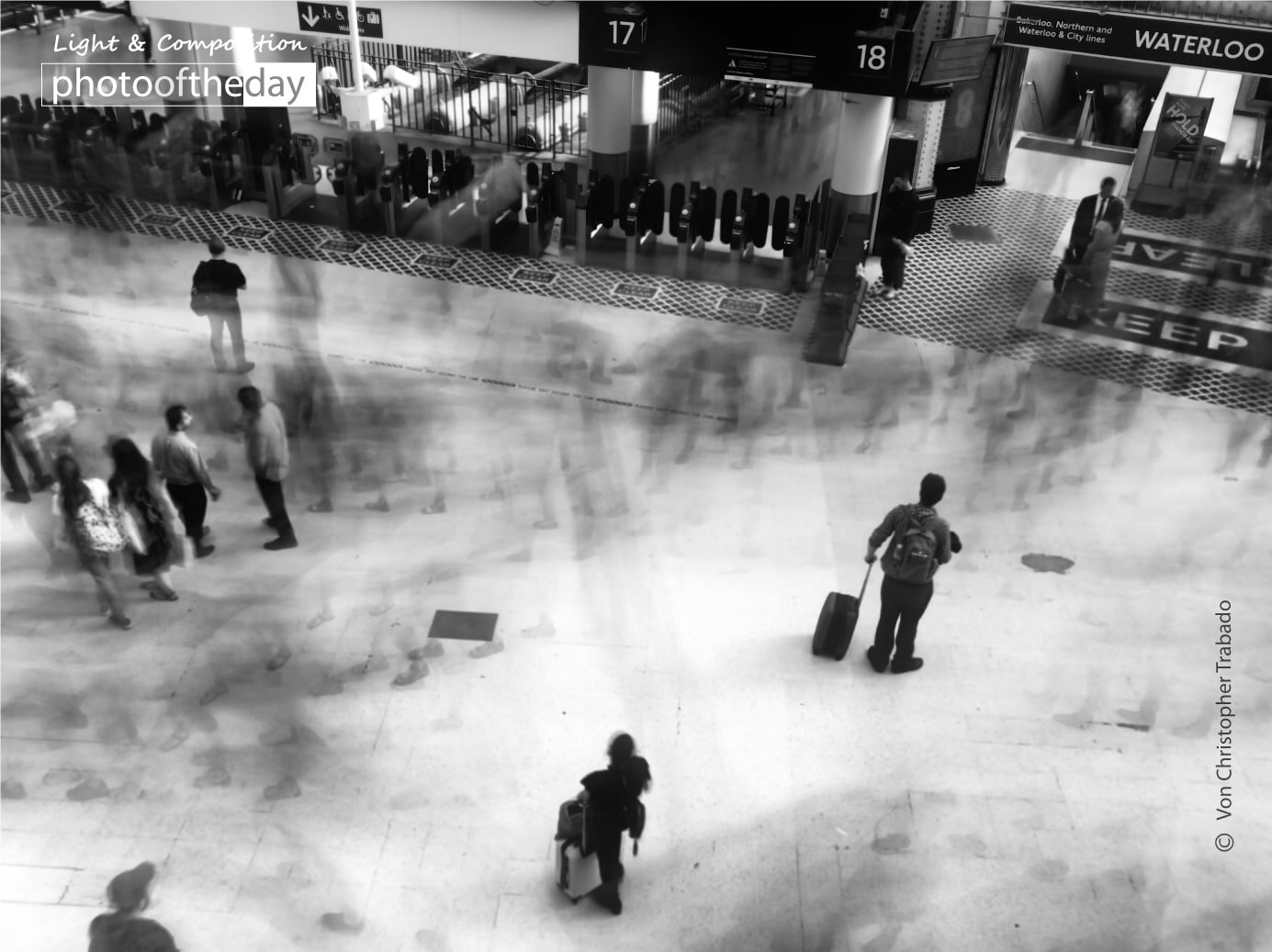
The Rush Hour by Von Christopher Trabado
Captured amidst the kinetic energy of London’s Waterloo East station, this experimental long-exposure photograph masterfully contrasts the stillness of individual subjects against the blurred, rhythmic motion of the commuting crowd. By utilizing a deliberate exposure technique, the photographer isolates specific figures, freezing their presence within a sea of bustling passengers. This image is award-worthy for its sophisticated balance of chaos and calm, demonstrating a keen eye for finding stillness in the heart of urban transit. The composition transforms a mundane daily routine into a compelling visual narrative, highlighting the photographer's ability to elevate everyday street scenes into evocative, artistic statements.
Von Christopher Trabado
Based in London, Von Christopher Trabado is a dedicated self-taught photographer with a primary focus on street, landscape, and architectural photography. Viewing the medium as both a creative outlet and a vital stress-reliever, he consistently explores the urban environment to document the overlooked details of daily life. His work is characterized by an enthusiastic pursuit of discovery, as he traverses London and its surrounding areas to capture the quiet, often ignored narratives hidden within the bustling city landscape.
Resonance Score Breakdown
Transparency Note: The resonance score (11.1/20) is calculated based on social engagement metrics collected before the award announcement.
Expert Photography Reviews · 6
The Ghost of the Commute
There is a specific silence that lives in the middle of a crowd. It is not the absence of noise, but the absence of connection. I remember the way my father used to stand on the train platform, his coat buttoned to the chin, eyes fixed on a point just past the tracks.
Read the reflection →The Weight of Passing
We are taught to fear the blur. We want the edges of our lives to be sharp, defined, permanent. We build walls and name streets, hoping to anchor ourselves against the inevitable drift.
Read the reflection →Reviews & Comments
Share your thoughts about this award-winning photograph. Your reviews contribute to the community engagement score.
Watching the commuters blur through Waterloo, I’m struck by how much easier it is to capture humans than the skittish creatures I usually track. There’s no risk of flushing a subject here, no need to hide in a blind for hours. It’s technically clean, but it feels hollow. I’d trade this entire kinetic display for one honest, unforced moment with a badger in the dark. It’s clever, sure, but it’s just too easy.
Waterloo’s rush isn’t just movement; it’s a river of ghosts. Von Christopher Trabado waited for the light to catch a single soul, anchoring them against the blurred tide of commuters. It’s a quiet miracle, really. I’ve spent enough hours in stations to know the loneliness of such crowds. He didn’t just capture motion; he listened to the stillness hiding inside the chaos. It’s a rare, haunting grace to find such silence in the middle of London.
Waterloo’s blur is technically sharp, but it leaves me cold. These commuters are just ghosts in a machine, anonymous shapes caught in a transit trap. I don’t see a single person here; I see a photographer hunting for a visual trick rather than a human connection. It’s a clever effect, sure, but where’s the life? I’d trade all this motion for one pair of eyes that actually met the lens. It’s just not a gift.
1/100sec at f/1.8, ISO 32, 4mm. It’s a smartphone sensor pushed to its limit in low light. The shutter speed is too fast for a true long-exposure blur, yet too slow to freeze the chaos effectively. It’s a compromise that doesn’t quite resolve. I’m annoyed by the digital noise creeping into the shadows. It’s technically lazy. You can’t fake motion blur with a handheld phone and expect the physics to hold up.
The shutter speed is perfect. It’s a deliberate, rhythmic blur that turns the Waterloo crowd into a living, breathing edit. I’m struck by how the static subjects anchor the frame; they’re the only ones not rushing toward a cut that never comes. It’s a cinematic tension I’ve chased for years. Trabado knows exactly what he’s holding here. He’s caught the exact moment the chaos stops to breathe. It’s a frame the editor keeps. Truly beautiful work.
The palette here evokes a Morandi-esque melancholy, where the grey of wet London slate bleeds into the bruised, electric violet of a commuter’s coat, creating a chromatic dissonance that’s utterly intoxicating. It’s a shivering, kinetic hum of light that makes my own pulse quicken, as if the very air in Waterloo has been stained by the frantic, blurred passage of ghosts, leaving only that singular, sharp ochre of a stationary soul to anchor the frame.