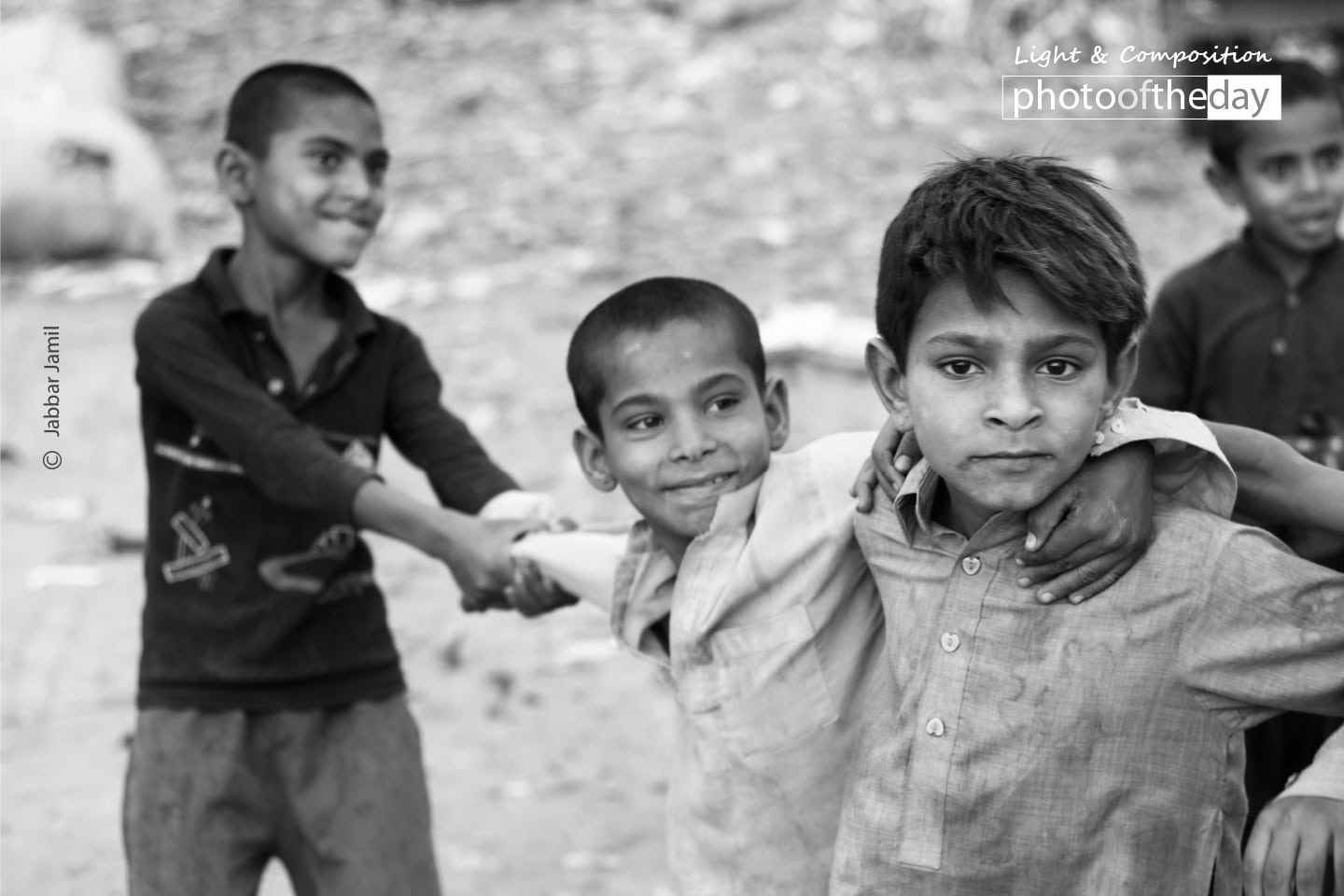
Happy Kids of Slums by Jabbar Jamil
In the vibrant streets of Sialkot, Jabbar Jamil captured a poignant moment of pure, unadulterated joy among children living in the slums. Drawn to their natural energy, the photographer stepped into their environment, allowing the children to play undisturbed as he documented their candid interactions. This image stands out for its raw emotional authenticity, transforming a fleeting encounter into a powerful narrative of resilience and happiness. By focusing on the genuine connection between the photographer and his subjects, Jamil elevates a simple street scene into an award-worthy testament to the universal language of childhood play.
Jabbar Jamil
Based in Sialkot, Pakistan, Jabbar Jamil is a dedicated street photographer who views his craft as a vital bridge to the outside world. He utilizes photography as both a creative outlet and a therapeutic practice, often venturing beyond his comfort zone to document the unfiltered realities of urban life. Through his lens, Jamil seeks to forge meaningful human connections, capturing scenes that reflect the complexities of his surroundings with honesty and artistic intent.
Resonance Score Breakdown
Transparency Note: The resonance score (11.5/20) is calculated based on social engagement metrics collected before the award announcement.
Expert Photography Reviews · 8
The Resilience of Wildflowers
In the harshest of environments, such as a scorched mountainside or a crack in a concrete sidewalk, the seeds of wildflowers often lie in a state of dormancy for years, waiting for the precise moisture and warmth to trigger their germination.
Read the reflection →The Currency of Laughter
In the quiet hours of the morning, when the house is still and the dust motes dance in the slivers of light, I often think about the things we collect.
Read the reflection →Reviews & Comments
Share your thoughts about this award-winning photograph. Your reviews contribute to the community engagement score.
“Happy Kids of Slums” makes me wince. Why does Jamil frame these children’s poverty as a backdrop for our consumption of their joy? It’s a tired trope that romanticizes precarity to make the viewer feel better about inequality. Does their laughter belong to them, or is it merely a prop for the photographer’s narrative of resilience? I’m tired of seeing marginalized lives reduced to aestheticized snapshots. Whose gaze benefits from this performance of happiness?
It’s a familiar trope, echoing the humanist street photography of Helen Levitt’s New York children, yet Jamil’s Sialkot scene lacks that rhythmic, decisive geometry. While the raw energy is palpable, I’ve seen this visual language exhausted since the mid-century. It’s technically competent, but it doesn’t push the conversation forward. I’m still waiting for a fresh perspective on poverty that avoids the trap of sentimentalizing joy. It’s a decent capture, but it’s just not new.
The light here isn’t the dramatic gold I usually chase, but a harsh, unfiltered glare that forces the children into sharp relief. They aren’t posing; they’re existing in the dust, caught in a rhythm I’ve spent years trying to find in the hills. It’s raw, and honestly, it makes my chest ache with a quiet, heavy longing. Jamil didn’t rush them. He waited until the air settled, letting their joy become the landscape itself.
The focal plane here is razor-thin, catching the grit of Sialkot’s dust suspended in the air. Jamil’s lens resolves the micro-contrast of the children’s skin against the harsh, high-noon diffraction. It’s technically demanding, yet the bokeh as a function of that wide aperture softens the slum’s chaos into a gentle, blurred hum. I’ve stared at these faces for an hour; the sheer optical clarity of their laughter actually makes my own chest ache with a quiet, sudden joy.
These kids are clearly performing for a lens, not living for themselves. I’ve spent enough time in the field to recognize when a photographer is an intruder rather than a guest. They’re looking right at him, waiting for the click. It’s a bright, energetic scene, but it lacks the quiet intimacy I crave. Honestly, it makes me feel a bit hollow. I want to see their world, not just their reaction to a stranger holding a camera.
f/4 at 1/500s, ISO 200, 35mm. A classic street setup, yet the shutter speed barely freezes the motion of the running children. It’s a gamble that almost fails. The shallow depth of field isolates the subjects, but the focus is soft on the lead child’s eyes. I’ve seen this mistake too often. It’s technically sloppy, yet the energy is undeniable. I find myself wishing for a faster shutter. It’s frustratingly close to perfection.
You didn’t just point your lens at these kids; you let them pull you into their orbit. I’ve spent enough time in places like Sialkot to know how easy it is to make poverty look like a tragedy. You chose the laughter instead. And that’s the truth of it. When I look at their faces, I don’t see a slum. I see the pure, wild energy of being alive. You waited. I can feel it.
In the dust of Sialkot, we see laughter that defies the architecture of poverty. Jabbar didn’t just point a lens; he sat in the dirt until the children forgot he was there. We look at these faces and we understand that joy isn’t a luxury, but a survival skill. It’s a beautiful, messy truth. I’ve spent hours staring at their smiles, and honestly, it makes me want to weep with the sheer weight of their light.