An Angry Boy by Jabbar Jamil
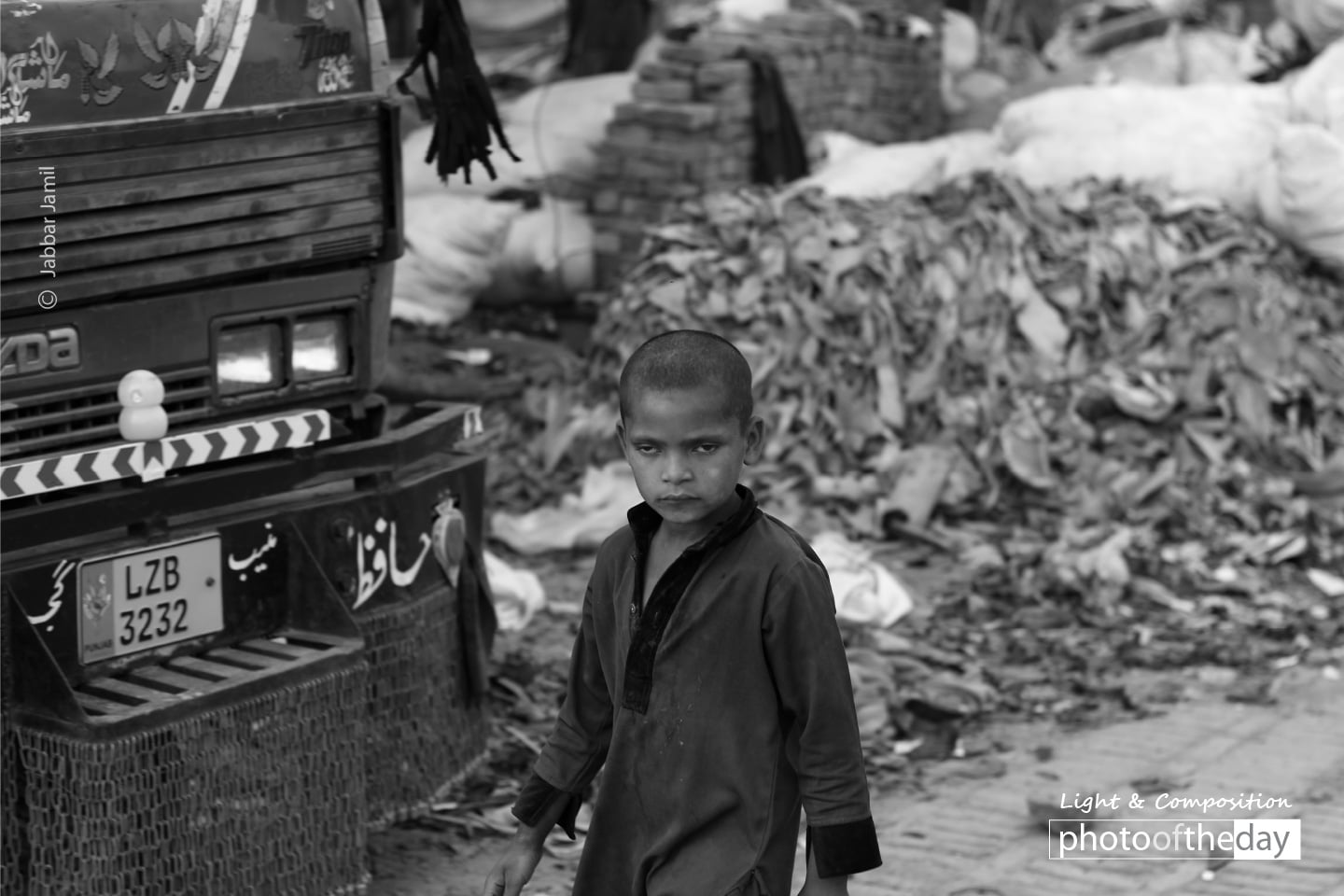
Captured on the outskirts of Sialkot, this portrait captures a young boy whose intense expression belies a gentle reality. The photographer, having sought permission to document the moment, was struck by the subject's natural demeanor during a return journey from a nearby village. This image stands out for its raw, unposed authenticity, showcasing the photographer's ability to find profound human connection in fleeting street encounters. It is an award-worthy study of character, where the interplay of light and the subject's guarded gaze invites the viewer to look beyond the surface of a seemingly angry expression to discover a quiet, everyday truth.
Jabbar Jamil
Based in Sialkot, Pakistan, Jabbar Jamil is a dedicated street photographer who views his craft as a vital bridge to the outside world. By stepping outside his comfort zone, he uses photography to forge meaningful human connections and express his creative vision. His work is characterized by a commitment to documenting the world as it truly appears, finding beauty and narrative depth in the candid, unvarnished moments of daily life.
Resonance Score Breakdown
Transparency Note: The resonance score (11.6/20) is calculated based on social engagement metrics collected before the award announcement.
Expert Photography Reviews · 7
The Weight of a Glare
I remember a boy in a dusty alleyway in Marrakech who looked at me with such fierce, unblinking intensity that I instinctively checked my pockets, wondering what I had taken from him.
Read the reflection →The Architecture of a Glance
We often mistake the furrowed brow for a storm, forgetting that the earth itself must crack before it can offer up a sprout. There is a specific, heavy silence that gathers in the corners of a face when the world has asked too much, or perhaps, when it has not yet asked enough.
Read the reflection →Reviews & Comments
Share your thoughts about this award-winning photograph. Your reviews contribute to the community engagement score.
That glare hits you like a punch. It’s raw, unfiltered, and honest. Jamil caught the boy in that exact flicker where defiance meets vulnerability. If he’d waited a heartbeat longer, the tension would’ve dissolved into a standard portrait. I’ve spent years chasing that look, and it’s rare to find it this sharp. One tenth of a second later and the shadow shifts, the frame collapses. He nailed it. It’s a gut-check of a shot.
There’s a heavy, guarded tension in this boy’s brow that makes me want to pull up a chair and just sit with him for a while. He’s not performing for the lens; he’s enduring it. You can see the distance he’s keeping, a wall built of dust and uncertainty. It’s a brave portrait. I feel a real ache in my chest looking at those eyes—they’ve seen too much for someone so young.
Most street portraits are snatched, mere accidents of timing. Yet, Jamil’s boy suggests a deeper investment. One doesn’t capture that specific, guarded intensity without lingering long enough for the subject to forget the lens exists. It’s a rare, quiet victory. I’ve spent enough afternoons shivering in the dust to recognize the patience required here. He didn’t just stumble upon this truth; he sat with it until it finally decided to look back.
Most street photography is suffocated by the obsession with clinical sharpness, but here, the motion blur in the boy’s periphery feels like a deliberate refusal to pin him down. It’s closer to the kinetic energy of a Francis Bacon study than a standard portrait. I’m genuinely struck by what Jamil chose not to resolve; the soft edges around the boy’s gaze force us to confront his intensity rather than just cataloging his features. It’s refreshingly unrefined.
The focal plane sits razor-thin across the boy’s irises, resolving the micro-contrast of his lashes with clinical precision. You can see the diffraction of light dancing in his pupils, a physical capture of a fleeting, guarded spirit. It’s breathtaking; I’ve spent hours tracing the way the lens handles those highlights. The bokeh, a function of a wide aperture, isolates his intensity beautifully. It’s not just a portrait; it’s a triumph of optics meeting raw, human truth.
The light here isn’t just illumination; it’s a heavy, dusty presence clinging to the boy’s skin. He stood in the cooling hour, perhaps as the sun dipped behind the Sialkot horizon. I feel a sudden, sharp ache in my chest looking at his guarded eyes. It’s as if he’s waiting for the world to settle. Jabbar didn’t rush this. He listened to the boy’s silence until the land itself allowed the shutter to fall.
Of the thousands of portraits I’ve reviewed, most rely on forced drama. This boy’s scowl isn’t a performance; it’s a genuine, fleeting friction between child and camera. The way the harsh Sialkot light catches his brow makes me want to reach out and smooth it away. It’s that specific, unvarnished vulnerability that ensures this will matter in thirty years. It doesn’t just capture a face; it preserves the exact weight of a moment that could’ve easily vanished.