A Photographer by Jabbar Jamil
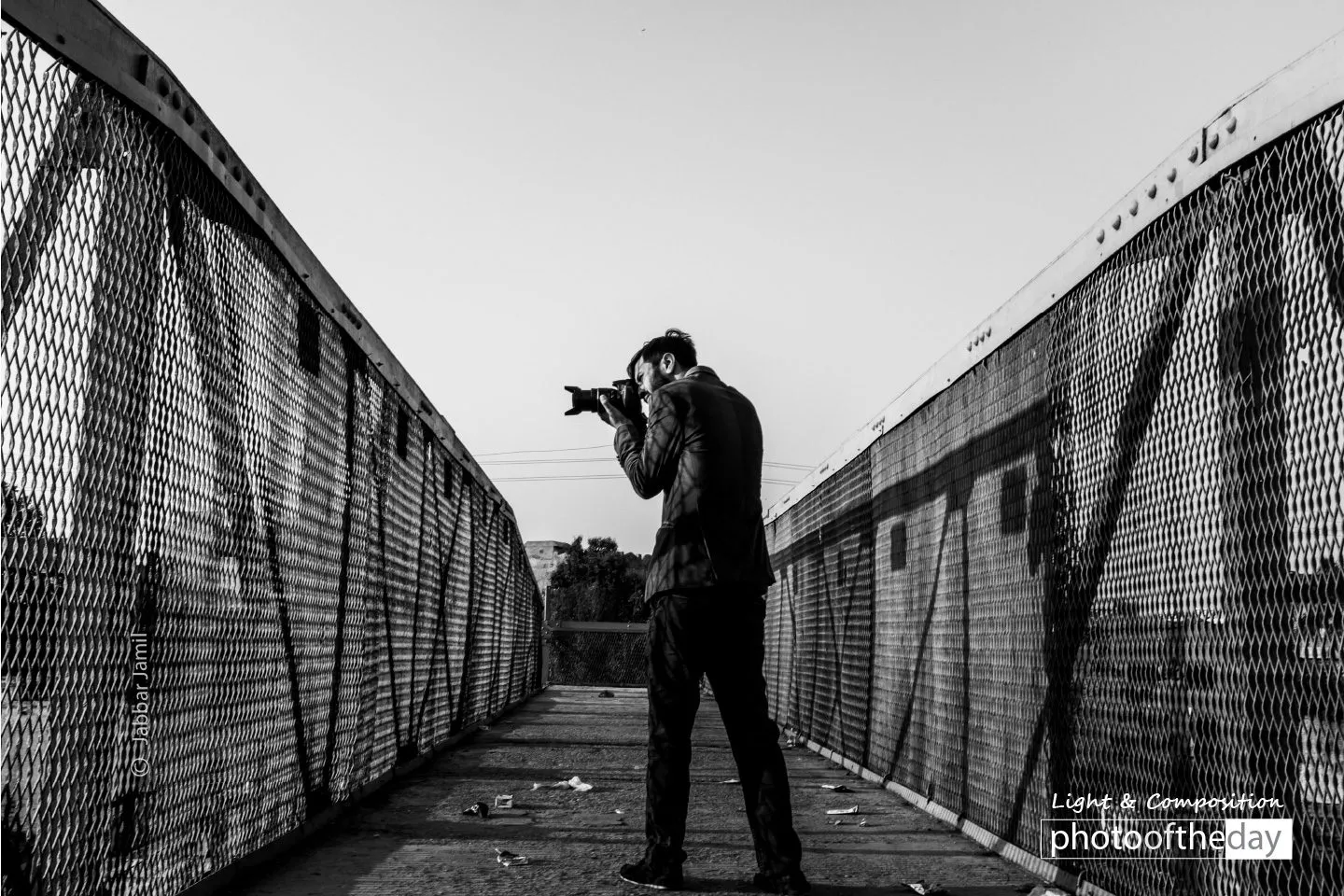
In this candid portrait, the photographer captures a fellow artist, Hammad, immersed in the act of creation. By choosing a black-and-white aesthetic, the photographer strips away distractions, focusing entirely on the human element that breathes life into the frame. The decision to observe rather than direct ensures an authentic, unposed moment that highlights the raw connection between the subject and his craft. This image is award-worthy for its ability to transform a simple street scene into a meaningful narrative, proving that the most compelling stories are those found in the quiet, spontaneous intersections of daily life.
Jabbar Jamil
Based in Sialkot, Pakistan, Jabbar Jamil is a dedicated street photographer who views his craft as a vital bridge to the outside world. His work serves as both a creative outlet and a therapeutic escape, allowing him to document the unfiltered realities of his surroundings with honesty and depth. By stepping outside his comfort zone, Jamil fosters meaningful human connections, using his lens to capture the essence of life beyond the frame.
Resonance Score Breakdown
Transparency Note: The resonance score (11.0/20) is calculated based on social engagement metrics collected before the award announcement.
Expert Photography Reviews · 8
The Ghost of the Gaze
There is a specific weight to the space behind a person’s eyes when they are looking at something you cannot see. It is the hollow of a room after the furniture has been moved, the dust motes dancing in the exact spot where a piano used to stand.
Read the reflection →The Quiet Witness
There is a sacred rhythm in the act of creation that exists long before the hands begin their work. It is a state of surrender, where the person becomes a vessel for the world to pass through. We often mistake this for labor, but it is actually a form of listening.
Read the reflection →Reviews & Comments
Share your thoughts about this award-winning photograph. Your reviews contribute to the community engagement score.
It’s a familiar trope—the artist at work—yet Jamil avoids the sentimental traps of the Cartier-Bresson school. The tonal compression here echoes the gritty, high-contrast realism of early post-war reportage, yet the subject’s posture feels startlingly modern. I’ve spent decades cataloging these quiet, observational portraits, but the raw, unvarnished intensity in Hammad’s gaze genuinely stopped me in my tracks. It’s a rare, honest dialogue between creator and tool that feels entirely, refreshingly present.
Hammad isn’t just holding a camera; he’s listening to the light. We see his focus, a quiet intensity that tells us he’s already heard the story before he’s even framed it. Jabbar Jamil didn’t interrupt that conversation. He simply stood back, letting the silence between them settle into the grain. It’s a rare, honest grace. Looking at Hammad’s hands, I feel a sudden, sharp ache for the stories we leave untold. It’s a photograph that asks to be returned to.
Most entries in this category rely on staged intensity, but Jamil’s work succeeds because it’s patient. By stripping away color, he forces us to confront the subject’s singular focus. I’ve seen thousands of portraits of artists, yet this one lingers because the subject’s posture isn’t performative; it’s exhausted. It makes me miss the quiet, analog sincerity of my own early days in the darkroom. In thirty years, this honesty will still feel entirely necessary.
The frame’s geometry is its salvation. Hammad’s posture creates a sharp diagonal, anchoring the composition against the verticality of the background architecture. It’s a rigid, calculated balance. The negative space doesn’t bleed; it contains. I’ve rarely seen such disciplined spatial tension in a candid work. While the narrative is secondary, the structural integrity is undeniable. It’s a cold, precise arrangement of mass that finally forces the eye to respect the frame’s hard edges.
Hammad is locked in. That’s the beauty of it. He’s not posing; he’s hunting for his own frame. Jamil caught him right as the intent hit his eyes. If he’d clicked a heartbeat later, the tension would’ve leaked out of the composition. It’s raw, honest, and I love the grit of it. It reminds me of Winogrand’s restless energy. You didn’t blink, Jamil. You caught the focus, and that’s everything in this game. Nice work.
Stripping away the chromatic spectrum feels like a betrayal of the light’s inherent poetry, yet here, the absence of colour creates a silence reminiscent of Morandi’s dust-laden bottles. It’s a stark, monochromatic meditation where the absence of ochre or cerulean forces one to confront the raw geometry of Hammad’s focus. I’ve found myself yearning for the warmth of a Sialkot sunset, but honestly, the velvet depth of these shadows possesses a haunting, melancholic gravity I simply adore.
Hammad leans into his craft, but whose gaze defines this intimacy? Jamil strips the scene of color, yet I can’t help but wonder if that monochrome choice masks a specific cultural reality in Sialkot. Is this truly an unposed moment, or is it a performance of the artist for the lens? It’s a beautiful frame, but it makes me uneasy. Why must we romanticize the creator while ignoring the power dynamic inherent in the camera’s presence?
The focal plane here is razor-thin, isolating Hammad’s intent with surgical precision. By stripping away color, Jamil forces the eye to resolve the micro-contrast of the skin against the lens’s bokeh as a function of aperture. It’s a rare, quiet capture where the diffraction limit doesn’t soften the subject’s gaze. I’m genuinely moved by how the light renders his focus; it’s as if the glass itself understands the weight of his creative process. It’s simply beautiful.