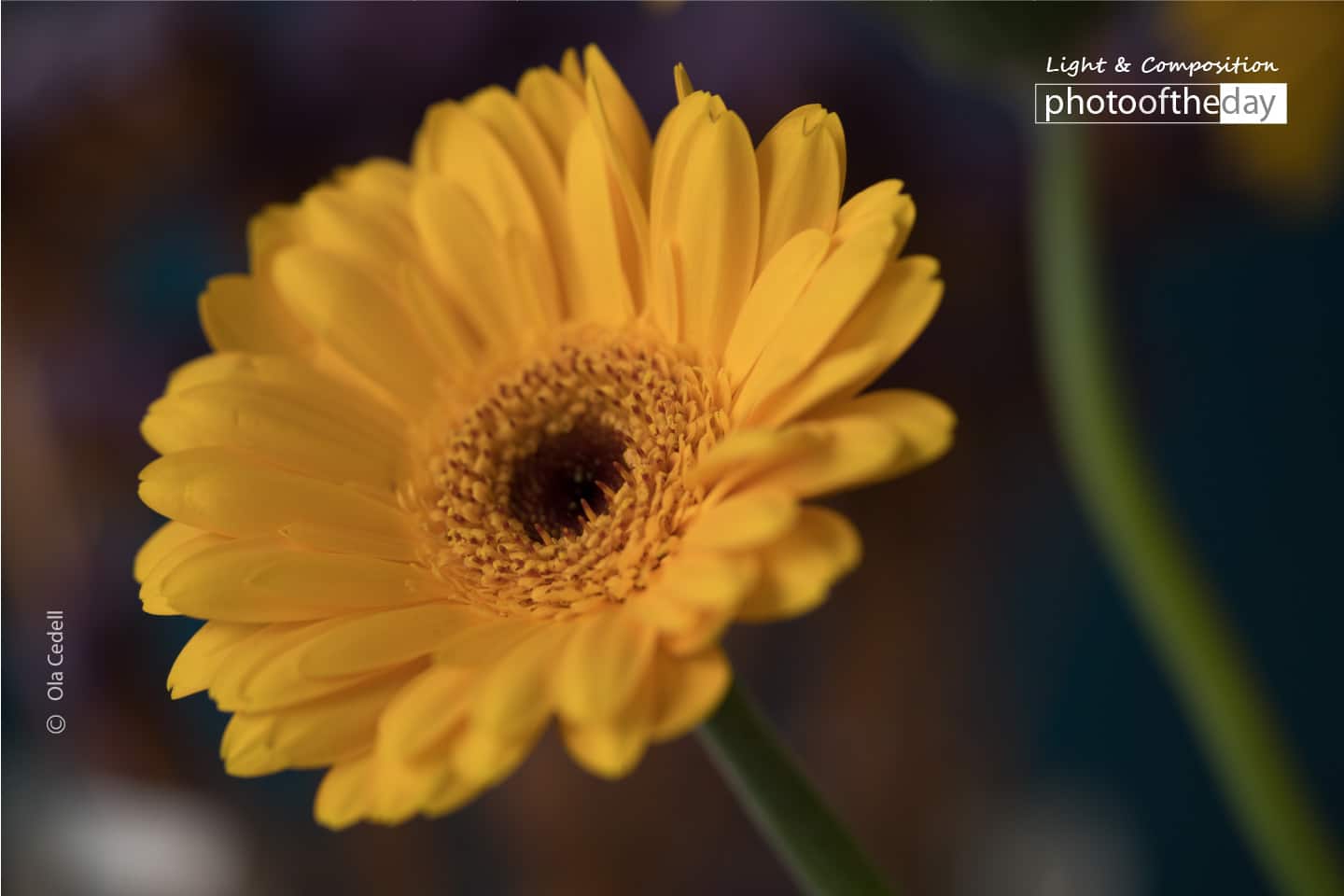
Colorful Gerbera by Ola Cedell
Captured as an exercise in mastering metering modes, this striking close-up of a Gerbera flower demonstrates a sophisticated understanding of light. By utilizing center-weighted metering, the photographer successfully balanced the vibrant subject against a dark, moody background, avoiding the overexposure issues encountered with matrix settings. The image was meticulously composed in manual mode, with the shutter speed carefully adjusted to achieve perfect exposure. This photograph is award-worthy for its technical precision and the way it transforms a simple botanical subject into a study of contrast, texture, and deliberate lighting control.
Ola Cedell
Born in southern Sweden in 1969, Ola Cedell has cultivated a diverse global perspective through his time living in Australia and Germany before returning to his home country. While maintaining a professional career in engineering, Cedell has pursued photography since 1996, eventually specializing in landscape and food imagery. His work is heavily influenced by the natural beauty of southern Sweden and the scenic regions of France, blending technical discipline with a lifelong passion for culinary aesthetics and creative exploration.
Resonance Score Breakdown
Transparency Note: The resonance score (12.3/20) is calculated based on social engagement metrics collected before the award announcement.
Expert Photography Reviews · 7
The Quietude of Being
Seneca once remarked that nature does not hurry, yet everything is accomplished. We often mistake stillness for inactivity, forgetting that the most profound growth occurs in the silence between breaths.
Read the reflection →The Weight of Color
Winter is a long negotiation with gray. We wait for the thaw, for the moment the earth decides to speak again in a different tongue. When the first color arrives, it is not a celebration.
Read the reflection →Reviews & Comments
Share your thoughts about this award-winning photograph. Your reviews contribute to the community engagement score.
Most floral close-ups are forgettable exercises in sharpness, but Cedell’s Gerbera avoids that trap. By crushing the shadows, the petals emerge with a tactile, velvet weight that feels almost sculptural. I’ve seen thousands of macro shots, yet this one lingers because it doesn’t just record a flower; it isolates a mood. It’s a quiet, dark triumph. In thirty years, this precise control of light will still feel intentional, unlike the fleeting trends that clutter our current feeds.
f/5.6 at 1/125s, ISO 100. A calculated choice. The center-weighted metering prevents the sensor from blowing out the petals, which I’ve seen ruin countless floral shots. It’s a disciplined approach to contrast. The depth of field is tight, isolating the texture without losing the form. Honestly, it’s refreshing to see someone actually use manual mode to force the camera to obey. The technical execution is correct. It’s not just a flower; it’s a controlled exposure.
We often forget that flowers have their own histories. When we look at this Gerbera, we aren’t just seeing light hitting petals; we’re seeing a subject that has been truly heard. Ola Cedell didn’t just measure the exposure; they sat with the bloom until it revealed its velvet secrets. I feel a quiet, aching stillness when I look at these deep shadows. It’s a portrait of resilience, and honestly, it’s a photograph that asks to be returned to.
Technically perfect, yet it leaves me cold. Why resolve every petal with such clinical, predictable sharpness? It’s a safe exercise in metering, but it lacks the soul of a risk. I’d rather see the Gerbera dissolve into a blur of color, pushing past this rigid botanical documentation. It’s closer to a textbook diagram than the visceral, painterly abstraction I crave. Why choose clarity when you could have captured the flower’s fleeting, chaotic essence instead?
Technical precision doesn’t equate to artistic depth. While the metering is sharp, I’m left cold by this clinical dissection of a Gerbera. Why must we strip nature of its context just to prove we can control light? It feels like a laboratory specimen, not a living thing. Does the darkness behind the petals hide something, or is it just an empty void? I’ve seen enough perfect flowers; I’m craving a reason to care.
Technically, it’s sharp. The metering is spot on. But where’s the pulse? I’m looking for the street, for the chaos that defines us. A flower doesn’t move, doesn’t hide, doesn’t offer that fleeting, unrepeatable tension Cartier-Bresson hunted. It’s a static study, not a decisive moment. I’d trade all that perfect contrast for a single frame where the world almost fell apart. It’s pretty, sure, but it’s safe. I need the street to bite back.
The focal plane here is razor-thin, slicing through the Gerbera’s velvet petals with surgical intent. At this magnification, the diffraction limit hasn’t yet softened the micro-texture of the pollen, revealing a cellular architecture the naked eye simply ignores. I’m genuinely breathless at how the bokeh, a function of that wide aperture, isolates the subject into pure, saturated color. It’s a rare moment where the lens doesn’t just record; it exposes the hidden physics of botanical life.