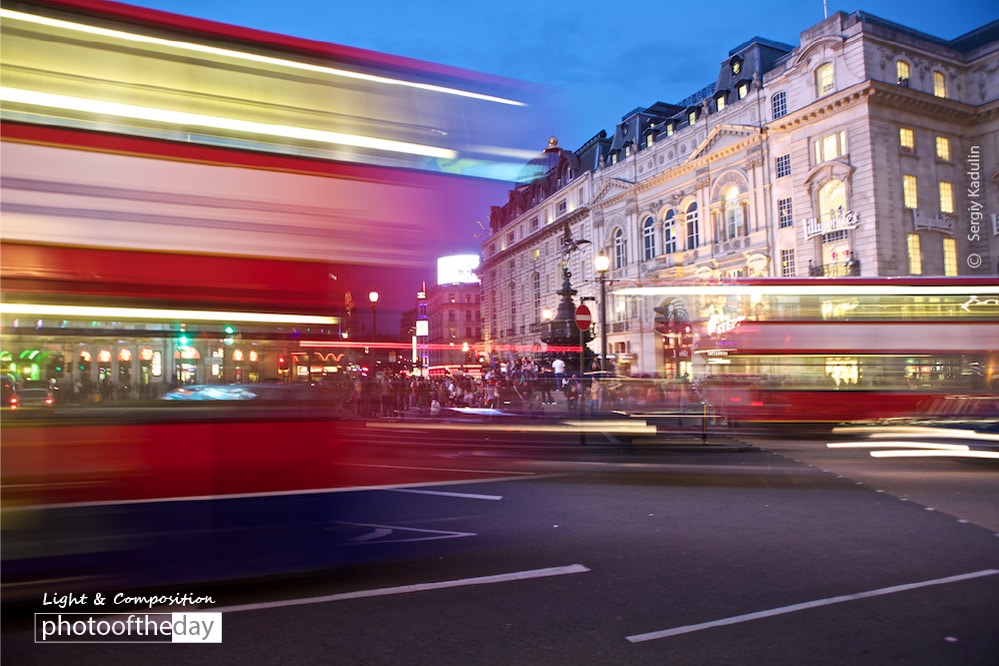
Piccadilly by Sergiy Kadulin
Capturing the vibrant pulse of London, the photographer sought to distill the magical spirit of Piccadilly Circus after dark. By utilizing the motion of iconic red double-decker buses, the image creates a dynamic red color cast that contrasts beautifully against the neon-lit urban backdrop. Lacking a tripod, the photographer ingeniously stabilized the camera against a metal fence to achieve the necessary long exposure. This deliberate technical choice, combined with the patience required to align the moving subjects, results in a compelling, award-worthy composition that perfectly encapsulates the kinetic energy and timeless allure of one of London's most famous landmarks.
Sergiy Kadulin
Born in Kyiv, Ukraine, in 1967, Sergiy Kadulin balances a distinguished career in information technology with a deep-seated passion for photography. After graduating from a military aviation academy and earning an MBA, he transitioned into leadership roles at major global firms, yet he consistently pursued his creative growth through rigorous study at the Kyiv School of Photography and the New York Institute of Photography. His work, which spans travel, landscape, and reportage, serves as a heartfelt medium for sharing his love of the world, nature, and humanity with an international audience.
Resonance Score Breakdown
Transparency Note: The resonance score (10.8/20) is calculated based on social engagement metrics collected before the award announcement.
Expert Photography Reviews · 4
The Flow of Becoming
Heraclitus famously observed that one cannot step into the same river twice, for the waters are ever-changing and the man himself is not the same as he was a moment before.
Read the reflection →The Ghost of the Commute
There is a specific silence that follows the departure of the last train. It is not the absence of sound, but the absence of purpose.
Read the reflection →Reviews & Comments
Share your thoughts about this award-winning photograph. Your reviews contribute to the community engagement score.
Piccadilly isn’t just a junction; it’s a blur of ghosts. Kadulin captures the red streaks of buses not as motion, but as a violent hemorrhage of light against the encroaching void. I’m unsettled by how the darkness here refuses to yield, swallowing the architecture whole. It’s a cold, kinetic ache. When I look at these smeared, crimson veins, I don’t see London’s pulse. I see the city’s desperate, fleeting attempt to outrun its own inevitable silence.
Piccadilly’s kinetic blur recalls the urban abstractions of Alvin Langdon Coburn, yet Kadulin’s red streaks feel distinctly modern. It’s a clever improvisation; stabilizing against a fence echoes the resourceful spirit of the early street photographers who lacked the luxury of a tripod. I’ve spent decades watching London’s pulse through a lens, but those crimson smears against the neon actually made me catch my breath. It’s a fresh, rhythmic dialogue with the city’s relentless, shifting geometry.
Before the eye identifies the blur of Piccadilly, something in the chest tightens. It’s the visceral hum of a city that doesn’t sleep. Those streaks of red light don’t just represent buses; they act as a pulse, quickening my own heart rate. I’ve returned to this frame three times today, and each time, the neon smear feels like a half-remembered dream. It’s that kinetic ache—the feeling of being entirely alone in a crowd—that lingers.
Piccadilly isn’t just a place; it’s a rhythm. We watch these red streaks blur past, and we realize the city is breathing. Sergiy didn’t just capture light; he listened to the frantic heartbeat of London. I feel a strange, lonely comfort in that long exposure, as if the ghosts of commuters are rushing toward a home we haven’t reached yet. It’s a portrait of a city that never stops to introduce itself, yet somehow, it’s listening.