Jol Moyur by Saniar Rahman Rahul
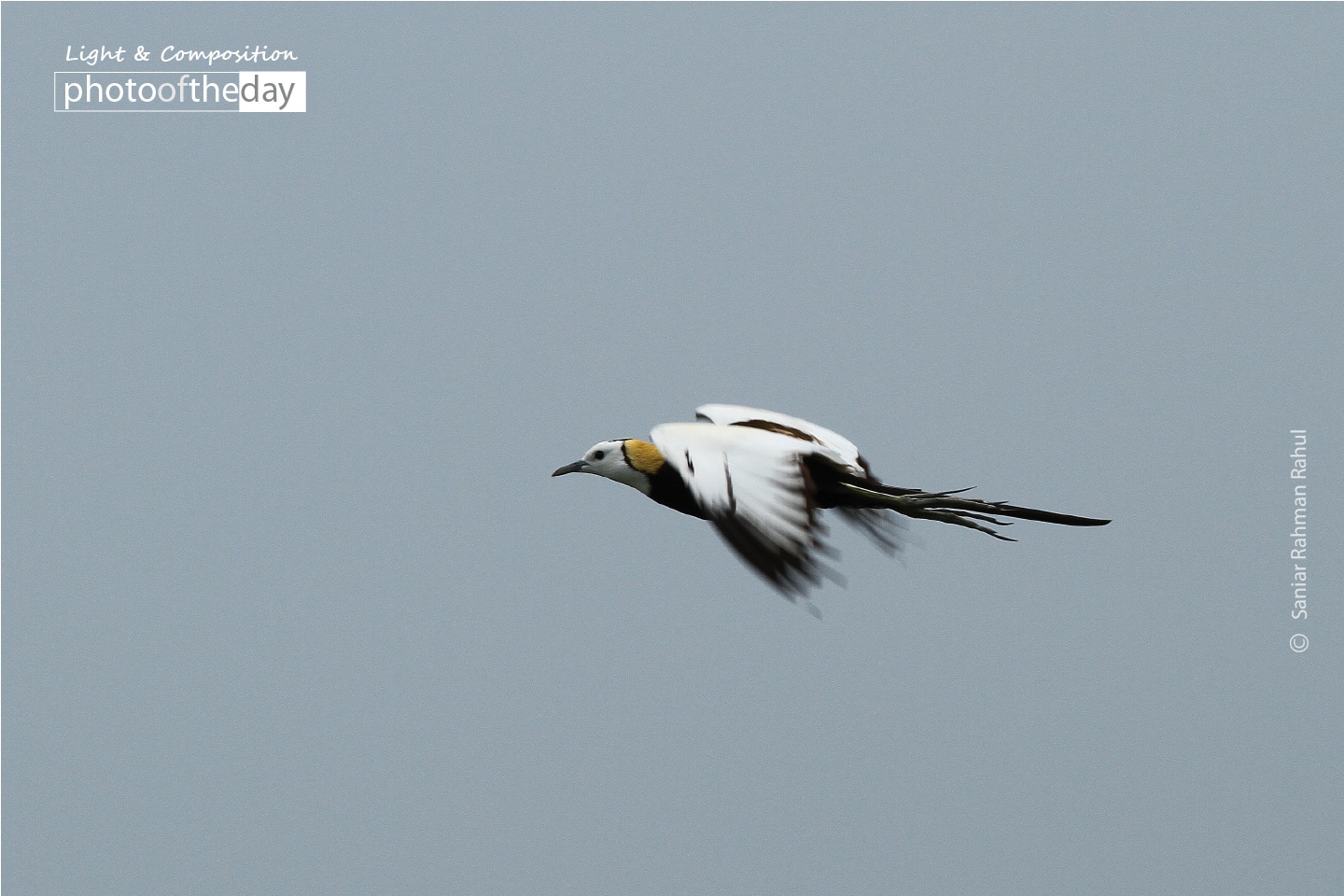
Captured within the unique wetland ecosystem of Tanguar Haor in Sunamganj, Bangladesh, this striking image features the Pheasant-tailed jacana, locally known as Jol Moyur. The photographer skillfully documents the bird in its breeding plumage, highlighting the dramatic contrast between its deep black body and the elegant white wings and golden hind neck. By isolating the subject against the serene, reflective waters of the haor, the image captures the essence of this monotypic species. The composition is award-worthy for its precise focus on the jacana’s intricate details, such as the distinct white eye stripe, showcasing a masterful balance of wildlife observation and technical execution.
Saniar Rahman Rahul
Based in Dhaka, Bangladesh, Saniar Rahman Rahul is an accomplished Art Director at Grey Worldwide with a deep-rooted passion for visual storytelling. His photographic journey began in childhood, inspired by his father, and was later refined through his extensive professional background in graphic design and advertising. Since winning his first major photography accolade in 2010, Rahul has consistently demonstrated a keen eye for detail and composition. His work reflects a sophisticated blend of technical precision and creative vision, shaped by years of experience in the competitive landscape of international advertising.
Resonance Score Breakdown
Transparency Note: The resonance score (12.2/20) is calculated based on social engagement metrics collected before the award announcement.
Expert Photography Reviews · 8
The Weight of Stillness
In the quiet hours of the morning, before the kettle whistles or the house begins its rhythmic creaking, there is a particular kind of silence that feels heavy with potential. It is not an empty silence, but a gathered one.
Read the reflection →The Weight of the Surface
The lotus leaf is a master of buoyancy, its surface coated in microscopic wax crystals that force water to bead and roll away, keeping the plant dry even in the heart of a deluge. It survives by refusing to be weighed down by the very element that sustains it.
Read the reflection →Reviews & Comments
Share your thoughts about this award-winning photograph. Your reviews contribute to the community engagement score.
The water doesn’t just hold the bird. It holds the silence. I’ve spent minutes watching the jacana drift across that vast, glass surface. It’s a study in restraint. The black plumage against the void. Nothing here is accidental. The empty corner is not empty. It’s the weight of the haor itself. I feel a sudden, sharp ache for that stillness. It’s rare to find a frame that knows exactly when to stop.
The water at Tanguar Haor doesn’t just reflect; it breathes. I’ve spent enough dawns waiting for the light to soften to know that Saniar didn’t chase this Jol Moyur. He waited until the bird and the wetland became a single, quiet thought. That golden neck glows against the stillness, and honestly, it makes my own pulse slow down. It’s a rare, holy silence captured in the breeding plumage, where the light finally stopped moving and simply listened.
The Jol Moyur is a striking creature, but it’s a subject that can’t offer consent. I’ve spent my life chasing the flicker of humanity in a subject’s eyes, that moment when a person chooses to let you in. Here, there’s only the cold precision of a lens. It’s technically sharp, sure, but it feels distant. I find myself longing for a pulse, for a gaze that acknowledges the observer. It’s beautiful, but it’s just biology.
The Pheasant-tailed jacana floats in a void, stripped of the Tanguar Haor’s complex reality. Why does the frame erase the surrounding wetland’s struggle? It’s a beautiful, clinical isolation, but I find it cold. Does this aesthetic perfection serve the bird, or just the photographer’s ego? We’ve turned a living creature into a static ornament. When we remove the context of a habitat, what are we actually preserving? It’s technically sharp, but it feels hollow.
Of the thousands of wildlife frames I’ve reviewed, most are merely clinical records. What separates this from the pack is the way the jacana’s golden neck cuts through the stillness of the Tanguar Haor. It’s not just a bird; it’s a quiet, regal defiance against the water’s vast emptiness. I find myself holding my breath looking at that white eye stripe. In thirty years, this clarity will still feel like a rare, stolen secret.
The Jol Moyur doesn’t merely float; it anchors the void. By isolating that stark, obsidian breast against the mirror of the Tanguar Haor, Rahul forces us to confront the silence inherent in nature’s geometry. It’s a haunting, heavy stillness. I’ve stared at the white eye stripe for an hour, and it feels like a cold, unblinking interrogation. We aren’t looking at a bird here; we’re looking at the darkness that defines our own fragile existence.
f/5.6 at 400mm, 1/1000s, ISO 400. A tight aperture choice for a bird in motion, but it’s the only way to isolate that jacana against the reflective chaos of the Tanguar Haor. The shutter speed is sufficient; the sensor noise is negligible. I’ve spent hours in wetlands, and frankly, I’m jealous of this focus. It’s sharp where it needs to be. The technical discipline here is correct. It doesn’t waste a single pixel.
You waited for that jacana to settle, didn’t you? It’s not just the sharp focus on those white eye stripes that gets me; it’s the stillness you found in the Tanguar Haor. I’ve spent enough time in the field to know that kind of patience isn’t technical—it’s a quiet respect for the subject. And honestly, looking at that reflection, I felt a sudden, cooling breath of wind. You were really there, weren’t you?