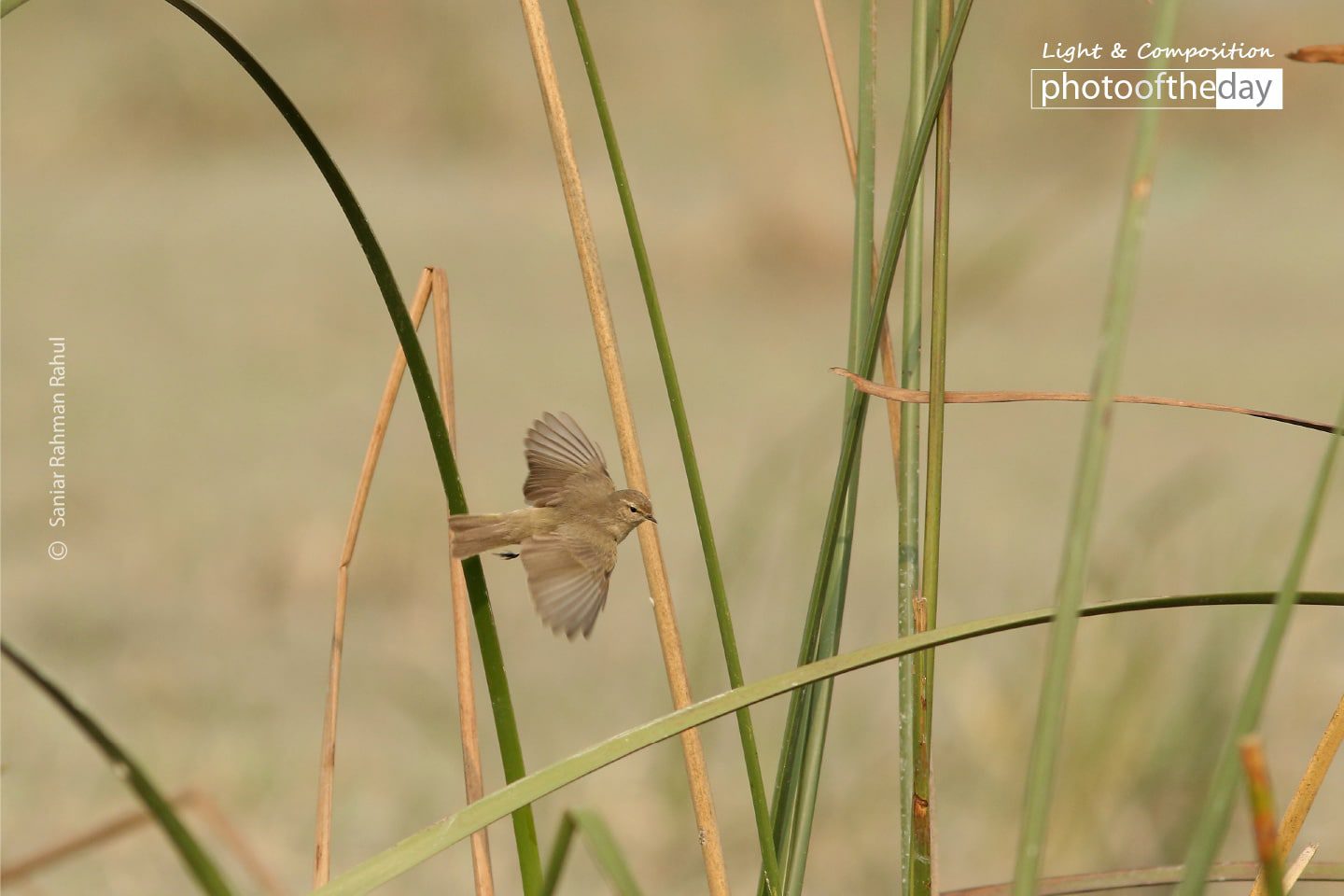
Common Chifchaf by Saniar Rahman Rahul
Captured on the serene landscapes of Bhola Island, this photograph showcases the Common Chiffchaff, a subtle yet elegant leaf warbler. The photographer masterfully isolates the bird against its natural habitat, highlighting the delicate greenish hues and whitish underparts that define this elusive species. By focusing on the bird's quiet demeanor during a moment of stillness, the image transcends a simple wildlife record, offering an intimate glimpse into the avian life of Bangladesh. The composition is particularly award-worthy for its technical precision and the photographer's ability to capture the essence of a creature often overlooked in the dense woodland canopy.
Saniar Rahman Rahul
Based in Dhaka, Bangladesh, Saniar Rahman Rahul is a distinguished creative professional with a deep-rooted passion for photography that began in his childhood. After establishing a successful career in graphic design and advertising, currently serving as an Art Director at Grey Worldwide, he rediscovered photography as a vital outlet for his artistic expression. His work reflects a blend of technical discipline and a keen eye for natural beauty, earning him significant recognition, including being named a winner of the Photo of the Month Award as early as 2010.
Resonance Score Breakdown
Transparency Note: The resonance score (12.3/20) is calculated based on social engagement metrics collected before the award announcement.
Expert Photography Reviews · 7
The Unseen Inhabitants
We often mistake the city for a purely human construct, a grid of concrete and commerce designed solely for our own convenience. Yet, urban geography is far more porous than our maps suggest.
Read the reflection →The Weight of a Feather
I keep a small, grey feather tucked inside the pages of a book of poetry I haven't opened in years. It is brittle now, the edges frayed like the hem of a winter coat that has seen too many seasons.
Read the reflection →Reviews & Comments
Share your thoughts about this award-winning photograph. Your reviews contribute to the community engagement score.
The Chiffchaff isn’t merely perched; it’s suspended in a void of its own making. Rahul has stripped away the clutter of Bhola Island, leaving only the bird’s fragile, greenish tension against a suffocating, dark depth. It’s a haunting stillness. I’ve stared at this frame for an hour, and I’m unsettled by how the darkness refuses to yield. It doesn’t invite us in. It demands we acknowledge the silence that swallows the creature whole.
Bhola Island’s greenery feels almost too curated here. Rahul isolates the Chiffchaff with clinical precision, yet I find myself craving the chaos of the actual canopy. Why strip away the context of a place so often defined by its vulnerability? It’s technically sharp, sure, but it feels like a specimen in a jar. Does this bird exist in a vacuum, or are we just ignoring the environment to make the frame look cleaner? It’s unsettling.
Wildlife isn’t my usual beat, but this Chiffchaff has that Winogrand tension. It’s a tiny, frantic heartbeat caught in the Bhola brush. Most people miss these flickers, but Rahul didn’t blink. One tenth of a second later and the bird is gone, the branch is empty, and the frame collapses. I felt a genuine jolt seeing that stillness. It’s not just a record; it’s a perfect, unrepeatable fraction of time. You were paying attention. That’s everything.
Before the eye identifies the bird, something in the chest softens. The Chiffchaff’s stillness forces a rhythmic synchronization; my own breath slows to match its fragile, suspended posture. It’s a quiet activation of the nervous system. When I return to this frame a year later, I don’t see a warbler anymore. I feel the damp, heavy air of Bhola Island. It’s a haunting, singular ache—the weight of a life so small, yet so perfectly held.
The olive-drab plumage of this Chiffchaff vibrates against the desaturated, Morandi-esque backdrop, a symphony of muted chartreuse that feels like the damp, mossy breath of Bhola Island itself. It’s a quiet, chromatic ache I’ve rarely encountered in wildlife portraiture; the way those pale, chalky underparts dissolve into the bokeh’s soft, indeterminate grey-green light is simply ravishing. One finds it’s not merely a bird, but a fleeting, feathered pulse of light caught in a melancholic, verdant dream.
The Chiffchaff sits at the intersection of a subtle diagonal, anchoring the frame’s negative space. Rahul has solved a complex spatial equation here; the branch creates a precise 1:4 ratio against the blurred backdrop, forcing the eye toward the bird’s sharp, geometric eye-ring. It’s a masterclass in balance. I’m genuinely struck by how the soft, desaturated greens don’t collapse into chaos. It’s rare to see such mathematical rigor applied to something so fleetingly alive.
It’s rare to see a frame so devoid of human datum, yet the Chiffchaff’s perch feels like a structural threshold. The light rakes across those twigs, defining the void between solid branches with a precision that mimics a well-lit atrium. I’m struck by the scale; it’s a tiny, living inhabitant in a vast, unbuilt landscape. It doesn’t need walls to define its space. Honestly, it makes me crave the quiet simplicity of a raw, unadorned structure.