Brotherhood by Sammam Junaid
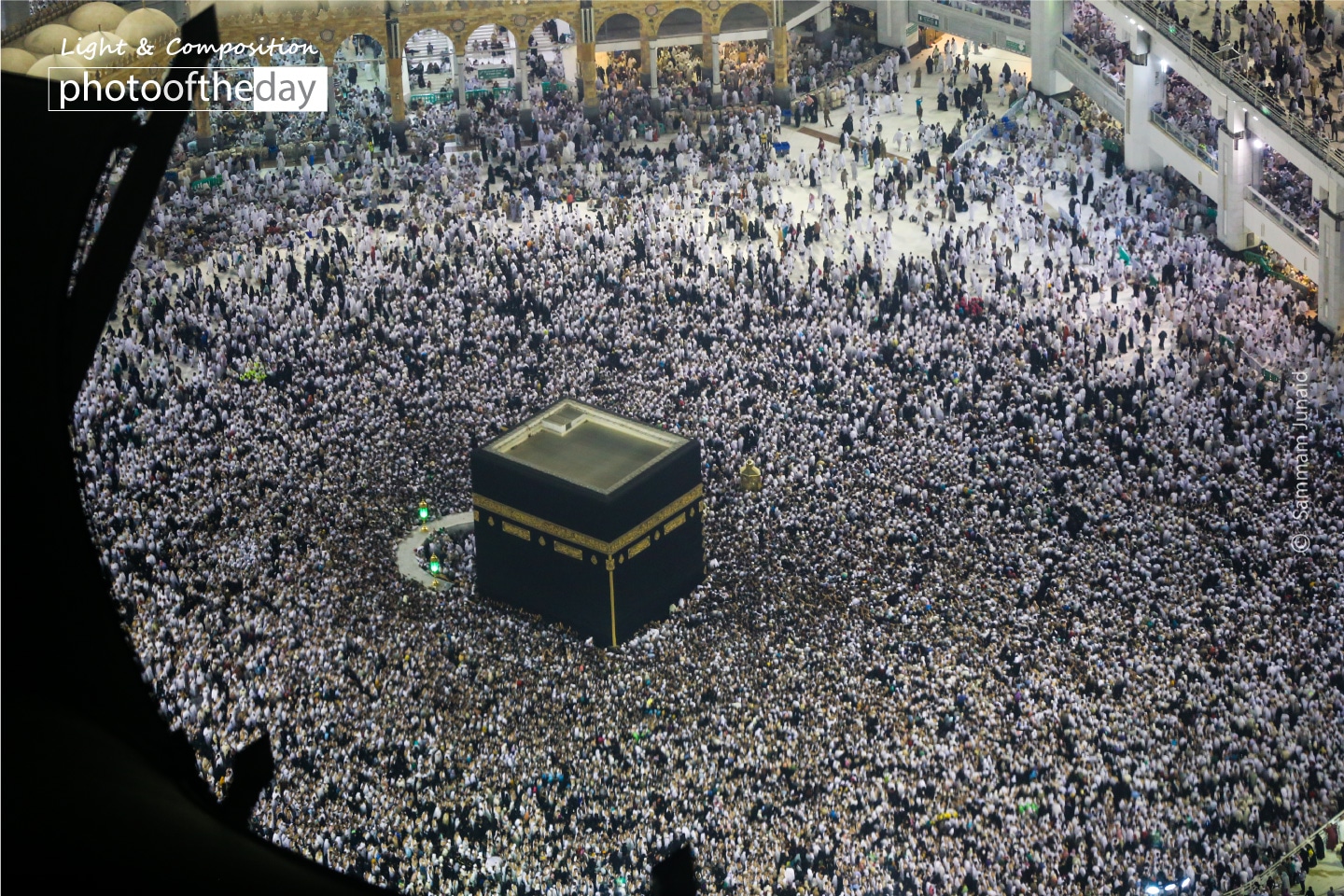
Captured at the heart of the Great Mosque of Mecca, this photograph documents the profound sense of unity shared by pilgrims gathered at the Kaaba. The photographer focused on the sea of individuals dressed in white, a visual manifestation of the Islamic principle of brotherhood and peace. By framing the iconic cuboid granite structure amidst the gathering, the image serves as a powerful testament to collective devotion. The composition is award-worthy for its ability to distill a complex, deeply spiritual atmosphere into a single, cohesive narrative of human connection and shared faith.
Sammam Junaid
Born in Bangladesh in 2003, Sammam Junaid is a self-taught photographer currently pursuing his studies at Notre Dame College. Driven by a deep curiosity for the natural world and human connection, he has developed his craft through active participation in various photography communities. His work reflects a dedicated pursuit of capturing beauty and cultural significance, marking him as a promising emerging talent in the international photography scene.
Resonance Score Breakdown
Transparency Note: The resonance score (11.3/20) is calculated based on social engagement metrics collected before the award announcement.
Expert Photography Reviews · 5
The Weight of One
I remember sitting in a crowded train station in Mumbai, watching the tide of commuters move toward the platforms. Everyone was rushing, yet there was a strange, rhythmic synchronicity to the chaos.
Read the reflection →The Architecture of Equality
Urban space is rarely neutral. Usually, the city is a map of hierarchies, where the quality of one’s housing or the accessibility of a plaza signals status, class, and exclusion.
Read the reflection →Reviews & Comments
Share your thoughts about this award-winning photograph. Your reviews contribute to the community engagement score.
White robes blur into a singular, faceless mass, stripping these pilgrims of their individual histories. It’s a clean, sanitized vision of unity that makes me feel strangely uneasy. Does this erasure of identity serve the spiritual narrative, or does it merely flatten the human experience for the sake of a tidy aesthetic? Whose gaze benefits from this homogenization? I crave the grit of a real person, yet Junaid offers only a sea of identical, anonymous devotion.
The blinding, bleached white of the pilgrims’ ihram robes creates a luminous, chalky expanse that recalls the stark, sun-drenched walls of a Vermeer, yet it’s the Kaaba’s deep, obsidian velvet—a black so profound it seems to swallow the very light of Mecca—that truly steals one’s breath. I’m utterly undone by how this crushing, abyssal darkness anchors the frantic, rhythmic sea of white, turning a spiritual gathering into a sublime, monochromatic symphony of absolute devotion.
Most Mecca photography is a chaotic blur of white fabric, but Junaid’s frame finds the geometry beneath the fervor. By anchoring the Kaaba slightly off-center, he forces the eye to navigate the pilgrims as a singular, rhythmic tide rather than a crowd. It’s the restraint that wins me over; I felt a genuine, quiet ache looking at the uniformity of those shoulders. In thirty years, this won’t just be a record; it’ll be a meditation on surrender.
One doesn’t simply stumble upon this perspective in the Great Mosque. It’s a chaotic, sweltering crush, yet the frame remains remarkably disciplined. I’ve spent enough time in crowds to know that finding this specific geometry amidst the white-clad tide requires hours of standing still while being jostled. It’s a quiet, earned stillness. I find myself feeling a rare, genuine envy for the patience required to let the composition settle into such perfect, rhythmic order.
There’s a stillness here that reminds me of waiting in a blind for a snow leopard to emerge. You can’t force this kind of synchronicity; it’s earned through absolute presence. I find myself holding my breath, feeling the weight of that collective devotion. It’s not an extracted moment of chaos, but a patient observation of a natural human migration. It’s rare to see such restraint in a crowd. I’m genuinely moved by the quiet rhythm.