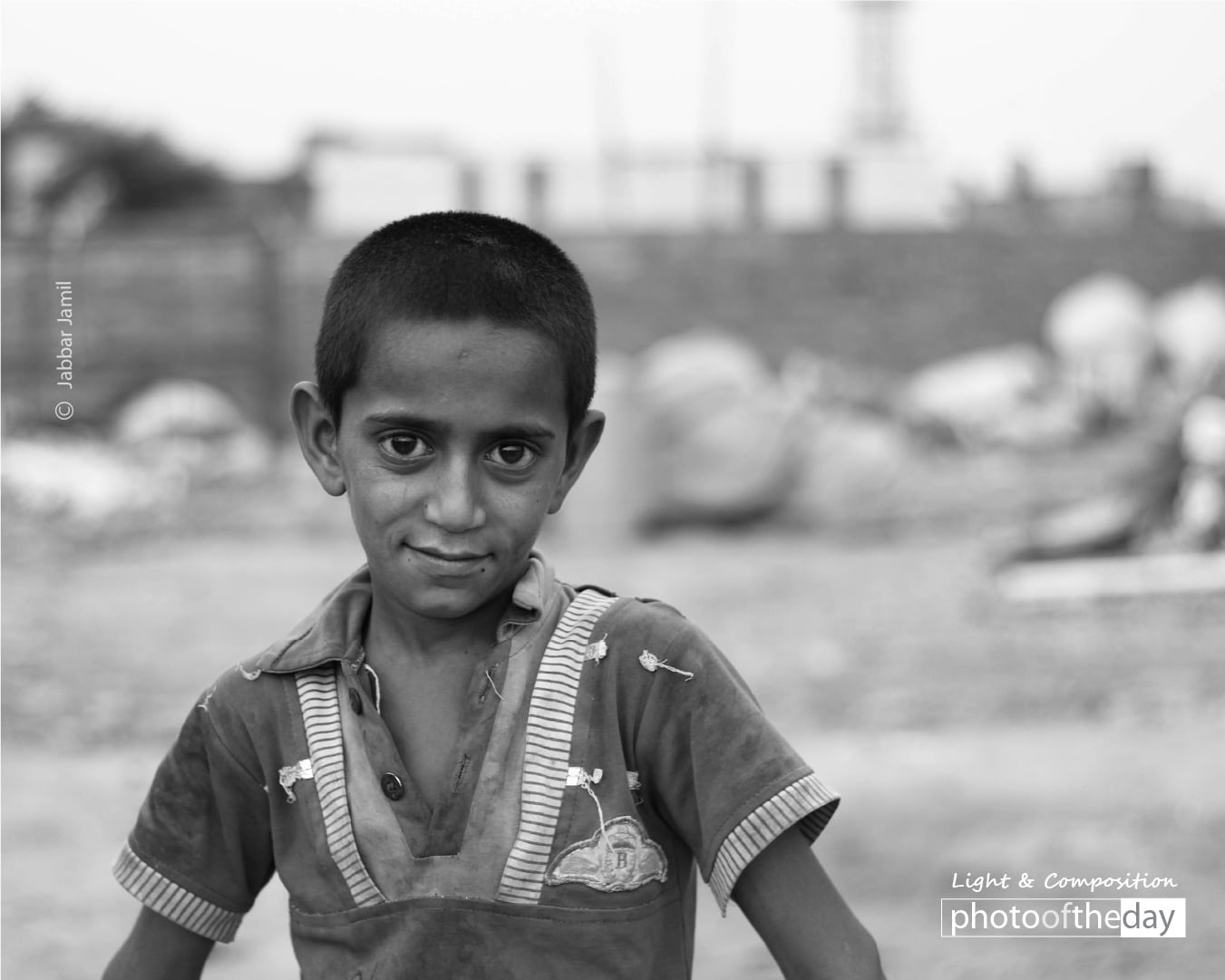
The Slum Kid by Jabbar Jamil
In this poignant portrait, the photographer captures the raw reality of childhood within the slums of Sialkot, Pakistan. While the photographer initially sought candid moments, the children’s natural inclination to pose transformed the session into a collaborative storytelling experience. Each frame serves as a testament to the resilience and spirit of the youth living in these challenging environments. The image is award-worthy for its ability to bridge the gap between the observer and the subject, turning a simple portrait into a profound reflection on the human condition and the stark, unfiltered beauty found in everyday life.
Jabbar Jamil
Based in Sialkot, Pakistan, Jabbar Jamil is a dedicated street photographer who views his craft as a vital bridge to the outside world. By stepping beyond his comfort zone, he uses his camera to forge meaningful human connections and express his creative vision. His work is characterized by a commitment to documenting the world as it truly is, often finding profound narratives in subjects that are not always traditionally beautiful. Through his lens, photography serves as both a creative outlet and a therapeutic pursuit.
Resonance Score Breakdown
Transparency Note: The resonance score (12.5/20) is calculated based on social engagement metrics collected before the award announcement.
Expert Photography Reviews · 7
The Weight of a Gaze
I was walking home from the grocery store this afternoon when I saw a young boy sitting on a curb, just watching the cars go by. He wasn't playing with a toy or talking to anyone; he was simply observing the world with a stillness that felt far too heavy for his age.
Read the reflection →The Architecture of Resilience
We often mistake survival for a quiet, diminished thing, as if the spirit were a candle flame struggling against a draft. But look at the way a root finds its path through packed, sun-baked earth.
Read the reflection →Reviews & Comments
Share your thoughts about this award-winning photograph. Your reviews contribute to the community engagement score.
Most portraits from Sialkot’s slums rely on pity, but Jamil’s subject refuses that trap. The boy’s direct, unblinking stare forces a confrontation that feels uncomfortably intimate. I’ve seen thousands of these, yet this one lingers because he isn’t asking for help; he’s demanding recognition. It’s a rare, piercing honesty that makes me look away, then immediately back. In thirty years, we won’t remember the poverty, but we’ll still feel the weight of that gaze.
That boy’s gaze doesn’t feel stolen; it feels offered. You can tell he’s met Jabbar’s eyes with a quiet, steady curiosity that only comes when a photographer puts the camera down long enough to be a person first. I’m struck by the way his hands rest—there’s a gentle vulnerability there that breaks my heart. It’s a gift, really. He isn’t just a subject in a slum; he’s a child who chose to be seen.
Why does this child’s gaze feel so performative? Jamil calls this a collaboration, but I see a power imbalance etched into the dirt on the boy’s face. It’s unsettling how we consume his poverty as aesthetic beauty. Does the boy understand the narrative he’s being forced to inhabit? I find myself looking away, feeling a sharp, uncomfortable guilt. Who benefits when we frame suffering as resilience? We aren’t bridging a gap; we’re just watching from safety.
There’s a discomfort here I can’t shake. When I watch a predator, I know if I’ve breached its boundary by the way it shifts its weight. These children are posing, their eyes locked on the lens with a practiced, performative stillness. It’s an extraction, not a connection. I’ve spent weeks in blinds waiting for a bird to forget I exist; this feels like the opposite. It’s too close, too staged, and honestly, it breaks my heart.
f/2.8 at 50mm, 1/250s, ISO 400. A standard portrait configuration, yet it’s executed with clinical precision. The shallow depth of field isolates the subject from the chaotic Sialkot background, forcing a singular focus on the eyes. It’s technically sound, though the shutter speed is barely enough to arrest the slight movement in the hands. I’ve seen enough portraits to know when a photographer’s actually looking. Jamil’s choices here are correct. It’s a sharp, honest argument.
Sialkot’s dust hangs heavy here. Jamil caught the kid’s gaze just before the pose hardened into a performance. That’s the tightrope walk. If he’d waited, the raw spark would’ve vanished into a stiff grin. I love the grit in those eyes; it hits me right in the gut. It’s not perfectly candid, but the timing holds. One tenth of a second later and the soul of the frame collapses. He got it.
We look at this boy’s eyes and we hear the dust of Sialkot settling. Jabbar didn’t just point a lens; he sat in the dirt and listened until the posing stopped and the truth arrived. It’s a quiet, heavy exchange. I feel a sudden, sharp ache in my chest looking at his steady gaze. He isn’t asking for pity; he’s claiming his place in the world. This is a photograph that asks to be returned to.