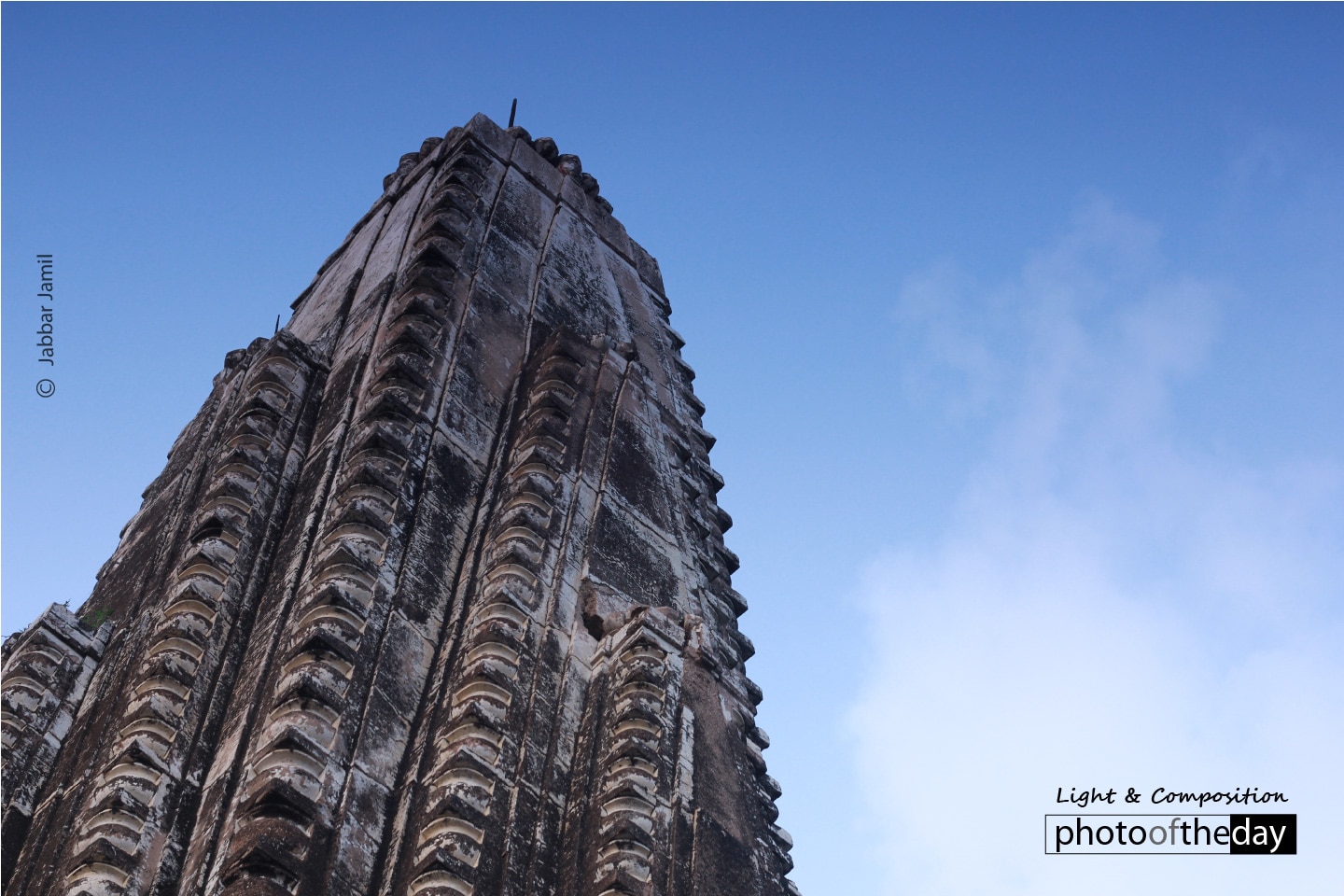
Abandoned Dome by Jabbar Jamil
Perched atop a dune along Allama Iqbal Road, this ancient temple dome stands as a silent witness to over a millennium of history, enduring countless cycles of damage and restoration. Jabbar Jamil captures the poignant stillness of the structure, using the stark contrast between the weathered architecture and a vibrant, gradient-enhanced sky to emphasize its abandonment. By highlighting the lack of color typically found in active sites, the photographer draws the viewer into a contemplative study of decay. This image is award-worthy for its evocative storytelling, transforming a neglected relic into a powerful visual narrative about the passage of time and the beauty found in forgotten places.
Jabbar Jamil
Based in Sialkot, Pakistan, Jabbar Jamil is a dedicated street photographer who views the medium as a vital bridge between his personal creativity and the outside world. He finds that the practice serves as both a profound stress reliever and a catalyst for human connection, pushing him well beyond his comfort zone. Through his lens, Jamil documents the raw reality of his surroundings, often seeking out the beauty in subjects that are not traditionally considered picturesque.
Resonance Score Breakdown
Transparency Note: The resonance score (11.1/20) is calculated based on social engagement metrics collected before the award announcement.
Expert Photography Reviews · 7
The Grit of Time
The taste of dry earth always lingers in the back of my throat when I think of places left behind. It is a gritty, mineral flavor, like dust kicked up by a sudden wind on a road that hasn't seen a traveler in years.
Read the reflection →The Architecture of Silence
There is a specific weight to a room that has forgotten the sound of a human voice. It is not merely empty; it is hollowed out, a vessel that once held the heat of prayers, the friction of daily life, and the soft, rhythmic scuff of sandals against stone.
Read the reflection →Reviews & Comments
Share your thoughts about this award-winning photograph. Your reviews contribute to the community engagement score.
The dome’s geometry is lost against that aggressive, artificial sky. It’s a shame; the masonry’s texture—the way light should rake across those weathered curves to define its mass—is flattened by the heavy-handed post-processing. I’m left craving the tactile reality of the threshold, the actual weight of the stone. It’s a missed opportunity to explore how the void inside interacts with the exterior. Honestly, it makes me ache for the building’s true, quiet dignity.
The ochre of this crumbling masonry, a shade reminiscent of Morandi’s dustiest pigments, clashes with a sky of bruised violet and electric cyan, creating a dissonance that’s frankly heartbreaking. It’s as if the dome is weeping for its lost vibrancy against that aggressive, gradient-heavy firmament. I’ve felt such a sharp, sudden ache in my chest observing how the light refuses to reconcile with the stone, leaving the structure suspended in a cold, chromatic exile.
It’s a sterile, hollow frame. While the jury praises the gradient-enhanced sky, I’m struck by the silence—not the profound stillness of a wild habitat, but the absence of life. Where are the nesting swifts or the lichen-grazing insects that should inhabit such a ruin? It feels extracted, a digital polish applied to a corpse. I’d trade that artificial sky for a single, honest sign of an ecosystem reclaiming its own space. It’s just empty.
The gradient-enhanced sky feels a bit too polished for my taste, almost suffocating the dome’s raw, crumbling texture. I’m craving more grit here. Why resolve the architecture so clinically when the subject is decay? It’s closer to a postcard than Sugimoto’s meditative voids. I’d have loved to see the motion of the wind or a long-exposure blur to dissolve that rigid geometry. It’s technically sound, sure, but it’s playing it far too safe.
The dome sits. It doesn’t ask for attention. The sky presses against the curve, a weight of blue. I’ve spent minutes watching the shadow stretch across the brick. It’s quiet here. The space around the structure isn’t just air; it’s a pause. I feel a sudden ache in my chest, a longing for this stillness. Nothing here is accidental. The empty corner is not empty. It’s the sound of a thousand years holding its breath.
The light here hasn’t been forced; it’s been invited. Jabbar waited for that heavy, bruised sky to settle behind the dome, letting the architecture breathe in the silence of Sialkot. I’ve felt that same ache in my chest when a structure finally stops fighting the horizon and just exists. It’s not about the decay, but the stillness that remains when everything else has left. He didn’t take this; he let it happen to him.
Of the thousands of architectural shots I’ve reviewed, most rely on tired symmetry. Jamil avoids this by letting the dome’s decay dictate the frame. The gradient sky feels a bit aggressive, almost distracting, yet it forces the weathered stone to hold its ground. It’s a haunting study of neglect that actually makes me feel the weight of those centuries. In thirty years, this won’t just be a record of a ruin; it’ll be a memory of silence.