Pathway by Jabbar Jamil
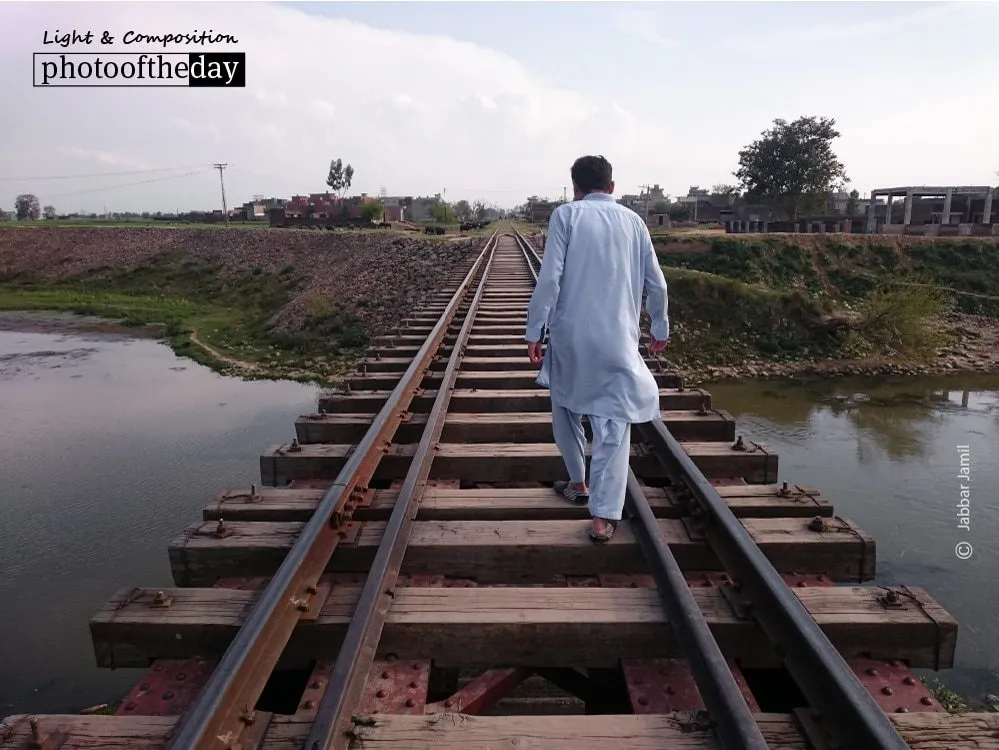
In this compelling documentary shot, Jabbar Jamil captures a precarious daily reality in Sialkot, Pakistan. Drawn to the striking leading lines of a railway bridge, the photographer waited patiently for a single subject to traverse the water stream, highlighting the tension between necessity and danger. Despite local warnings, residents rely on this path as their only viable route. The image is award-worthy for its powerful storytelling and precise composition, transforming a risky, mundane commute into a poignant visual narrative about human resilience and the stark, often unvarnished beauty found in everyday life.
Jabbar Jamil
Based in Sialkot, Pakistan, Jabbar Jamil is a dedicated street photographer who views his craft as a vital bridge to the world beyond his comfort zone. Through his lens, he seeks to forge human connections while using photography as both a creative outlet and a therapeutic pursuit. Jamil is committed to documenting the world exactly as he finds it, often focusing on the raw, authentic, and sometimes challenging realities of daily life that exist outside the realm of traditional beauty.
Resonance Score Breakdown
Transparency Note: The resonance score (13.0/20) is calculated based on social engagement metrics collected before the award announcement.
Expert Photography Reviews · 3
The Architecture of Necessity
We are often told that the shortest distance between two points is a straight line, but life rarely offers us the luxury of a paved road. Instead, we find ourselves walking along the narrow, rusted edges of what is required, balancing our weight against the pull of the abyss.
Read the reflection →The Weight of the Crossing
Why do we insist on building bridges where the earth itself seems to say no? We are creatures of habit, tethered to the paths we have carved out of necessity, often ignoring the fragility of the ground beneath our feet.
Read the reflection →Reviews & Comments
Share your thoughts about this award-winning photograph. Your reviews contribute to the community engagement score.
At f/2, the Sony’s sensor struggles with the extreme peripheral light falloff, yet it’s precisely this optical limitation that isolates the subject against the Sialkot bridge. The focal plane is razor-thin, rendering the water’s texture with a sharpness that defies the sensor’s tiny format. I’m genuinely moved by how the diffraction of light across that rusted metal surface creates such haunting, micro-contrast. It’s a precarious, beautiful collision of physics and human necessity that I can’t stop watching.
One suspects Jamil didn’t just stumble upon this bridge. That singular figure crossing the water suggests a morning spent shivering in the damp, waiting for the light to align with the necessity of the commute. It’s a precarious business, both for the subject and the lens. I’ve spent enough hours in similar mud to appreciate the commitment here. It’s a quiet, earned moment of human grit. He clearly returned until the frame felt heavy enough to hold.
1/1000sec at f/2, ISO 50, 5mm. A smartphone sensor pushed to its limit. That f/2 aperture on a 5mm focal length creates a depth of field that’s surprisingly forgiving, yet it’s a lazy choice for a landscape. It’s sharp enough, but the lack of true optical compression flattens the bridge’s tension. I’ve seen this bridge before; it’s dangerous. Jamil’s technical choices don’t quite capture that peril. It’s technically competent, but it’s cold. I’m left wanting more.