Shawala Temple by Jabbar Jamil
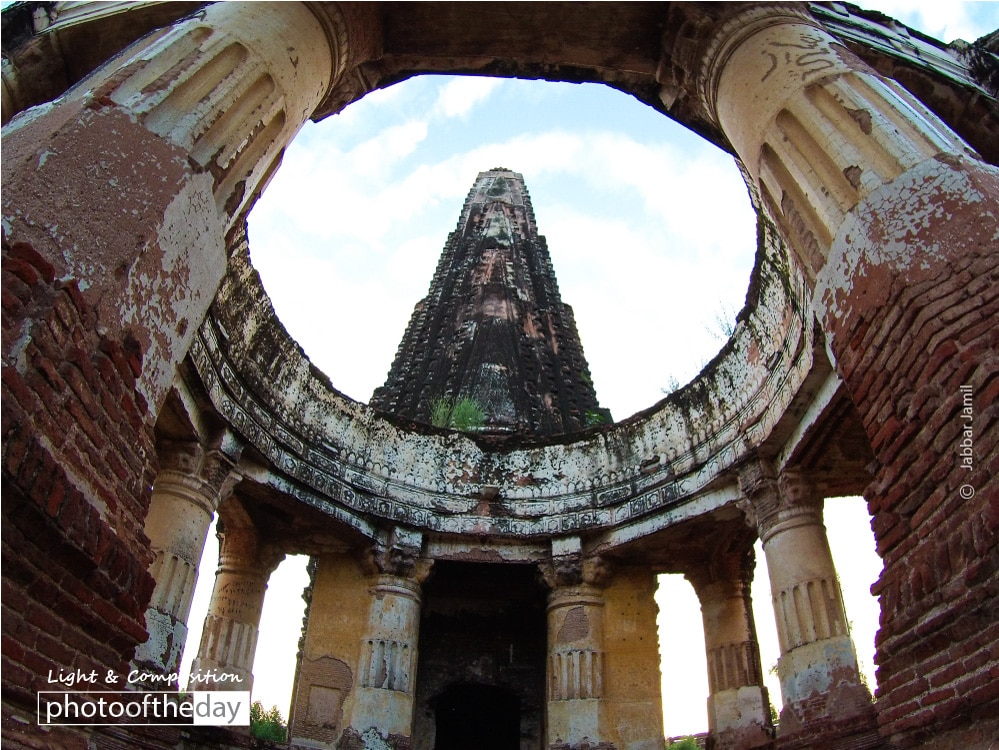
Captured in the historic city of Sialkot, this image documents the Shawala Temple, a poignant relic of a pre-partition era when the site served as a vibrant hub for Hindu religious festivals. By choosing a low-angle perspective, the photographer emphasizes the architectural resilience of the ruins against the passage of time. This composition not only highlights the structural details of the remaining temple but also serves as a powerful testament to cultural heritage and historical memory. The image is award-worthy for its ability to transform a decaying site into a compelling narrative of identity and architectural endurance.
Jabbar Jamil
Based in Sialkot, Pakistan, Jabbar Jamil is a dedicated street photographer who views the medium as a vital bridge to the outside world. His work focuses on capturing the raw, unfiltered essence of his surroundings, often finding beauty in subjects that are not traditionally aesthetic. By stepping outside his comfort zone, Jamil uses photography as both a creative outlet and a therapeutic practice, aiming to foster human connections that transcend the images themselves.
Resonance Score Breakdown
Transparency Note: The resonance score (10.9/20) is calculated based on social engagement metrics collected before the award announcement.
Expert Photography Reviews · 4
The Dust of Echoes
The smell of dry earth after a long drought is a specific kind of hunger. It is the scent of stone that has forgotten the touch of rain, a sharp, mineral grit that settles at the back of the throat.
Read the reflection →What Remains After
Stone does not forget. It holds the shape of the hands that placed it, even when the roof has long since surrendered to the sky. We build to defy the wind, to mark a place as ours, yet the seasons have a different rhythm.
Read the reflection →Reviews & Comments
Share your thoughts about this award-winning photograph. Your reviews contribute to the community engagement score.
The light here doesn’t demand attention; it lingers, tired and soft, against the weathered stone of the Shawala Temple. Jabbar must have felt the silence of Sialkot pressing in as he knelt. It’s a quiet, heavy stillness. I’ve spent enough dawns waiting for the shadows to soften to know he didn’t rush this. Looking at these crumbling walls, I feel a sudden, sharp ache for the prayers that once filled this space. It’s hauntingly beautiful.
Low angles often romanticize decay, but here, the perspective feels predatory. Why does the temple’s crumbling facade need to be framed as a monument to resilience? I find the aestheticization of this site uncomfortable, almost voyeuristic. Does the photographer care about the community that once prayed here, or just the geometry of their absence? It’s a polished shot, yet it leaves me cold. Whose history are we actually consuming when we strip away the human context?
The low angle forces a vertical compression that threatens the frame’s integrity. It’s a precarious balance. The temple’s crumbling masonry creates a jagged, aggressive geometry against the sky. I’m genuinely unsettled by how the negative space pulls the eye toward the periphery, leaving the center hollow. It doesn’t quite resolve, yet the structural tension holds. The composition demands a more disciplined anchor, but it’s a compelling failure of form that I can’t stop watching.
The Veho’s sensor struggles here, but that’s exactly why I’m drawn to it. It’s not about the architectural resilience; it’s about the digital smear where the light hits the stone. Jamil’s choice to embrace this low-fidelity distortion feels closer to Sugimoto’s long-exposure theatres than conventional documentation. Why resolve the texture when the blur captures the decay so much more viscerally? It’s wonderfully messy. I’d take this fractured, honest imperfection over a sterile, sharp architectural study any day.