Joy by Jabbar Jamil
Captured during a morning excursion in Galle, Sri Lanka, this image documents a spontaneous moment of childhood innocence. While walking to breakfast, the photographer encountered a group of children playing in a courtyard, their joy palpable and infectious. Upon noticing the camera, the children’s excitement grew, allowing the photographer to document their genuine interactions. The image is award-worthy for its authentic emotional resonance and the photographer's ability to seamlessly integrate into the scene, transforming a fleeting street encounter into a timeless narrative of play and human connection.
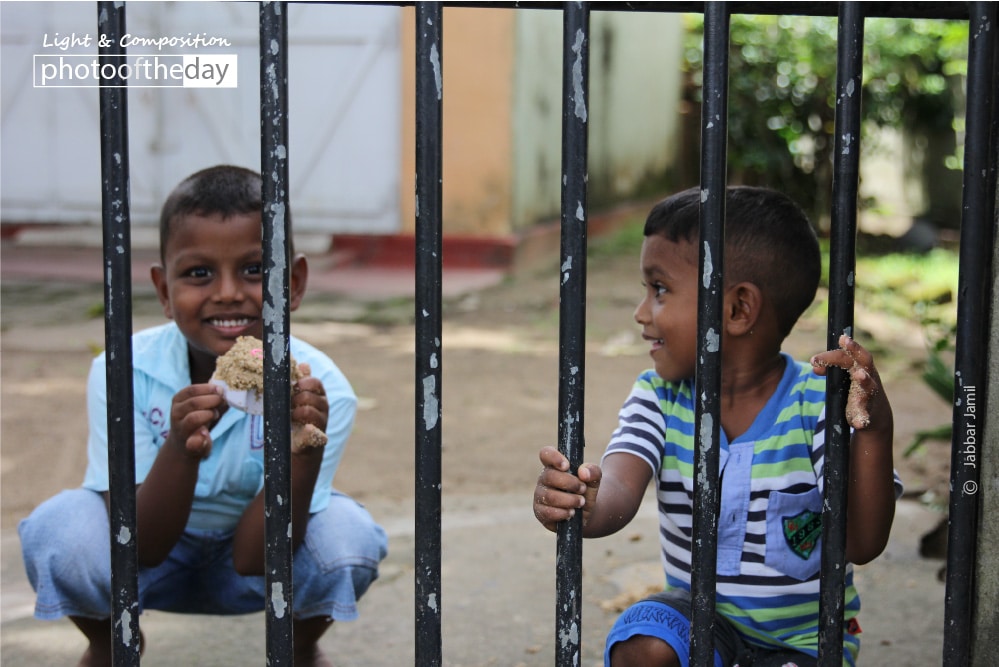
Exposure 1/1250sec @ f/2.8 | ISO 320 | Focal Length 35mm
Jabbar Jamil
Based in Sialkot, Pakistan, Jabbar Jamil is a dedicated street photographer who views the medium as a vital bridge to the outside world. By stepping outside his comfort zone, he uses his camera to forge meaningful human connections and express his creative vision. For Jamil, photography serves as both a therapeutic outlet and a candid lens through which he documents the unfiltered realities of the world around him, finding beauty and significance in the everyday scenes he encounters.
Resonance Score Breakdown
Transparency Note: The resonance score (11.5/20) is calculated based on social engagement metrics collected before the award announcement.
Expert Photography Reviews · 4
The Weight of Laughter
I was walking home from the grocery store this afternoon when I saw two kids chasing each other around a mailbox. They weren't playing a game with rules or a finish line; they were just running because their legs were fast and the air felt good.
Read the reflection →The Architecture of Laughter
Laughter is a wild, unmapped geography. It begins in the marrow, a sudden tremor that rises like sap in spring, breaking through the hardened crust of the everyday.
Read the reflection →Reviews & Comments
Share your thoughts about this award-winning photograph. Your reviews contribute to the community engagement score.
Galle’s sun is a violent, bleaching force, yet Jamil’s frame retreats into the courtyard’s mercy. It’s here that the shadows thicken, holding the children’s laughter in a heavy, velvet suspension. I’ve always found such unbridled joy suspicious, but in this darkness, it feels earned, almost defiant. The light doesn’t reveal; it merely permits the shadow to think. It’s a haunting, quiet resistance against the glare. I find myself wanting to hide there with them, away from the light.
“Joy” feels like a tourist’s trophy, not a genuine encounter. Why does the camera’s presence heighten the children’s performance rather than capture their reality? It’s unsettling how the photographer claims to integrate seamlessly while the subjects clearly pivot toward the lens. Does the frame exist for the children, or for the traveler’s breakfast-time narrative? I find the power imbalance here deeply uncomfortable. Whose innocence are we actually consuming, and why does it feel so staged?
Most street photography is just noise, but this shot of the Galle courtyard hits differently. I’ve seen thousands of children playing in frames, yet most feel staged or hollow. Here, the 35mm perspective keeps the viewer grounded in the dust, not hovering above it. It’s the raw, unposed chaos that makes me smile every time I look. In thirty years, this won’t be a dated travel snap; it’ll be a vital, breathing memory of pure, unfiltered childhood.
It’s a pleasant enough snapshot, but one suspects it was captured on the way to a croissant. There’s a lack of grit here; it’s all too easy. I’ve spent weeks in the humidity of Galle waiting for the light to actually mean something, and this feels like a tourist’s lucky break. It’s charming, certainly, but it hasn’t been earned. I’d have preferred to see the photographer return until the children stopped noticing the lens entirely.