Uncommon Way by Nirupam Roy
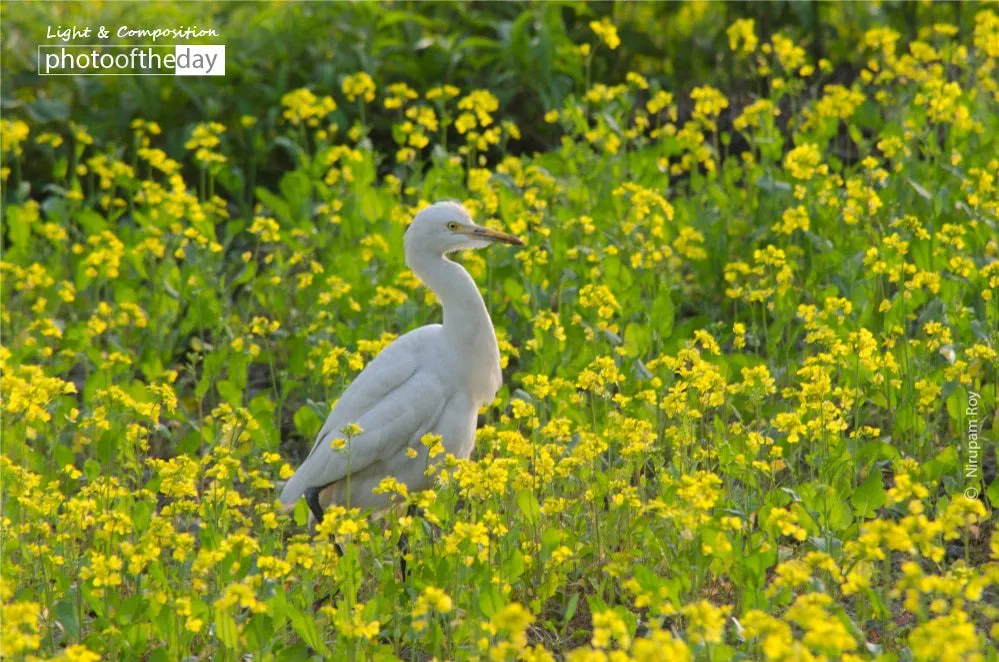
Captured during a routine commute, this image highlights a striking encounter between vibrant yellow mustard flowers and a group of herons. The photographer was drawn to the unusual presence of these birds in a field devoid of water, a sight that prompted a return visit with a camera to document the scene. By carefully framing the herons against the saturated floral backdrop, the photographer transformed a simple daily observation into a compelling visual narrative. The image is award-worthy for its keen eye for the unexpected in nature and the harmonious color palette that elevates a mundane landscape into a moment of serene beauty.
Nirupam Roy
Based in Tufanganj, West Bengal, Nirupam Roy is a dedicated school teacher who discovered his passion for photography during a family trip to the coast of Odisha. Inspired by the desire to document his son and the surrounding natural beauty, he transitioned from a casual observer to a committed artist. Photography has since become a transformative pursuit for Roy, offering him a sense of peace and a profound new perspective on the natural world and the human experience.
Resonance Score Breakdown
Transparency Note: The resonance score (11.3/20) is calculated based on social engagement metrics collected before the award announcement.
Expert Photography Reviews · 7
Where the Earth Breathes
There is a quiet wisdom in the way nature ignores our human categories. We define a field by its harvest and a wetland by its water, yet life often chooses to bloom in the spaces between our expectations.
Read the reflection →The Unlikely Guest
I keep a small, silver thimble in my desk drawer, worn smooth by my grandmother’s thumb. It is a useless thing now, a relic of a life spent mending tears in fabric, yet I cannot bring myself to discard it.
Read the reflection →Reviews & Comments
Share your thoughts about this award-winning photograph. Your reviews contribute to the community engagement score.
f/5.6 at 200mm, 1/500s, ISO 200. The compression of the 200mm focal length flattens the mustard field, forcing the herons into a tight, artificial plane. It’s a calculated choice that pays off. The shutter speed is sufficient to freeze the birds, though the depth of field is razor-thin. I’ve seen this setup fail often, but here, the focus is sharp where it matters. It’s technically sound. Honestly, the precision of that focus actually surprised me.
The mustard field acts as a vast, saturated datum, flattening the horizon until the herons break the plane. It’s a curious spatial tension; without water, the birds feel unmoored, lacking their natural threshold. I’m struck by how the yellow light washes over the plumage, turning mass into mere silhouette. It’s a beautiful, disorienting void. I find myself wanting to walk through that frame, just to see if the ground holds the weight of the air.
The saturated yellow of these mustard fields echoes the vibrant palette of Eliot Porter’s dye-transfer prints, yet the herons’ placement feels jarringly surreal. It’s a strange, dry-land inversion of the pastoral tradition. I’ve spent decades cataloging the natural world, but the sheer absurdity of these birds amidst the blooms genuinely made me laugh aloud. Roy’s framing avoids the usual sentimentality, finding a quiet, unexpected tension that feels like a fresh sentence in a very old conversation.
The cadmium yellow of these mustard fields, reminiscent of Van Gogh’s most feverish Provençal dreams, creates a startling, almost liquid brilliance that swallows the herons’ stark, chalky plumage. It’s a chromatic collision I find utterly intoxicating; the birds aren’t merely present, they’re suspended in a golden, atmospheric hum. One feels the heat radiating from the petals, a tactile, saturated warmth that transforms this mundane West Bengal commute into a painterly meditation on light’s quiet, persistent, and undeniable authority.
The frame holds a sudden, rhythmic stillness. Those herons aren’t just birds; they’re actors hitting their marks in a sea of yellow. It’s a wide shot that demands a long take. I’ve watched this field for a minute now, and I’m genuinely struck by how the lack of water creates such tension. The cut would’ve ruined the serenity. Roy caught the exact second the scene stopped being a commute and started being cinema.
You saw the birds in that dry field and didn’t just walk past. That’s the human part of this—the curiosity to return. I’ve spent enough time in the field to know that yellow can easily swallow a subject, but you kept the herons sharp against the mustard. It’s a quiet, strange peace you found in Coochbehar. And honestly, looking at it, I can almost smell the dust and the flowers. You waited. I feel it.
Yellow mustard fields usually signal agricultural bounty, yet these herons look stranded, not fed. Why are they here, miles from water? I find the saturated gold unsettling, almost masking the birds’ displacement. Does the frame prioritize the photographer’s aesthetic satisfaction over the reality of this ecosystem? It’s a pretty picture, sure, but I can’t shake the feeling that we’re romanticizing a struggle for survival. Whose landscape is this, really, when the wildlife becomes mere color theory?