Grater Thick-knee by Saniar Rahman Rahul
Captured within the sprawling, untamed wilderness of the Sundarbans in the Bay of Bengal, this striking portrait of a Great Thick-knee highlights the bird in its natural habitat. The photographer expertly utilized a long lens to isolate the wader against the rugged, open shingle banks it calls home. By capturing the bird in its resident environment, the image offers a rare glimpse into the life of this tropical species. The photograph is award-worthy for its sharp focus, clean composition, and the intimate perspective it provides of a creature that typically blends seamlessly into its gravelly surroundings.
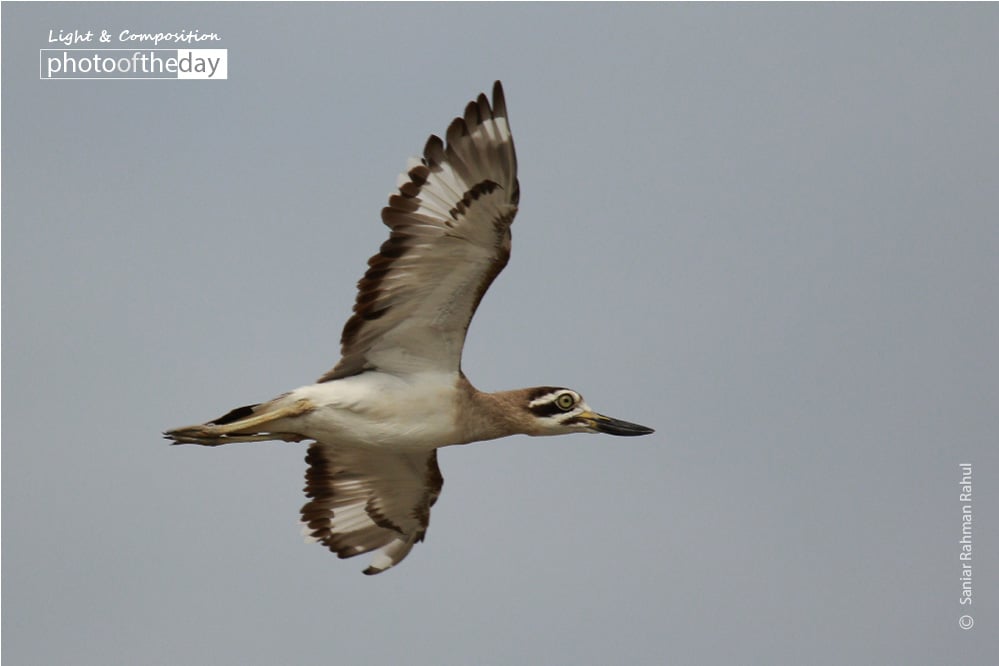
1/5000sec @ f/6.3 | ISO 640 | Focal Length 600mm
Saniar Rahman Rahul
Based in Dhaka, Bangladesh, Saniar Rahman Rahul is a seasoned creative professional who balances a distinguished career in advertising with a deep-seated passion for photography. His artistic journey began in childhood, inspired by his father’s work with a camera, before he later refined his visual sensibilities through years of experience in graphic design and pre-press media. Currently serving as an Art Director at Grey Worldwide, Rahul brings a sophisticated eye for composition and narrative to his wildlife photography, consistently capturing the natural beauty of the South Asian landscape.
Resonance Score Breakdown
Transparency Note: The resonance score (12.1/20) is calculated based on social engagement metrics collected before the award announcement.
Expert Photography Reviews · 5
The Art of Standing Still
I once spent an afternoon in a salt marsh with an old guide named Elias. He told me that the secret to seeing the wild isn't in how fast you move, but in how well you disappear.
Read the reflection →The Art of Stillness
The Great Thick-knee possesses a remarkable form of camouflage, standing so perfectly still against the river shingle that it effectively dissolves into the landscape, becoming a part of the geology itself.
Read the reflection →Reviews & Comments
Share your thoughts about this award-winning photograph. Your reviews contribute to the community engagement score.
The Great Thick-knee is a master of camouflage; seeing one so clearly on those shingle banks makes me suspicious. At 600mm, the compression is tight, but the bird’s posture suggests it’s alert, not relaxed. Did the photographer earn this proximity, or was the bird flushed into a defensive stance? I’ve spent days in the Sundarbans, and it’s rarely this easy. If this was extracted through pursuit rather than patience, the clarity feels hollow to me.
The Sundarbans don’t give up their secrets easily. Saniar must have waited in the stifling heat, listening to the silence of the shingle banks until the Great Thick-knee finally trusted the air. I’ve spent enough mornings in the mud to know that stillness; it’s a prayer. The bird’s gaze feels ancient, almost heavy. I find myself holding my own breath, feeling the humidity of the delta rising off the gravel. It’s a quiet, holy patience.
Most wildlife shots are just snapshots of feathers, but this one sticks. The Great Thick-knee’s eye, sharp against that chaotic, pebbled texture, forces a confrontation. I’ve seen thousands of bird portraits, yet this one feels like a quiet, ancient stare-down. It’s the depth of field that saves it; by blurring the background just enough, Rahul makes the bird feel monumental. I honestly find myself holding my breath whenever I look at it. It’s earned its place.
Before the eye identifies the bird, a sudden stillness settles in the chest. The Great Thick-knee’s gaze is a sharp, yellow anchor, pulling my pulse into its own rhythm. I’ve returned to this frame three times today; each time, the gravelly texture of the Sundarbans feels less like a landscape and more like a quiet, encroaching solitude. It’s that unblinking stare that haunts me—it doesn’t just watch; it waits for me to look away first.
The Great Thick-knee doesn’t merely inhabit the shingle; it emerges from the void of the Sundarbans like a thought struggling against oblivion. I’m struck by how the shadows beneath its talons anchor the creature to the earth, refusing to let it dissolve into the gravel. It’s a brutal, quiet defiance. When light hits those feathers, it doesn’t invite us in. It warns us. Darkness isn’t missing here; it’s the very thing holding the bird together.