The Blue-eared Kingfisher by Saniar Rahman Rahul
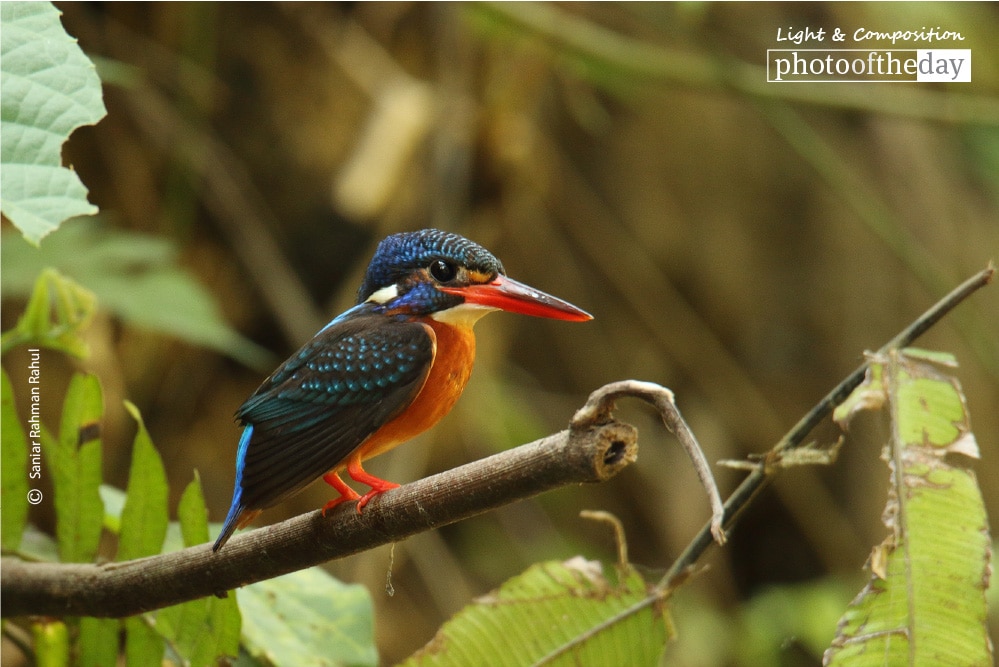
Captured within the dense, shaded canopy of Kaptai National Park, this image showcases the elusive Blue-eared Kingfisher in its natural habitat. The photographer utilized a long focal length to isolate the bird against the lush, dark foliage, capturing the distinct, deep rufous underparts and dark crown that differentiate this species from its common cousin. The composition highlights the kingfisher’s focused posture as it hunts near a small stream. This photograph is award-worthy for its technical precision in challenging low-light forest conditions and its intimate portrayal of a rare avian subject in the heart of the Bangladeshi wilderness.
Saniar Rahman Rahul
Based in Dhaka, Bangladesh, Saniar Rahman Rahul is an accomplished Art Director and photographer whose creative journey began in childhood while observing his father’s work. After establishing a successful career in graphic design and advertising with global agencies like Grey Worldwide, he rediscovered his passion for photography in 1997. His work is defined by a keen eye for detail and a deep appreciation for the natural world, earning him recognition as an early pioneer in the Light & Composition awards circuit.
Resonance Score Breakdown
Transparency Note: The resonance score (11.7/20) is calculated based on social engagement metrics collected before the award announcement.
Expert Photography Reviews · 8
The Architecture of Stillness
The kingfisher waits with a patience that defies the frantic pace of the forest floor, its body held in a state of absolute dormancy, save for the rhythmic pulse of its throat.
Read the reflection →Patience in the Green
I remember sitting by a creek in the Daintree with a guide named Elias. We spent three hours in total silence, waiting for a flash of movement that never came. My legs were cramping, and the humidity felt like a heavy wool blanket, but Elias didn't shift once.
Read the reflection →Reviews & Comments
Share your thoughts about this award-winning photograph. Your reviews contribute to the community engagement score.
In the dense canopy of Kaptai, the kingfisher acts as a living datum, anchoring the chaotic, vertical rhythm of the forest. I’m struck by how the foliage creates a natural fenestration, framing the bird against a void of deep shadow. It’s a fragile structure of light and leaf. While I usually crave the human scale, there’s a quiet, structural integrity here. It’s not just a bird; it’s a tiny, vibrant inhabitant defining the vastness of its wild room.
The kingfisher’s beak establishes a sharp horizontal vector, bisecting the frame at a precise golden ratio. It’s a masterclass in spatial tension; the bird’s dense, dark crown anchors the upper-left quadrant, perfectly balanced by the blurred, rhythmic foliage in the negative space below. I’m genuinely struck by how the shallow depth of field creates a geometric isolation. It’s not just a bird; it’s a solved equation of light and form, perfectly contained within the forest’s chaotic geometry.
Before the eye identifies the kingfisher, something in the chest tightens. The darkness of the Kaptai canopy acts as a sensory deprivation chamber, forcing a sudden, sharp focus. I feel my own breath hitch, mirroring the bird’s stillness. It’s the electric blue that haunts me; it doesn’t just sit on the feathers, it vibrates against the gloom. When I return to this, I’m still waiting for the splash. It’s a quiet, predatory tension I can’t shake.
Deep in the Kaptai canopy, the light doesn’t fall; it lingers, trapped by emerald leaves. Rahul waited here, motionless, until the forest exhaled. At 1/60th of a second, he caught the kingfisher’s stillness, a blue spark against the heavy, humid gloom. I’ve spent enough hours in such shadows to know the ache in his shoulders. It’s a quiet, holy patience. When I look at this, I feel the damp air of the stream against my own skin.
At 600mm, the focal plane is razor-thin, yet Rahul has locked focus onto the kingfisher’s eye with surgical intent. The f/6.3 aperture renders the dense Kaptai foliage into a soft, creamy bokeh, isolating the bird’s iridescent plumage. I’m genuinely breathless at how the sensor resolved those rufous feathers against the gloom. It’s a triumph of light management; the diffraction limit hasn’t compromised the fine detail, revealing a clarity that our own eyes simply couldn’t hold.
The bird’s posture anchors the frame, yet the surrounding foliage threatens to dissolve into chaotic noise. It’s a precarious balance. The dark, vertical weight of the branches creates a rigid cage, forcing the eye back to the kingfisher’s sharp, blue-eared profile. I’ve rarely seen such aggressive negative space used to isolate a subject so effectively. It doesn’t just sit there; it commands the entire picture plane. The structural discipline here is, frankly, quite satisfying.
We look at this kingfisher and we don’t just see a bird; we see a sentinel. Saniar Rahman Rahul didn’t just point a lens; he waited in the humid silence of Kaptai until the creature trusted him enough to reveal its focus. I’m struck by that intense, unblinking gaze. It’s a portrait of pure, quiet intent. We feel the stillness of the forest in its eyes. It’s a photograph that asks to be returned to.
You waited in that humid, dark canopy until the forest stopped holding its breath. I can feel the stillness you endured to catch that kingfisher’s focus. It’s not just a bird; it’s a moment of pure, singular intent. I’ve spent enough time in the brush to know how easily that patience breaks. You didn’t just take a picture; you earned a quiet conversation with a creature that doesn’t want to be seen. That’s honest work.