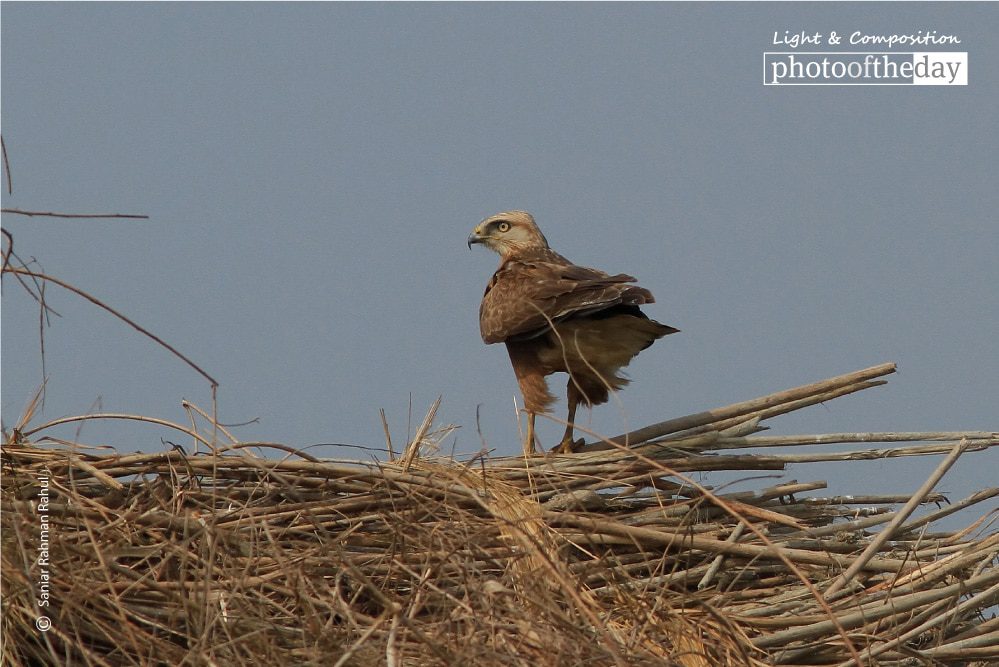
Long-legged Buzzard by Saniar Rahman Rahul
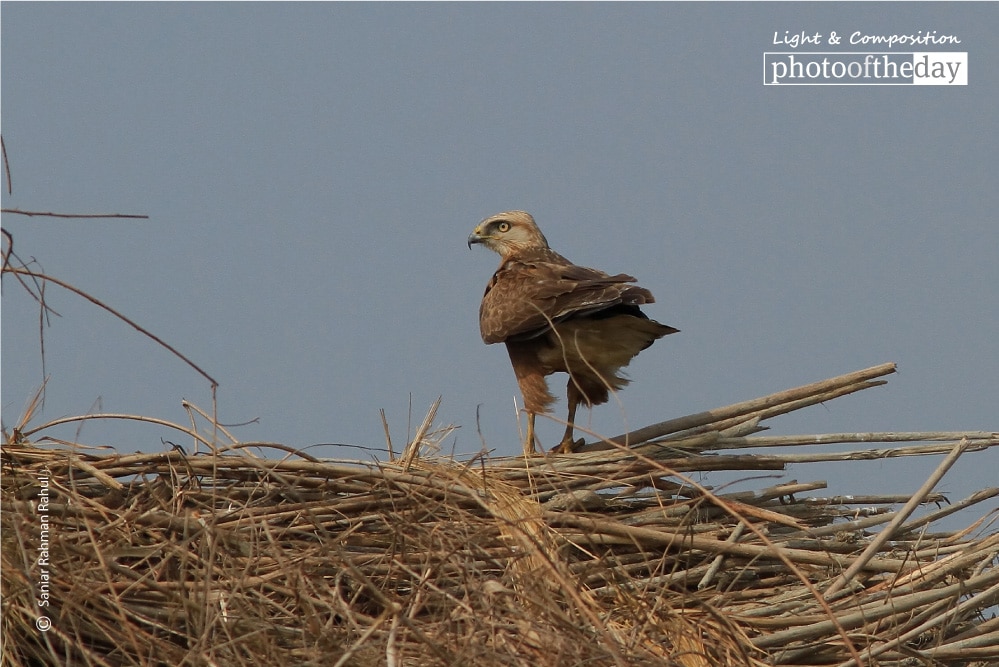
Captured on the newly emerged riverbanks of the Padma in Rajshahi, this striking portrait of a long-legged buzzard showcases the bird of prey in its natural, rugged habitat. The photographer expertly isolates the raptor against the vast, open plains, emphasizing its robust stature and distinct plumage. This image is award-worthy for its sharp clarity and the patient observation required to document such a wary subject in the wild. By focusing on the intricate details of the buzzard’s form, the composition highlights the raw beauty and predatory grace of this species, offering a compelling glimpse into the wildlife of Bangladesh.
Saniar Rahman Rahul
Based in Dhaka, Bangladesh, Saniar Rahman Rahul is a seasoned Art Director at Grey Worldwide with a deep-rooted passion for visual storytelling. His journey into photography began in childhood, inspired by his father, and was later refined through his extensive professional background in graphic design and advertising. Since winning his first major photography award in 2010, Rahul has balanced his high-profile career in the advertising industry with a dedicated pursuit of wildlife and fine art photography, consistently demonstrating a keen eye for composition and technical precision.
Resonance Score Breakdown
Transparency Note: The resonance score (10.5/20) is calculated based on social engagement metrics collected before the award announcement.
Expert Photography Reviews · 8
The Unclaimed Horizon
We often mistake the edges of our cities for empty space, labeling them as 'wasteland' or 'wilderness' simply because they do not conform to the rigid grid of our daily utility. Yet, these riverbanks and shifting plains are the true frontiers of the urban geography.
Read the reflection →The Weight of the Watchful
I keep a small, tarnished brass key in a velvet-lined box, though I have long since forgotten which door it once opened. It is heavy for its size, cold to the touch, and carries the phantom weight of a house that no longer exists.
Read the reflection →Reviews & Comments
Share your thoughts about this award-winning photograph. Your reviews contribute to the community engagement score.
The Padma riverbanks aren’t known for their hospitality. One doesn’t simply stumble upon a buzzard here; one earns the bird’s trust through hours of stillness in the silt. I’ve spent enough mornings shivering in similar mud to appreciate the discipline required for this clarity. It’s a quiet, gritty portrait. Rahul didn’t just find this raptor; he waited until the world stopped noticing him. It’s a rare, honest piece of work. I’m genuinely impressed.
The buzzard stands upon the silt, a sentinel of the Padma’s indifference. It’s not the sharp plumage that haunts me, but the way the light refuses to soften the bird’s predatory gaze. Shadows here don’t merely define form; they anchor the creature to a desolate, shifting reality. I’ve felt this cold isolation before, watching a Tarkovsky film where the silence becomes a physical weight. It’s a brutal, honest confrontation with a world that doesn’t care if we watch.
The buzzard stares back, but what does it see? Rahul isolates this raptor against the barren Padma riverbanks, stripping away the context of a changing landscape. It’s a technically precise portrait, yet I feel a strange coldness looking at it. Why must we reduce a wild predator to a static, aesthetic object? Does this isolation serve the bird, or just our desire to possess the exotic? It’s sharp, sure, but it feels hollow.
The Padma’s silt doesn’t just hold the bird; it holds the silence of a long wait. I’ve felt that same stillness, where the air grows thin and the buzzard finally trusts the horizon. He stood there in the cooling hour, letting the light soften the raptor’s gaze. It’s a quiet communion. Looking at those sharp, amber eyes, I feel a sudden, sharp ache for the wild, untamed riverbanks I haven’t visited in far too long.
You waited on those riverbanks until the world fell away, didn’t you? It’s a sharp, lonely portrait. I’ve spent enough time in the field to know the patience this took. Because you didn’t rush, the buzzard’s gaze feels heavy, almost weary. It’s not just a bird; it’s a presence. I felt a sudden, quiet chill looking at that vast, empty space behind it. You caught a moment of pure, wild solitude. That’s rare. Respect.
Most wildlife shots are just trophies, but this buzzard lingers. Of the thousands I’ve reviewed, few capture that specific, wary tension in the eyes. It’s the way the bird’s talons grip the silt—a raw, tactile connection to the Padma’s shifting banks—that makes me stop. It doesn’t just document a species; it records a fleeting, rugged silence. I’d bet in thirty years, we’ll still be looking at this, wondering how it held its ground so perfectly.
The riverbank acts as a raw, horizontal datum, stripping away the built environment to reveal pure topography. Rahul’s buzzard occupies this void with a predatory stillness that mimics the tension of a cantilevered slab. It’s a stark study of mass against an infinite horizon. I’m struck by the way the light catches the bird’s plumage, articulating depth where I’d expect only flatness. It’s a lonely, beautiful reminder that space exists even without our walls.
The focal plane here is razor-thin, perfectly isolating the buzzard’s ocular structure. I’m genuinely moved by the micro-contrast in those feathers; it’s where the lens resolves beyond human perception, capturing textures the eye usually blurs. By keeping the aperture wide, the bokeh as a function of depth-of-field renders the Padma riverbanks into a soft, atmospheric wash. It’s a rare moment where the diffraction limit hasn’t compromised the raptor’s fierce, predatory clarity. Truly, it’s an optical triumph.