Greater Painted-snipe by Saniar Rahman Rahul
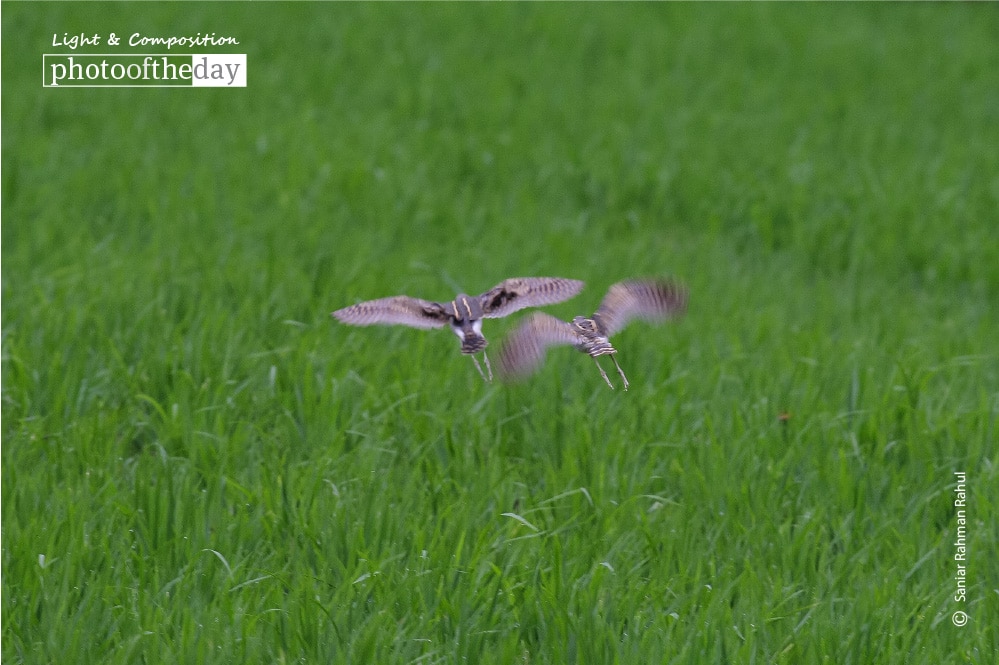
Captured at the renowned Jahangirnagar University in Bangladesh, this photograph highlights the Greater Painted-snipe, a striking wader known for its distinct eye patch and reddish-brown bill. The photographer skillfully documents the bird within its natural marshland habitat, emphasizing the intricate patterns of its buff-spotted wings and the elegant posture of the species. This image is award-worthy for its precise focus and the intimate perspective it offers on a bird that is often elusive. By capturing the subject in its environment with such clarity, the photographer provides a compelling look at the biodiversity found within the wetlands of South Asia.
Saniar Rahman Rahul
Based in Dhaka, Bangladesh, Saniar Rahman Rahul is an accomplished Art Director at Grey Worldwide with a deep-rooted passion for visual storytelling. His journey into photography began in childhood, inspired by his father, and was later refined through his extensive professional background in graphic design and advertising. Since winning his first major photography accolade in 2010, Rahul has continued to blend his technical expertise in pre-press media with a keen eye for nature, resulting in a body of work that captures the delicate beauty of his surroundings with professional precision.
Resonance Score Breakdown
Transparency Note: The resonance score (13.2/20) is calculated based on social engagement metrics collected before the award announcement.
Expert Photography Reviews · 4
The Quiet Architecture of Waiting
There is a specific kind of stillness that belongs only to the marsh. It is not an empty silence, but a heavy, velvet anticipation, as if the reeds themselves are holding their breath to see what the tide might bring.
Read the reflection →The Architecture of Stillness
The Greater Painted-snipe is a master of the marshland’s margins, possessing a plumage that mimics the dappled light filtering through reeds, allowing it to dissolve into the landscape until it is indistinguishable from the mud and shadow.
Read the reflection →Reviews & Comments
Share your thoughts about this award-winning photograph. Your reviews contribute to the community engagement score.
The marshland here functions as a fluid architecture, a shifting datum where the snipe’s posture mimics the verticality of the reeds. It’s a study in texture, yet I find myself longing for the horizon’s edge. By isolating the bird, we lose the threshold between water and land. Still, the way light catches those buff-spotted wings against the dark, void-like water is haunting. It’s a quiet, structural elegance that makes me want to step right into that wetland.
The Greater Painted-snipe’s plumage here echoes the meticulous ornithological plates of John Gould, yet it’s the shallow depth of field that pulls this into the modern era. It’s a delicate balance; the bird’s posture feels almost sculptural, reminiscent of Eliot Porter’s dye-transfer precision. I’ve spent decades cataloging these avian studies, but the way the marsh grass blurs into a soft, painterly abstraction genuinely caught my breath. It’s a rare, quiet triumph of contemporary fieldcraft.
The Greater Painted-snipe is notoriously skittish, yet here it stands, unbothered by the lens. I’ve spent enough dawn hours in marshland mud to know that this level of intimacy isn’t just luck; it’s a quiet, deliberate surrender of the photographer’s ego. Seeing the bird’s plumage so clearly, without the frantic posture of a disturbed creature, genuinely warms my heart. It’s a rare, earned moment where the animal clearly felt safe enough to simply exist.
The ochre of the marshland reeds, echoing the muted, dusty palette of a Morandi still life, cradles this Greater Painted-snipe in a chromatic embrace that feels almost sacred. It’s the subtle, bruised violet of the shadows beneath those buff-spotted wings that truly catches my breath, grounding the bird in a humid, atmospheric density. One finds here a rare, quiet harmony, where the light doesn’t merely illuminate; it whispers of the damp, ancient earth itself.