Playing with the Door Drapes by Ryszard Wierzbicki
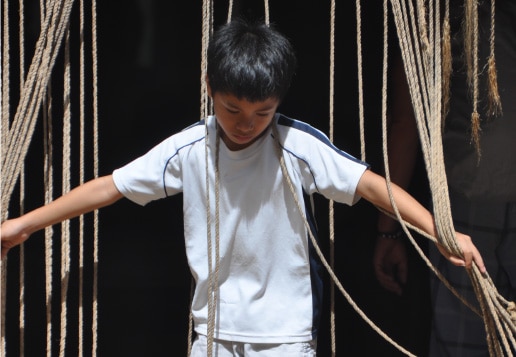
While exploring the historic San Isidro Labrador Church in Lazi, Siquijor, the photographer captured a poignant, candid moment of a young boy interacting with the heavy door drapes. The image masterfully balances the architectural grandeur of the church with the fleeting, natural curiosity of childhood. By isolating the subject against the textured backdrop of the drapes, the photographer creates a narrative of quiet contemplation and boredom. This photograph is award-worthy for its exceptional composition and the photographer's ability to transform a simple, everyday interaction into a compelling visual story that resonates with cultural and human depth.
Ryszard Wierzbicki
Born in 1963, Ryszard Wierzbicki is a Polish-born photographer and educator currently based in Swindon, United Kingdom. After a diverse career in social sciences and marketing, he transitioned into a life of travel, scuba diving, and photography, focusing his lens on the exploration of South-East Asia. His work is deeply influenced by his commitment to humanitarian efforts, including his volunteer work with orphans in Thailand and Burma. Through his travel forums, he shares his passion for documenting the world, blending his background in child care education with a keen eye for candid human moments.
Resonance Score Breakdown
Transparency Note: The resonance score (12.4/20) is calculated based on social engagement metrics collected before the award announcement.
Expert Photography Reviews · 6
The Weight of a Curtain
I spent twenty minutes this morning trying to find my keys, only to realize they were in the pocket of the coat I wore yesterday. It was one of those small, silly moments that makes you feel like you are moving through the world with your eyes half-closed.
Read the reflection →The Weight of the Veil
There is a particular gravity to the thresholds we cross, those heavy curtains that separate the sacred from the mundane. In older houses, or in the quiet corners of ancient stone buildings, fabric acts as a boundary—a soft, swaying wall that demands we pause before entering.
Read the reflection →Reviews & Comments
Share your thoughts about this award-winning photograph. Your reviews contribute to the community engagement score.
We watch this boy lose himself in the heavy, velvet folds of the Lazi church drapes. It’s a quiet, restless dance between a child’s boredom and the weight of history. I’ve spent hours in such spaces, and I can almost hear the hum of the sanctuary. He isn’t posing; he’s just existing. It’s a tender, fleeting moment of solitude that makes my heart ache for the simplicity of being young and waiting.
The interplay of light here echoes the chiaroscuro of early pictorialists, yet it’s the boy’s tactile engagement with the heavy fabric that pulls me in. It’s reminiscent of Cartier-Bresson’s decisive moments, though stripped of his usual urban geometry. I’ve spent decades cataloging such fleeting curiosities, yet the way the drape’s texture anchors the child’s restlessness feels genuinely fresh. It’s a quiet, honest dialogue between colonial architecture and the unscripted, messy reality of childhood. I’m truly charmed.
You waited for that boy to disappear into the fabric, didn’t you? It’s a quiet, heavy moment. I’ve spent enough time in old churches to know that specific kind of boredom, the way a child turns architecture into a playground. You didn’t force the scene; you just let the light and the drapes do the work. It makes me miss the simplicity of being young. There’s something honest happening here. You really felt that stillness.
The verticality of the drapes anchors the frame, providing a necessary counterweight to the boy’s kinetic posture. It’s a rigid geometry that keeps the chaos of childhood from spilling over. The negative space isn’t merely empty; it’s a structural necessity that forces the eye toward the fabric’s heavy folds. I’ve grown weary of such sentimental subjects, yet the tension here holds. It doesn’t collapse into mere anecdote. The frame remains disciplined, precise, and entirely sufficient.
Heavy fabric. A boy lost in the folds. It’s a quiet geometry of boredom. I’ve spent minutes watching him disappear into the shadow of the drapes. The church walls recede. Nothing here is accidental. The empty corner is not empty. It’s a breath held in a stone room. I feel a sudden, sharp ache for that stillness. It’s rare to find a frame that knows when to stop. He doesn’t need to be seen.
The heavy drapes of San Isidro Labrador swallow the boy, reducing his agency to a mere aesthetic texture. Why does the frame prioritize the church’s colonial architecture over the child’s actual experience? It’s a classic tourist gaze, turning a local kid into a prop for a picturesque narrative. I feel a sharp, uncomfortable ache watching him disappear into the fabric. Does he know he’s being framed as a symbol of quiet boredom, or is he just playing?