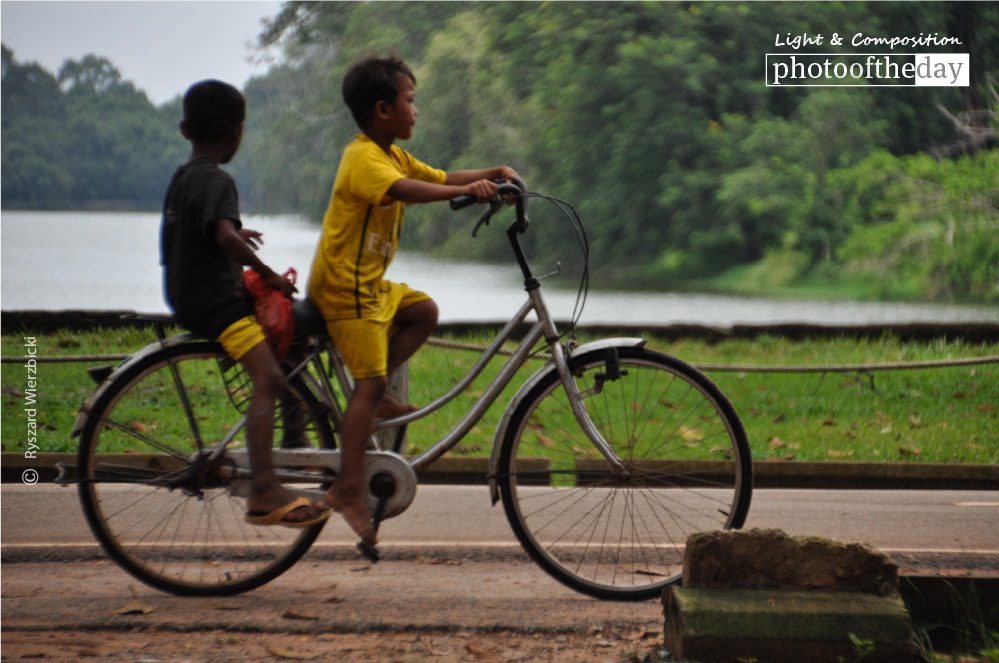
Angkor Cyclists by Ryszard Wierzbicki
Captured during an August 2014 excursion to Cambodia, this image shifts the focus from the monumental history of Angkor Wat to the quiet rhythm of daily life. The photographer observed local residents navigating the ancient site on bicycles, finding the human element as compelling as the stone architecture itself. By utilizing a long focal length, the photographer isolated the cyclists against the backdrop, creating a candid portrait of movement and tradition. This photograph is award-worthy for its ability to transform an ordinary commute into a poignant narrative, highlighting the intersection of historical grandeur and the enduring simplicity of local culture.
1/500sec @ f/6.3 | ISO 560 | Focal Length 250mm
Ryszard Wierzbicki
Born in 1963, Ryszard Wierzbicki is a Polish-born photographer and traveler now based in Swindon, United Kingdom. After a diverse career in education and marketing, he transitioned into a life dedicated to photography, scuba diving, and global exploration. His work is deeply influenced by his experiences in South-East Asia and his commitment to humanitarian efforts, including volunteering for orphanages. As the founder of the travel and photography forums Instant Travelling and World Around, he actively fosters a community for fellow explorers, documenting the world through a lens of curiosity and cultural engagement.
Resonance Score Breakdown
Transparency Note: The resonance score (10.9/20) is calculated based on social engagement metrics collected before the award announcement.
Expert Photography Reviews · 5
The Weight of Passing Time
Does the stone remember the footsteps that have long since faded into the dust? We build monuments to defy the erosion of memory, stacking heavy blocks toward the sky as if to anchor ourselves against the inevitable tide of change.
Read the reflection →The Rhythm of the Stone
I remember a morning in Siem Reap when the humidity felt like a physical weight, pressing down on the red dust of the road. I sat near a vendor selling iced coffee, watching the locals navigate the periphery of the temples.
Read the reflection →Reviews & Comments
Share your thoughts about this award-winning photograph. Your reviews contribute to the community engagement score.
Most travel photography at Angkor is just postcard filler, but Wierzbicki’s choice to compress the frame with a 250mm lens changes everything. By flattening the distance between the cyclists and the stone, he forces a collision between the eternal and the mundane. It’s a quiet, rhythmic tension I haven’t seen in years. I felt a genuine pang of nostalgia looking at it; it’s a rare moment where the human pace actually matches the weight of history.
The stone walls of Angkor don’t just hold history; they breathe. Ryszard caught the cyclists in that heavy, humid air where time seems to fold. He waited for the moment the human rhythm aligned with the ancient silence. I’ve felt that stillness myself, where the light feels like a physical weight on your shoulders. It’s a quiet, fleeting grace. Watching them pedal through that golden haze, I find myself wanting to put my camera down and simply listen.
1/500sec at f/6.3, 250mm, ISO 560. A telephoto reach on a D90 demands stability; here, it’s just enough to isolate the subjects. The f/6.3 aperture is a compromise, yet it keeps the cyclists sharp against the compressed stone background. I’ve spent enough time in Angkor to know the heat haze is brutal, but the shutter speed held firm. It’s a technically sound execution. I actually find the compression here quite satisfying. It works.
At 250mm, the compression of the focal plane flattens the Angkor backdrop into a soft, textured bokeh, a function of the f/6.3 aperture isolating the cyclists. I’m genuinely moved by how the lens resolves the dust motes dancing in the humid light; it’s a delicate interplay of diffraction and contrast. While the D90’s sensor struggles with the ISO 560 noise, the optics capture a fleeting, rhythmic grace that the human eye would simply blur into motion.
There’s a quiet dignity here that I genuinely admire. By pulling back with that 250mm lens, Wierzbicki avoided the intrusive, frantic scramble so common in travel photography. He didn’t force his way into their commute; he let the rhythm of the site dictate the frame. It’s a rare restraint. I’ve spent enough time in the field to know that distance isn’t just a technical choice—it’s a sign of respect for the subject’s autonomy.