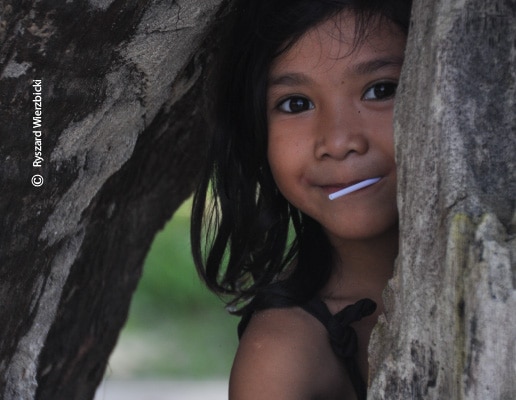
An Alimanguan Girl by Ryszard Wierzbicki
Captured on a bright morning at Alimanguan village, Palawan Island, this portrait highlights a spontaneous encounter with a young girl eager to pose. The photographer utilized a long focal length to isolate the subject against the coastal backdrop, creating a soft, natural aesthetic that emphasizes the girl's expressive presence. The image is award-worthy for its authentic connection between the photographer and the subject, capturing a fleeting, candid moment of childhood curiosity. Through careful framing and a gentle approach, the photograph transcends a simple portrait, offering a poignant glimpse into life in a remote Philippine coastal community.
Ryszard Wierzbicki
Born in 1963, Ryszard Wierzbicki is a Polish-born photographer and educator currently based in Swindon, United Kingdom. After a diverse career in social sciences and marketing, he transitioned into a life of travel, scuba diving, and photography following his move to the UK in 2006. His work is deeply influenced by his exploration of South-East Asia and his commitment to humanitarian efforts, including his volunteer work with orphanages. Through his platforms, Instant Travelling and World Around, he shares his passion for documenting the world's diverse cultures and landscapes.
Resonance Score Breakdown
Transparency Note: The resonance score (12.3/20) is calculated based on social engagement metrics collected before the award announcement.
Expert Photography Reviews · 6
The Unwritten Map of Childhood
Why do we assume that the eyes of a child are merely mirrors, reflecting only what we have already seen? We often look at the young and see a future waiting to be filled, a blank page awaiting the ink of experience. But perhaps they are not empty at all.
Read the reflection →The Unfolding Leaf
In the forest understory, the fiddlehead fern does not rush its emergence. It remains tightly coiled in a state of protective dormancy, waiting for the precise humidity and warmth of the season to signal that it is safe to unfurl.
Read the reflection →Reviews & Comments
Share your thoughts about this award-winning photograph. Your reviews contribute to the community engagement score.
The background here is a blur of coastal vernacular, yet it’s the girl’s position against that weathered timber wall that catches me. By compressing the depth with a long lens, Wierzbicki flattens the threshold between her and the structure. It’s a shame we lose the spatial datum of the village, but the way light grazes her skin against that rough, sun-bleached wood—it’s haunting. I find myself wishing I could see the room behind her.
The light here is too forgiving, too eager to please. By flattening the coastal glare, Wierzbicki denies the girl her necessary darkness. She exists in a shallow, bright vacuum, stripped of the mystery that defines human presence. I’ve stared at her eyes, searching for the weight of the Pacific, but find only a surface. It’s a tragedy of clarity. Without shadow, she doesn’t think; she merely waits for the shutter to release her from existence.
We look at this girl in Alimanguan and we see the salt of the Palawan coast in her gaze. Ryszard didn’t just point a lens; he waited for the silence between them to settle. It’s a rare, fleeting grace. I’ve spent hours staring into her eyes, and I’m struck by how she holds the space, unhurried and alive. This is a portrait that asks to be returned to. It’s a quiet, beautiful conversation captured in light.
Most portraits from Palawan rely on the exoticism of the setting, but this one survives because of the girl’s gaze. At 219mm, Wierzbicki compressed the coastal blur into a soft, painterly backdrop that forces us to confront her eyes. I’ve seen thousands of travel portraits, yet this one lingers. It’s the slight tilt of her head that gets me; it’s not a pose, it’s a question. Thirty years from now, that curiosity will still feel entirely alive.
A long lens at 220mm suggests a photographer keeping his distance, perhaps to avoid disturbing the scene. It’s a clean portrait, certainly, but one wonders if the girl’s eagerness to pose was worth the lack of grit. I’ve spent weeks in the tropics waiting for the light to stop being so polite. It’s a pleasant enough shot, but I can’t help feeling it was bought on the cheap. It’s missing the ache of the return.
The girl stands against the blur of Palawan. The lens pulls the horizon close, yet leaves her in a quiet pocket of air. It’s the restraint I crave. She doesn’t crowd the frame. She occupies the silence. I’ve spent minutes looking at the soft, out-of-focus sand behind her. It’s not empty. It’s a pause. I feel a sudden, sharp ache for that stillness. Nothing here is accidental. The space around her holds the weight.