The Ruddy Shelduck by Saniar Rahman Rahul
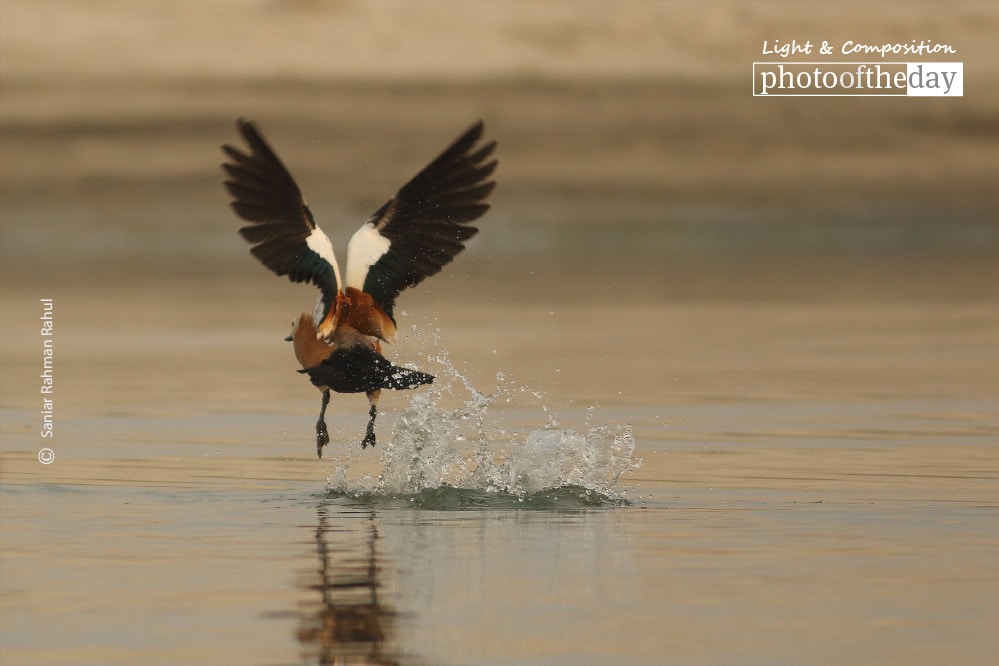
Captured on a newly formed sandbar along the Padma River in Rajshahi, this portrait of a Ruddy Shelduck highlights the bird's striking orange-brown plumage and distinctive black flight feathers. The photographer expertly isolates the waterfowl against the river's natural backdrop, capturing the essence of this migratory species during its wintering period in the Indian subcontinent. The image is award-worthy for its sharp focus and the harmonious balance between the subject's vibrant colors and the serene, textured environment of the riverbank, showcasing a profound appreciation for wildlife behavior and natural aesthetics.
Saniar Rahman Rahul
Based in Dhaka, Bangladesh, Saniar Rahman Rahul is a seasoned Art Director at Grey Worldwide with a career deeply rooted in the visual arts. His journey into photography began in childhood, inspired by his father, and was later refined through his extensive professional background in graphic design and advertising. Rahul’s work reflects a sophisticated eye for composition and detail, earning him early recognition as a pioneer in the regional photography community and establishing him as a prominent figure in contemporary wildlife and creative photography.
Resonance Score Breakdown
Transparency Note: The resonance score (11.1/20) is calculated based on social engagement metrics collected before the award announcement.
Expert Photography Reviews · 7
The Quiet Migration of Being
There is a rhythm to the turning of the seasons that we often overlook in our haste to arrive at the next destination. We forget that life is not merely a series of goals, but a long, slow migration of the spirit.
Read the reflection →The Geometry of Drift
The Ruddy Shelduck is a creature of the high-altitude wetlands, yet it possesses a curious instinct for the low-lying silt of riverbanks when the frost settles over the northern ranges.
Read the reflection →Reviews & Comments
Share your thoughts about this award-winning photograph. Your reviews contribute to the community engagement score.
Before the eye identifies the bird, a sudden stillness settles in the chest. The Ruddy Shelduck’s burnt-orange plumage pulls at my own sense of displacement, a quiet ache for somewhere I’ve never been. It’s the isolation on that sandbar that catches; it feels lonely, yet entirely sufficient. When I return to this, I find my breath mimicking the river’s slow, textured rhythm. It’s a haunting, vibrant anchor that follows me into the dark.
Of the thousands of wildlife portraits I’ve reviewed, most are merely technical exercises. What separates this from the rest is the deliberate restraint in the sandbar’s texture. It doesn’t just document a bird; it captures the quiet isolation of the Padma River. I’ll admit, the way the orange plumage vibrates against that muted, monochromatic silt actually made me stop and breathe. It’s a rare, honest stillness that will still feel vital thirty years from now.
The Padma River’s sandbar isn’t just a backdrop; it’s a silent witness to the shelduck’s winter solitude. I’ve spent enough dawns waiting for birds to know he stood there in the cooling hour, holding his breath as the light softened against those orange feathers. It’s a quiet, humble grace. Looking at the way the light catches the silt, I feel a sudden, sharp ache for that riverbank’s stillness. He didn’t rush the bird; he listened.
The frame functions as a precise 1:3 horizontal division. The Shelduck anchors the lower-left intersection, its posture creating a sharp diagonal vector that cuts across the river’s soft, horizontal grain. I’m genuinely captivated by how the bird’s orange plumage acts as a high-contrast focal point, balancing the negative space of the sandbar. It’s a beautifully solved spatial equation; the geometry holds the subject perfectly, preventing the composition from drifting into the void of the river.
We look at this Ruddy Shelduck and we don’t just see a bird; we see a traveler resting on the Padma’s shifting sands. Rahul has listened to the river’s silence, capturing a gaze that feels ancient and weary. It’s a portrait of migration, of a life lived between horizons. I’m moved by the way those black feathers cut through the orange glow. It’s a photograph that asks to be returned to, again and again.
You waited on that sandbar, didn’t you? I can feel the stillness in your bones. It’s not just a bird; it’s a quiet, orange-brown pulse against the vast, cold grey of the Padma. I’ve spent enough time in the mud to know that patience isn’t just about gear—it’s about disappearing. You caught a moment of genuine solitude here. And honestly? It makes me want to pack my bag and head to the riverbank myself.
A Ruddy Shelduck on a sandbar is a skittish creature; it doesn’t just pose for a lens. I’ve spent enough mornings in the silt to know that getting this close requires either a blind or a very lucky, very long wait. It’s a clean shot, but I’m left wondering if the bird was truly at ease. I’d love to believe this was earned through patience, but the proximity makes me hold my breath.