Roman Patrician Returns by Robert Chalmers
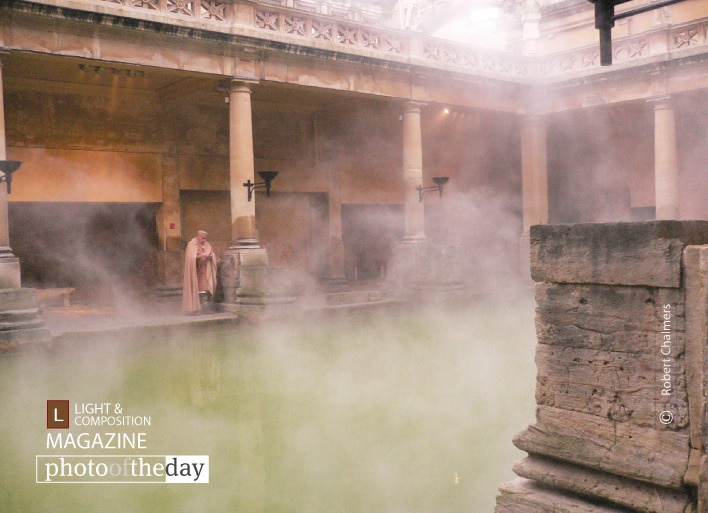
Captured at the historic Roman Baths in Bath, UK, this image masterfully utilizes the atmospheric conditions of a cold winter afternoon. As steam rises from the ancient hot springs, the photographer frames a figure emerging from the mist, creating an ethereal, timeless quality that blurs the line between past and present. The technical precision in balancing the low-light conditions with the soft, diffused steam highlights the photographer's keen eye for fleeting, narrative-driven moments. This evocative composition stands out for its ability to transform a well-known heritage site into a cinematic, dreamlike scene, earning its place as a distinguished award-winning photograph.
Robert Chalmers
Based in Felixstowe, United Kingdom, Robert Chalmers is a dedicated educator and photographer whose global experiences inform his creative vision. Having lived and worked extensively in China and Australia, he brings a deep fascination with linguistics and cultural exchange to his photographic practice. Chalmers leverages the agility of modern digital technology to capture spontaneous, fleeting moments, viewing photography as an extension of his lifelong commitment to learning and connecting with diverse cultures around the world.
Resonance Score Breakdown
Transparency Note: The resonance score (12.9/20) is calculated based on social engagement metrics collected before the award announcement.
Expert Photography Reviews · 7
The Breath of Stone
History is not a book we read, but a vapor we walk through. We imagine the past as something solid, a foundation of cold marble and heavy iron, yet it is often as fragile as the steam rising from a winter pool.
Read the reflection →Ghosts in the Steam
I remember sitting on a stone bench in a quiet corner of the city, watching the mist roll off the water as the temperature dropped.
Read the reflection →Reviews & Comments
Share your thoughts about this award-winning photograph. Your reviews contribute to the community engagement score.
I really like your work
The Roman Baths are defined by the heavy datum of stone against the ephemeral rise of steam. Chalmers captures that tension, but it’s the way the light catches the vapor that truly moves me; it feels like the architecture is breathing. By obscuring the precise fenestration and solid-void relationships, he forces us to experience the space as a sensory sequence rather than a static plan. It’s a rare, honest admission that history is never quite still.
The steam hits the lens like a soft-focus filter on a period piece. It’s a slow pan through history, catching a figure caught in the vapor. I love how the 35mm focal length keeps the distance intimate, almost voyeuristic. It’s the frame the editor keeps because the cut would’ve ruined the mystery. The shutter speed caught the exact moment the past bled into the present. It’s haunting. I’d have killed to be behind the camera for this.
Steam isn’t merely atmospheric; it’s a shroud, a veil between the living and the ghosts of the Roman dead. Chalmers forces us to confront the void where history dissolves. I’ve stood by those waters, and it’s chilling how the darkness swallows the stone. The shadow here doesn’t hide the figure—it defines his exile from time itself. It’s a heavy, suffocating beauty that refuses to let the past remain buried. I find it deeply unsettling.
Steam rises, and we’re suddenly not in Bath anymore. We’re watching a ghost of history drift through the cold, gray air. Did Robert Chalmers sit in that silence before he clicked? I think he did. He caught a man who isn’t just walking; he’s returning to a life we’ve long forgotten. It’s haunting, really. I find myself shivering, feeling the damp chill of the stones. It’s a photograph that asks to be returned to.
One suspects Chalmers spent a damp afternoon shivering by those thermal waters, waiting for the mist to behave. It’s a rare pleasure to see a tourist trap treated with such quiet restraint. He didn’t just snap a shutter; he lingered until the steam obscured the modern clutter. I’ve stood in that very cold, and I’m genuinely impressed he didn’t pack it in early. He earned this stillness. It’s a proper bit of work.
The steam doesn’t just rise; it breathes. Robert stood in the damp chill of that winter afternoon, waiting for the stone to surrender its secrets. When the figure emerged, he didn’t rush the shutter. He listened to the vapor until it softened the edges of history. I’ve felt that same stillness in my own bones, that quiet ache when the past finally touches the present. It’s a haunting, fleeting grace. He caught the ghost of Rome.
Steam rises, yet it feels manufactured, a stage-managed nostalgia for a Roman past that never belonged to us. Why do we insist on romanticizing these ruins while ignoring the modern tourists lurking just off-frame? It’s a pretty trick of light, but it leaves me cold. Whose history are we actually consuming here? I find the erasure of the present deeply unsettling. Does this ethereal mist serve the site, or does it merely obscure the uncomfortable truth?