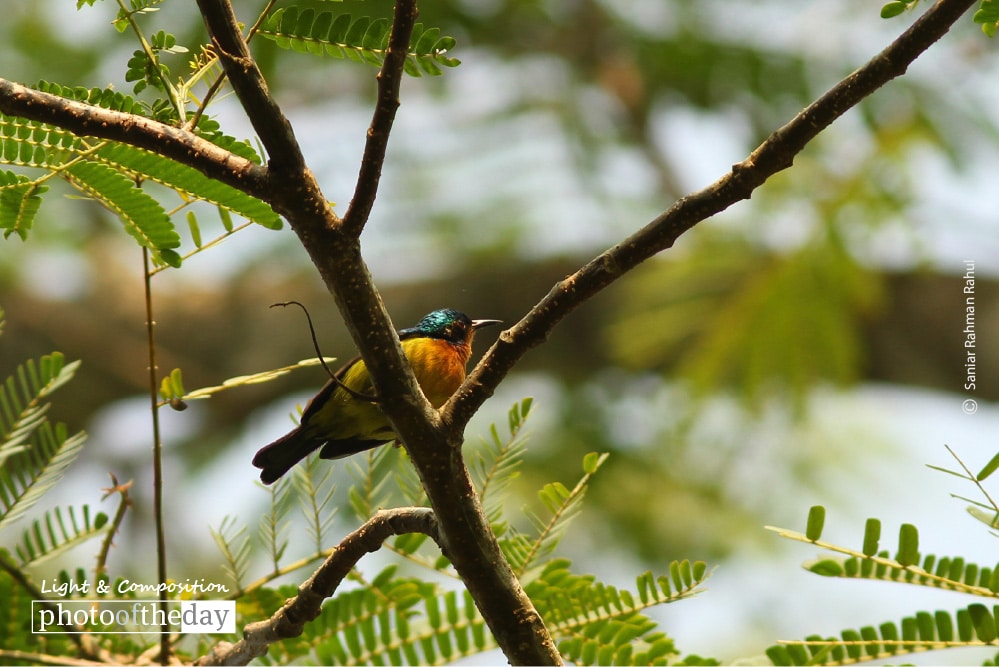
Ruby-cheeked Sunbird by Saniar Rahman Rahul
Captured within the lush, protected canopy of the Rema-Kalenga Wildlife Sanctuary in Bangladesh, this portrait of a ruby-cheeked sunbird highlights the vibrant beauty of the Nectariniidae family. The photographer skillfully isolates the bird against the soft, verdant textures of its natural lowland forest habitat, emphasizing its delicate plumage and characteristic brilliance. This image is award-worthy for its exceptional composition, which draws the viewer into the intimate world of one of Asia’s most elusive forest dwellers. The photograph serves as a testament to the patience required in wildlife photography, capturing a fleeting moment of stillness in the heart of a biodiverse sanctuary.
Saniar Rahman Rahul
Based in Dhaka, Bangladesh, Saniar Rahman Rahul is an accomplished Art Director at Grey Worldwide with a deep-rooted passion for visual storytelling. His journey into photography began in childhood, inspired by his father’s work, and was later refined through his extensive professional background in graphic design and advertising. Since rediscovering his creative focus in 1997, Rahul has become a celebrated figure in the photography community, recognized for his technical precision and artistic vision. His work frequently bridges the gap between commercial design expertise and the raw, natural beauty of the world around him.
Resonance Score Breakdown
Transparency Note: The resonance score (13.2/20) is calculated based on social engagement metrics collected before the award announcement.
Expert Photography Reviews · 8
The Weight of a Breath
There is a stillness that precedes the arrival of something small. It is not the absence of movement, but the deliberate holding of it. In the deep woods, where the light struggles to reach the moss, one learns to stand so quietly that the pulse becomes a distraction.
Read the reflection →The Weight of a Wingbeat
In the quiet corners of a garden, we often mistake stillness for absence. We assume that because a creature is small, its life is somehow less heavy, less burdened by the gravity of existence.
Read the reflection →Reviews & Comments
Share your thoughts about this award-winning photograph. Your reviews contribute to the community engagement score.
f/5.6 at 400mm, 1/500s, ISO 800. A calculated gamble on light. The shutter speed barely arrests the micro-movements of the sunbird, yet the focus is surgically precise on the eye. I’ve spent hours in similar canopies; it’s a miserable, dark environment for a lens. Rahul didn’t over-process the noise, which I respect. He kept the integrity of the plumage. It’s a clean, disciplined execution. The technical choices actually support the subject here. Rare.
The shutter snaps, and the forest goes silent. It’s a perfect tracking shot that stopped dead. The sunbird’s iridescent plumage cuts through the bokeh like a sudden jump cut, vibrant and sharp against the deep, verdant blur. I’ve spent hours in editing suites hunting for this exact stillness. It’s breathless. The composition holds the tension of a bird about to bolt, yet it stays. I’m genuinely jealous of the patience it took to nail this frame.
In the Rema-Kalenga canopy, we find a tiny life suspended in green. Rahul hasn’t just snapped a bird; he’s waited until the creature felt safe enough to reveal its character. We look at that ruby throat and we understand the weight of a silent conversation. It’s a portrait of stillness that hums with life. I’ve spent minutes just watching its eye, feeling the quiet pulse of the forest. This is a photograph that asks to be returned to.
The canopy acts as a living datum, a complex structural grid of organic fenestration. Rahul captures the sunbird not as a subject, but as a kinetic point of focus within this dense, verdant void. It’s a rare moment where the depth of the forest feels tangible, almost habitable. I find myself wanting to step past the foliage, to feel the humidity of that threshold. It’s a beautiful, fleeting architecture of light and shadow.
The forest floor in Rema-Kalenga doesn’t give up its secrets easily. Saniar waited in the humid, filtered green, listening for the flutter of wings. When the sunbird finally landed, the light caught its throat like a burning coal against the mossy dark. I’ve spent enough mornings in the brush to know the ache in his shoulders. It’s a quiet, holy stillness. Looking at it, I feel the damp earth beneath my own boots. He was listening.
The sunbird’s throat, a shimmering, iridescent violet-blue like the deepest shadows in a Vermeer, vibrates against the verdant, moss-dampened bokeh of the sanctuary. It’s a chromatic collision that leaves one breathless, as if the forest itself were exhaling emerald light. I’ve rarely seen such a visceral, saturated tension between the bird’s metallic, jewel-toned brilliance and the soft, humid greens of the canopy; it’s truly a fever dream of pigment that I simply cannot stop watching.
The bird’s placement along the lower-left third creates a necessary fulcrum. It’s a precarious balance, yet the negative space above provides the required breathing room. The diagonal branch anchors the frame, preventing the subject from drifting into chaos. I’ve grown weary of cluttered wildlife shots, but this doesn’t succumb to sentiment. It’s clinical. The spatial tension holds perfectly. It’s rare to find such disciplined geometry in a forest. The frame remains taut, and it’s undeniably precise.
You waited in that humid canopy until the world went quiet, didn’t you? I can feel the stillness in your frame. It’s not just a bird; it’s a tiny, frantic heartbeat caught in a moment of grace. I’ve spent enough time in the brush to know how easily this could’ve been a blur. You held your breath, and because you did, we get to see that flash of iridescent color. There’s something honest happening here.