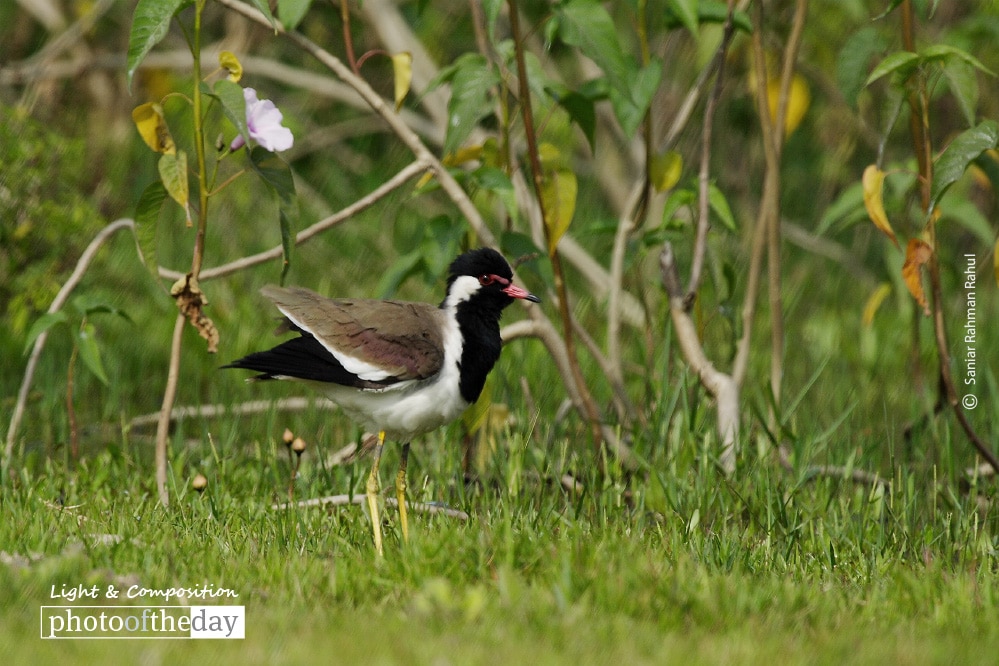
Red-wattled Lapwing by Saniar Rahman Rahul
Captured at the serene Muhuri Dam, this striking portrait of a Red-wattled Lapwing highlights the bird's distinctive features, from its vivid red wattle and black-tipped bill to its slender yellow legs. The photographer expertly utilized a 400mm focal length to isolate the subject against the natural landscape, capturing the intricate details of its plumage. This image is award-worthy for its sharp focus and the intimate perspective it offers on a species often recognized by its presence in pairs. The composition masterfully balances the bird's natural elegance with the environmental context of the dam, showcasing the photographer's keen eye for wildlife behavior.
Saniar Rahman Rahul
Based in Dhaka, Bangladesh, Saniar Rahman Rahul is an accomplished Art Director and photographer whose creative journey began in childhood while watching his father work with a camera. After establishing a successful career in graphic design and advertising, he rediscovered his passion for photography, blending his professional visual expertise with a deep appreciation for the natural world. His work, which has earned international recognition including multiple awards from Light & Composition, reflects a sophisticated eye for detail and a lifelong dedication to the visual arts.
Resonance Score Breakdown
Transparency Note: The resonance score (11.7/20) is calculated based on social engagement metrics collected before the award announcement.
Expert Photography Reviews · 8
The Quiet Watcher
There is a particular rhythm to the wild that we often overlook in our haste. It is a rhythm of patience, of standing perfectly still while the world turns around us.
Read the reflection →The Weight of a Watchful Eye
There is a silence that belongs only to the edge of the water. It is a brittle, waiting silence. We walk through the world assuming we are the observers, the ones who name and categorize, yet we are constantly being measured by eyes that do not speak our language.
Read the reflection →Reviews & Comments
Share your thoughts about this award-winning photograph. Your reviews contribute to the community engagement score.
The Red-wattled Lapwing stands isolated, its sharp gaze piercing the frame. But why does the Muhuri Dam feel like a backdrop rather than a home? I find myself unsettled by this clinical detachment. Is this bird a subject or merely a specimen for our consumption? When we strip away the habitat to highlight the plumage, what do we lose of the creature’s actual life? It’s technically precise, sure, but it feels strangely lonely. Who are we looking for?
It’s technically competent, sure, but I find this lapwing portrait dreadfully safe. By freezing the bird at 1/640sec, Rahul has opted for the most conservative path imaginable. Where’s the tension? I’d rather see the kinetic energy of those yellow legs blurred into a streak of motion. It’s a bird, not a taxidermy specimen. Why resolve every feather when you could’ve captured the bird’s frantic spirit? It’s just too polite for my taste.
The lapwing’s wattle, a searing, arterial crimson, vibrates against the muted, silt-heavy ochres of the Muhuri Dam, creating a chromatic tension that feels almost violent in its precision. I’m utterly captivated by how those slender, mustard-yellow legs anchor the bird within a palette reminiscent of a Morandi still life, yet it’s the way the light catches the plumage’s metallic sheen that truly haunts me. It’s a gorgeous, dissonant symphony of earth and blood that simply demands one’s full attention.
At f/7.1, the 400mm focal length avoids the diffraction limit, allowing the sensor to resolve the Lapwing’s intricate plumage with startling clarity. I’m genuinely moved by how the focal plane isolates those yellow legs against the soft, bokeh-rich backdrop of the Muhuri Dam. There’s no chromatic aberration bleeding into the red wattle, just pure, sharp light. It’s a rare moment where the glass doesn’t just capture a bird; it reveals the very texture of its existence.
Most wildlife shots are just taxidermy with a pulse, but this lapwing holds a gaze that feels genuinely defiant. I’ve stared at thousands of bird portraits, yet this one sticks because the sharp, aggressive red of the wattle cuts through the muted dam background like a warning. It’s not just a technical capture; it’s a confrontation. I’d hang this in thirty years because it captures the bird’s restless, frantic energy perfectly. It’s a rare, honest encounter.
The lapwing’s posture creates a rigid vertical axis, slicing the frame with clinical precision. It’s a study in geometric economy. The negative space surrounding the bird isn’t merely empty; it’s a pressurized void that forces the eye back to the sharp, yellow-legged fulcrum. I’ve grown weary of wildlife shots that rely on sentiment, but this structure holds. The tension between the avian form and the flattened plane is undeniable. It’s a rare, disciplined success.
Before the eye identifies the bird, a sudden stillness settles in the chest. That vivid red wattle acts like a sharp, rhythmic pulse against the muted dam water. It’s an activation of the nerves, a quiet alertness I’ve felt only when watching something wild hold its ground. When I return to this, the yellow legs still feel like a fragile anchor. It’s a haunting, solitary tension that follows me into the quiet of the evening.
We look at this Lapwing and we aren’t just seeing a bird; we’re meeting a sentinel. Saniar waited by the Muhuri Dam, listening to the silence until the creature felt safe enough to reveal its character. Those sharp, alert eyes hold a history of the wetlands. It’s a portrait of pure vigilance. I find myself holding my breath, afraid to break the spell. It’s a photograph that asks to be returned to, again and again.