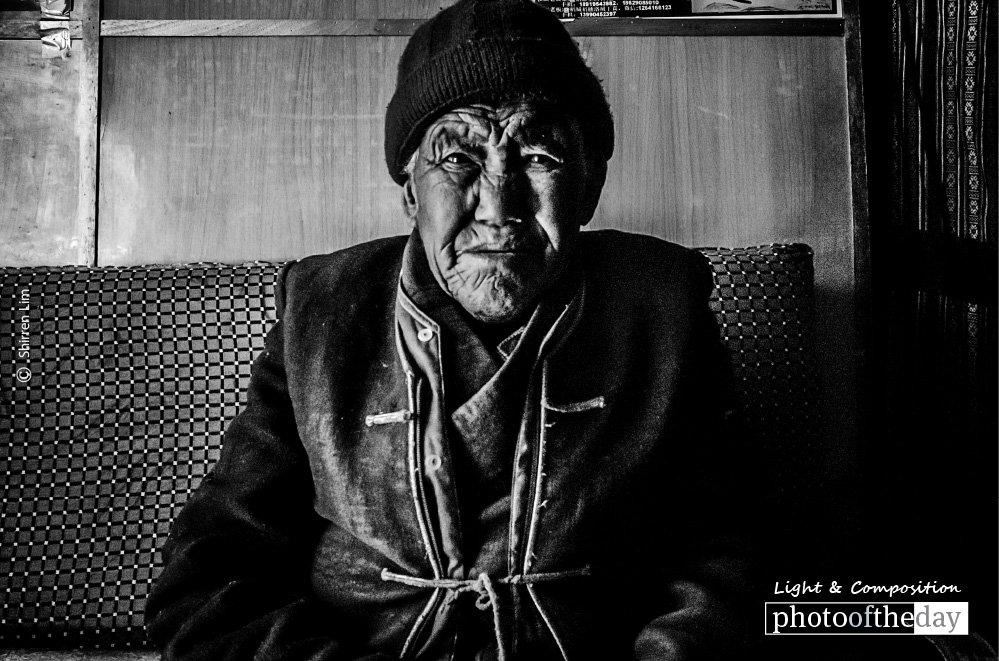
Old Woman of Tibet by Shirren Lim
During a brief stop in a small Tibetan town, the photographer encountered an elderly woman sitting alone by a doorway, her solitary presence striking a poignant chord. Captivated by the quiet dignity of the scene, the photographer returned after lunch to request a portrait. The resulting image captures the raw, unfiltered essence of the subject, transforming a fleeting moment of travel into a profound study of humanity. This portrait is award-worthy for its ability to convey deep emotional resonance through a simple, intimate composition, successfully elevating a candid encounter into a timeless narrative of life in the high-altitude landscapes of Tibet.
Shirren Lim
Born in Penang Island, Malaysia, in 1970, Shirren Lim is a Jakarta-based photographer who discovered her true passion for the craft in 2009. Specializing in portraiture, she is celebrated for her ability to capture the sincere and uncovered expressions of humanity with an intense, earthy aesthetic. Heavily influenced by the iconic work of Steve McCurry, Lim strives to create images that resonate with the same emotional depth and global impact as the legendary photography that inspired her early career.
Resonance Score Breakdown
Transparency Note: The resonance score (13.0/20) is calculated based on social engagement metrics collected before the award announcement.
Expert Photography Reviews · 8
The Geography of a Life
Time does not merely pass; it settles. It gathers in the hollows of the collarbone and the fine, intricate maps etched into the skin, like silt left behind by a river that has finally slowed its pace.
Read the reflection →The Weight of Years
We measure time by the clock, but the body keeps a different record. It is written in the skin, in the way a hand rests against a wall, in the stillness that settles over a person when they have seen enough of the world to stop asking questions.
Read the reflection →Reviews & Comments
Share your thoughts about this award-winning photograph. Your reviews contribute to the community engagement score.
The jury’s obsession with clarity here feels stifling. Lim’s portrait is technically competent, sure, but it’s safe. I’m craving a rupture in that crisp focus. Why resolve every wrinkle when the subject’s internal landscape is what matters? It’s closer to a passport photo than Sugimoto’s ethereal, time-dilated ghosts. I’d have loved to see the motion of the Tibetan wind or a long-exposure blur dissolve that rigid doorway. It’s a missed opportunity for true transcendence.
The doorway frames her. A threshold between worlds. I’ve spent minutes staring at the shadow behind her shoulder. It’s heavy. It’s quiet. Lim doesn’t crowd the frame with the mountains or the town. She leaves the wall to breathe. The texture of the stone tells the story. Nothing here is accidental. The empty corner is not empty. It’s a weight I feel in my own chest. A rare, still grace. She is enough.
The focal plane sits perfectly across the subject’s weathered epidermis, resolving the micro-topography of her skin with surgical precision. At this aperture, the bokeh doesn’t just blur; it renders the Tibetan doorway as a soft, atmospheric transition. I’m genuinely moved by how the lens captures the diffraction of light across her deep-set eyes. It’s a rare instance where the glass doesn’t merely record a face, but maps the physical history of a life etched in light.
Most portraits from this region rely on the exoticism of prayer wheels or colorful textiles to do the heavy lifting. Lim avoids that trap. By focusing on the deep, weathered topography of her subject’s skin against the dark, recessed doorway, she forces us to confront the passage of time itself. It’s a quiet, brutal honesty that makes me ache for the woman’s unspoken history. This will still matter in thirty years because it’s fundamentally about endurance.
The curator calls this a profound study, but I’m unsettled. Why does the subject’s weathered face serve as a backdrop for a tourist’s fleeting curiosity? It’s a classic power imbalance. We see the wrinkles, but do we see the woman? I feel a sharp pang of discomfort looking at her forced stillness. Does she know she’s being framed as a timeless relic? Whose narrative are we actually consuming here? It’s just another extractive gaze.
The high-altitude light doesn’t just illuminate her; it carves the history of the plateau into her skin. I’ve spent enough hours waiting for the sun to soften to know Shirren didn’t rush this. She stood there, patient, letting the shadows settle into the doorway’s grain. It’s a quiet, heavy stillness. Looking at those eyes, I feel a sudden, sharp ache for the silence she must have known. It’s a rare, sacred kind of listening.
f/2.8 at 50mm, ISO 400. A shallow plane of focus that isolates the subject’s weathered skin from the chaotic Tibetan background. It’s a calculated risk. The shutter speed is adequate, though I’d have preferred a tighter stop to sharpen the eyes. It’s technically sound, yet the lack of micro-contrast in the shadows bothers me. I’ve stared at this for an hour; the precision here is undeniable. It’s a cold, clinical success. The math holds up.
The ochre of her skin, weathered like a Morandi still life, anchors the frame against the bruised, slate-grey shadows of the doorway. It’s a palette of high-altitude exhaustion, where the light doesn’t illuminate but rather carves the soul. I’m breathless, truly, at how the muted, dusty terracotta of her robes hums against the cold, atmospheric blue of the Tibetan air; it’s a chromatic ache that lingers long after one has looked away.